

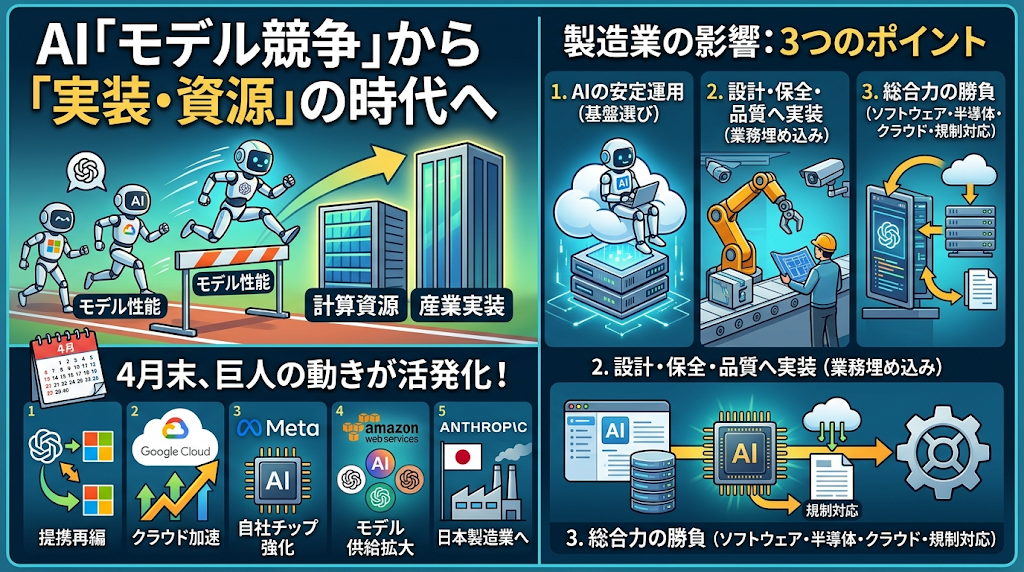
This week in the AI industry was not just a “race to launch a new model,” but a week in which the composition of who holds the computational resources, which clouds to offer, and which industry areas to penetrate more deeply became even clearer. The end of April, in particular, saw the restructuring of OpenAI’s partnership with Microsoft, Google’s accelerating cloud growth, Meta’s strengthening of its own AI semiconductors, the expansion of model supply to Amazon Web Services, and Anthropic’s expansion into the Japanese manufacturing industry. AI is moving from “the fruits of research and development” to “the foundation for industrial implementation. Reuters OpenAI Anthropic
From a manufacturing perspective, there are three points of interest. First, it has become more important which infrastructure to choose for stable operation than the difference in AI performance itself. Second, the competitive axis of AI implementation has shifted from PoC to business-embedded implementation, including design, maintenance, quality, and cyber security. Third, the value of AI is no longer determined by the software alone, but by its overall strength, including semiconductors, cloud computing, industry-specific solutions, and regulatory compliance. Reuters Reuters Reuters
Topics.
1. reorganization of the alliance between OpenAI andMicrosoft to restructure the AI supply chain
On April 27, OpenAI and Microsoft announced revised terms of their partnership. According to Reuters, Microsoft will have a non-exclusive license to the OpenAI IP until 2032, while OpenAI will have more room to do business with other companies such as Amazon and Google. opened up room for deals with other companies such as Amazon and Google. This should not be seen as a deterioration of the relationship between the two companies, but rather a redesign that prioritizes increased distribution over exclusivity as AI becomes increasingly commercialized. Reuters OpenAI
This reorganization has major implications for users in the manufacturing industry. In the past, “which model to use” and “which cloud to use” were strongly linked, but in the future, it will be easier to select an AI infrastructure more flexibly according to one’s existing IT infrastructure, security requirements, and the operational conditions of overseas sites. The adoption of generative AI is moving from model selection to procurement, auditing, and integrated architecture selection. Reuters OpenAI
Implications for Draftsmen: AI functions linked to CAD/PLM/MES will no longer be “single vendor assumptions. AI for design drawing summary, specification difference check, BOM consistency check, etc. will be easier to implement due to more flexible cloud selection, but it will be more important to design to avoid vendor lock-in.
Alphabet’s Google Cloud is growing rapidly, and the start of external sales of TPUs makes it clear that “AI is an infrastructure industry.
Alphabet’s financial results and the market’s assessment of them on April 29-30 were among the week’s most important AI news: according to Reuters, Google Cloud sales jumped 63% YoY to $20 billion, with enterprise AI demand being the main driver of growth. Furthermore, Google explained that it has begun selling TPUs directly to some of its customers, having previously limited them primarily to its own use and cloud offerings; the competition for AI has entered a full-stack game that includes not only models, but also chip supply, data center capacity, and development tools. Reuters Reuters
At the same time, Reuters reported that major tech companies are expected to invest over $700 billion in AI in 2026. This means that the success or failure of AI applications will no longer depend solely on the ingenuity of apps, but on the ability to secure computational resources. In the manufacturing industry, it is increasingly likely that future competitive advantage will be determined not only by how much AI is used internally, but also by which industry AI platform is used. Reuters Reuters
Implications for the drafting industry: For compute-intensive applications such as drawing search, 3D model comparison, and drawing inspection support, future options will include TPU-based systems as well as GPUs. Design departments are entering a phase where they should focus on the outlook for the continuous supply of computing infrastructure and processing costs rather than AI applications alone.
3. Meta Digs Deep into AI Semiconductors with Broadcom, Changing the Meaning of a Huge Investment
In April, Meta announced an expanded partnership with Broadcom, signaling a plan to move forward with multi-generation MTIA (Meta Training and Inference Accelerator) development. The official announcement revealed a multi-gigawatt deployment starting with over 1GW, and a collaboration that includes design, advanced implementation, and networking. In addition, Reuters reported on April 29 that Meta has raised its capital expenditure forecast for 2026 to $125-145 billion, making AI not a race to create “smart software” but an industrial race with large upfront investments in power, equipment, semiconductors, and networks. Meta Reuters
This move is also cause for manufacturers to rethink the simple assumption that the cost of implementing AI should go down in the future. While inference cost optimization is progressing, stable operation of advanced AI still requires significant capital investment. Therefore, manufacturing companies should adopt a strategy of implementing AI from high-ROI areas that are specialized for specific operations, rather than having a large-scale infrastructure of their own. Meta Reuters
Implication for drafting industry: In design departments that handle images, drawings, and simulations, it is realistic to focus on cost-effective processes such as drawing inspection automation, abnormal dimension detection, and design knowledge retrieval before expanding the scope of AI applications.
OpenAI will be fully deployed on AWS, and the key to success for enterprise AI will be “whether it can be placed on existing infrastructure.
Amazon announced on April 29 that AWS sales grew 28% y/y to $37.6 billion, with growth driven by demand for AI; according to Reuters, the company maintains a $200 billion target for AI-related investments in 2026. Additionally, OpenAI officially announced that it has launched a limited preview of its OpenAI model, Codex, and Amazon Bedrock Managed Agents for the AWS environment. This indicates that the deciding factor when companies adopt AI is whether it can be used on top of existing security, authentication, procurement, and operational flows, rather than “moving to a new environment”. Reuters OpenAI
In particular, Codex’s AWS implementation is not just for software development departments in the manufacturing industry. There is a large amount of “small code” in the periphery of field operations, such as factory system modifications, analysis of legacy assets, automatic generation of equipment maintenance scripts, and automation of form processing. By entering directly into this area, generative AI could increase the speed of on-site improvements. OpenAI Reuters
Implications for Draftsmen: Design AI is more likely to take root if it is introduced in a manner that connects to existing PDM, document management, and authentication infrastructure, rather than as a stand-alone tool. Natural embedding into existing workflows, rather than tool selection, will be the difference between winning and losing.
Anthropic andNEC are developing industry-specific products in Japan, and AI is moving from “general-purpose” to “field-specific.
The strategic collaboration between Anthropic and NEC, announced on April 24, is not to be missed this week: Anthropic has positioned NEC as its first global partner in Japan, and in addition to deploying Claude to approximately 30,000 NEC Group employees, the two companies will jointly develop secure, industry-specific In addition to deploying Claude to approximately 30,000 NEC Group employees, Anthropic will jointly develop secure , industry-specific AI products for financial, manufacturing, and local governments. In addition, Claude will be integrated into NEC’s security operations and BluStellar Scenario. This is a step forward from “selling high-performance general-purpose LLM as-is” to “implementing products that meet the quality, safety, and reliability requirements of Japanese companies. Anthropic
What is important for the manufacturing industry is that the main focus of AI implementation is no longer chatbots, but rather practical systems loaded with industry knowledge. There are many situations where general-purpose AI alone is difficult to use, such as quality documents, work standards, safety regulations, procurement requirements, and cyber countermeasures, all of which are strictly context-dependent in the Japanese manufacturing environment. This collaboration shows the direction to fill the “last wall” in this area. Anthropic
Implications for the drafting industry: In drafting and design departments, “field-specific AI” that can learn and reference in-house drawing standards, JIS and customer specifications, and past defect information is more likely to produce practical results than general generative AI.
General Considerations for Manufacturing
Synthesizing this week’s news, the use of AI in the manufacturing industry is entering its next phase. The first phase was streamlining peripheral tasks such as text summarization and meeting notes. The second phase is penetration into core operations directly related to revenue and shop-floor quality, such as design review, maintenance, quality assurance, supply chain decision making, and software repair. What stands out this time is that all the major players are intensifying their competition for the infrastructure of “where and how to run AI,” which means that manufacturing users are now in an environment where it is difficult to postpone implementation decisions. Reuters Reuters Reuters
On April 30, it was reported that AGCOM, the Italian telecommunications regulator, had requested an EU investigation into Google’s AI search functionality, including its impact on news distributors and transparency. The handling of sources, misinformation, rights handling, and accountability will become increasingly important in the future. In the manufacturing industry, when dealing with quality documents and design basis, it is essential to have not only output accuracy, but also auditability and traceability of sources. Reuters
Therefore, the policy that manufacturing companies should take now is clear. Rather than implementing the system company-wide, they should start with themes that meet the following three conditions: (1) high-frequency operations for design, quality, and maintenance; (2) areas that can be easily integrated with existing infrastructure; and (3) applications for which ROI can be easily quantified. Then, rather than comparing model performance, the focus should be on cloud selection, access rights design, log management, and connection to industry documentation. This week’s AI news tells us that the AI race in manufacturing has moved from the “touch and try” phase to the “pick a winning implementation” phase. OpenAI Anthropic Reuters
summary
The AI industry at the end of April 2026 was a week in which the battle for implementation infrastructure – cloud distribution, semiconductors, enterprise adoption, industry specialization, and regulatory compliance – was front and center, rather than the flashy competition for model performance. This is good news for manufacturing. This is good news for manufacturers, as AI is finally taking shape to “get on the shop floor. Reuters Meta Anthropic
The focus will not be on which company will produce the most powerful AI, but on which company can make AI be used in a stable, safe, and low-friction manner to meet the constraints of the manufacturing floor. Over the next week or so, it will be more worthwhile to follow the news from the perspective of “what’s coming down the pike for manufacturing sites,” rather than just introducing new features.
Source List
- OpenAI, “The next phase of the Microsoft OpenAI partnership ,”
https://openai.com/index/next-phase-of-microsoft- partnership/ - Reuters, “Microsoft, OpenAI change terms of deal so startup can court Amazon and others ,”
https://www.reuters.com/legal/ litigation/microsoft-end-exclusive-license-openais-technology-2026-04-27/ - Reuters, “Alphabet revenue tops expectations on record quarter for cloud unit ,”
https://www.reuters.com/business/ alphabets-cloud-unit-beats-quarterly-revenue-estimates-strong-ai-demand-2026-04-29/ - Reuters, “Google Cloud pulls ahead as Big Tech’s AI bet swells to $70 billion “
https://www.reuters.com/business/retail- consumer/google-cloud-pulls-ahead-big-techs-ai-bet-swells-700-billion-2026-04-30/ - Meta, “Meta Partners With Broadcom to Co-Develop Custom AI Silicon ,”
https://about.fb.com/news/2026/04/meta-partners- with-broadcom-to-co-develop-custom-ai-silicon/ - Reuters, “Meta shares fall on concerns over AI spending, legal scrutiny, “
https://www.reuters.com/business/meta-lifts- capital-expenditure-forecast-doubling-down-ai-push-2026-04-29/ - Reuters, “Amazon tops cloud expectations on strong AI demand, shares rise “
https://www.reuters.com/business/retail- consumer/amazon-beats-quarterly-cloud-growth-estimates-2026-04-29/ - OpenAI, “OpenAI models, Codex, and Managed Agents come to AWS ,”
https://openai.com/index/openai-on-aws/ - Anthropic, “Anthropic and NEC partner to build AI-native engineering at scale in Japan “
https://www.anthropic.com/news/ Anthropic-nec - Reuters, “Italy’s media regulator asks EU to investigate Google AI search tools over publisher concerns ,”
https://www. reuters.com/sustainability/society-equity/italys-media-regulator-asks-eu-investigate-google-ai-search-tools-over-publisher-2026-04 -30/