
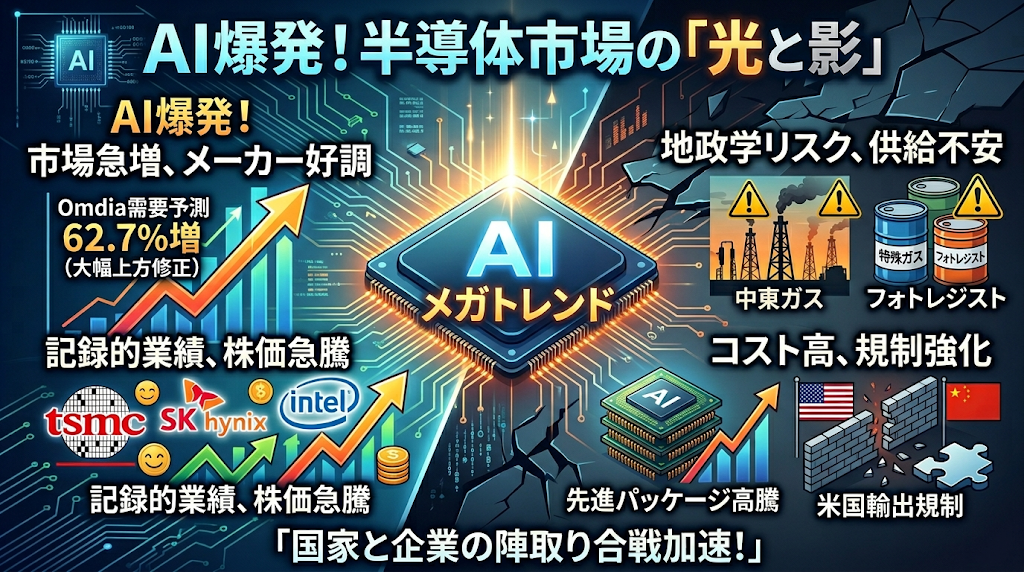
This month in semiconductor news was a month of unprecedented “AI megatrends” brought about by the explosive expansion of artificial intelligence infrastructure and the dramatic tectonic shifts in the supply chain that have accompanied it. Top manufacturers such as TSMC, SK Hynix, and Intel achieved record-breaking earnings and share price surges, as symbolized by market research firm Omdia’s sharp upward revision of its demand forecast for 2026 to 62.7% growth. At the same time, however, geopolitical risks and physical constraints that could drag down growth have emerged, such as supply concerns over specialty gases and photoresists due to tensions in the Middle East, soaring advanced packaging costs, and new U.S. restrictions on semiconductor equipment exports to China. The fierce battle between nations and companies for technological supremacy is accelerating.
- TSMC Posts Record Q1 Earnings with 58% Net Income Growth, Strong 2nm Mass Production and Production Expansion in the U.S.
TSMC, Taiwan’s largest foundry, announced record revenue and net income for the first quarter of 2026, with net income up 58% year over year to NT$572.5 billion. This is a tremendous leap forward from the previous year. This record performance was driven by extremely strong demand for chips for the artificial intelligence infrastructure that is rapidly being built around the world. In addition, the company raised its full-year revenue growth forecast to over 30%, indicating that the AI market will continue to boom over the long term. In technology development, the company announced that it has entered volume production of its next-generation 2nm process and that its future roadmap includes deployment of the “A13” and “A12” processes by 2029. In addition, in response to the global supply chain reorganization, the company has launched a huge master plan to build 12 factories and 4 packaging facilities in Arizona, USA, and plans to start 3nm mass production at the second factory in the second half of 2027. With its overwhelming technological superiority and robust production and supply system, the company is further solidifying its position as the absolute king of the foundry market. - SK Hynix Achieves 5X Profit Growth in Q1, Accelerates Mass Production of Next-Generation Memory for AI and New Dedicated Plant
South Korean memory giant SK Hynix has announced a five-fold year-on-year surge in profits and sales for the first quarter of 2026, on the back of explosive demand for broadband memory (HBM) and other products for artificial intelligence infrastructure. SK Hynix has announced a historic performance, with first-quarter 2026 profits surging five-fold year-on-year and sales reaching 52 trillion won. The operating profit margin reached an astounding 72%, demonstrating a profitability that is far superior to that of competitors. In response to this strong demand, the company decided to make a major strategic shift, shifting more than half of its NAND flash memory production output to next-generation 321-layer chips, while simultaneously pioneering the industry’s first mass production of 192GB SOCAMM2. Furthermore, the company has begun construction of a new advanced packaging plant dedicated to AI memory, P&T7, in Cheongju, South Korea, with a huge investment of funds. In the development of HBM4, the next-generation standard, we are deepening our collaboration with TSMC of Taiwan and promoting advanced integration of memory and logic, and we are stepping up our offensive to completely seize the lead in the high-capacity, high-speed memory market, which fundamentally determines the performance of AI data centers. - Intel’s strong earnings led to a 28% jump in stock price, and the company will provide its cutting-edge 14A process for Tesla’s next-generation AI chips.
Intel Inc. reported solid results for the first quarter of 2026, exceeding market expectations, with revenue up 7% year over year to $13.6 billion. The stock price surged a record 28% on the back of increased demand for CPUs for servers and PCs, as well as the prospect of achieving yield targets for the next-generation 18A process ahead of schedule to mid-year. In addition, Tesla, led by Elon Musk, has become the first customer to use Intel’s state-of-the-art 14A manufacturing process in its massive Terafab self-driving semiconductor development project. Intel’s bold strategy to break out of the slump it has been in and concentrate its enormous management resources on a fundamental restructuring of its foundry business and the development of next-generation processes is bearing fruit. The company’s move to bring global semiconductor manufacturing dominance back to the U.S. mainland is rapidly gaining the support of the technology giant. - Omdia Dramatically Upgrades Semiconductor Demand Forecast for 2026 to 62.7%, AI Special Demand Driving Unprecedented Growth Cycle
Omdia, a global market research firm, has dramatically revised its 2026 global semiconductor market The company has dramatically revised its growth forecast upward to a 62.7% year-on-year increase. Demand for AI servers and high-performance chips is expanding far faster than initially expected, clearly indicating that the semiconductor industry as a whole is entering an intense and unprecedented growth cycle. In conjunction with this, the Semiconductor Equipment and Materials International (SEMI) also reported that global semiconductor equipment billings for 2025 have reached a record level of $135 billion, a 15% increase over the previous year. This overwhelming special demand has given chip makers a powerful incentive to execute bullish capex spending, even if it means scrapping previous plans, and is driving an unprecedented economic boom with huge capital flows from front-end to back-end, from inspection equipment to the materials market. - U. S. Further Tightens Regulations on Manufacturing Equipment Exports to China; MATCH Bill and Other Measures Take Conflict over Technology Hegemony to Extreme
The U.S. government is moving forward with a new “MATCH Bill” proposal to further tighten technology export controls on China’s semiconductor industry, directly blocking the export of chips to Huahong, China’s second largest foundry, and other This comprehensive tightening of regulations is a direct block to exports of chip manufacturing equipment to China’s second largest foundry, Huahong, and other companies. This comprehensive tightening of regulations clearly targets not only the latest extreme ultraviolet lithography equipment, but also the deep ultraviolet lithography equipment widely used in mature processes and related after-sales services, demonstrating a strong will to thoroughly delay the covert transition by Chinese manufacturers to advanced manufacturing processes such as 7nm on their own. The United States is also a strong supporter of the Chinese manufacturers’ move to 7nm and other advanced manufacturing processes. Furthermore, the U.S. is strongly urging its allies, Japan and the Netherlands, to adopt coordinated and strict regulatory measures. In response to this strong U.S. encirclement, the Chinese government has also invested enormous state subsidies, 3.6 times that of the U.S. over the past decade, including a US$38 billion memory expansion plan in Wuhan, accelerating the fragmentation of global supply chains and confrontations over economic security. - Tensions in the Middle East are spreading to the supply chain, causing serious supply concerns for physical materials such as helium and photoresists.
As geopolitical tensions in the Middle East region, including the conflict between Iran and Israel, increase, the physical infrastructure and materials supply chain that underpins semiconductor production lines is under serious threat. The situation is particularly critical for Japan’s photoresists (photoresist) industry. In particular, the fact that Japanese suppliers of photoresists (photosensitive materials) depend on naphtha from the Middle East for more than 40% of their raw materials has come to light, and there are strong concerns about the risk of disruptions in the manufacture of cutting-edge chips due to disruptions in marine logistics. In addition, the Semiconductor Industry Association of Taiwan has requested the government of Taiwan to make an emergency strategic stockpile of helium and liquefied natural gas, which are essential for the cooling and cleaning processes of semiconductors. In order to manufacture high-performance chips for artificial intelligence, not only advanced miniaturization technology but also a stable supply of extremely high-purity special gases and chemicals is an absolute requirement. However, an unexpected chain of geopolitical risks is directly threatening the procurement of these key resources, and the entire industry is under pressure to diversify its procurement network and sharply increase production costs. - Innovations to Solve AI Infrastructure Power Consumption Problems, Meta’s Space Solar Power Initiative and the Rise of Photovoltaic Convergence Technologies
With the dramatic evolution of generative AI models, data center power consumption is ballooning to astronomical proportions, and the industry is embarking on radical innovations to break through the physical limits of energy supply. . IT giant Meta has announced an unprecedented space solar power project that will orbit a solar collection satellite 22,000 miles above the Earth to power an AI data center directly from space. In the field of semiconductor packaging, the practical application of “optoelectronic fusion technology,” which simultaneously achieves a dramatic increase in data transfer speed and a significant reduction in power consumption by replacing electrical signals with optical signals, is advancing at a rapid pace. Japan’s Leading-edge Semiconductor Technology Center (LSTC), a technology research association, has been selected for a related state-supported project, and Intel and companies affiliated with Softbank are jointly developing the next-generation memory “ZAM (HB3DM)” that combines data transfer performance far superior to existing broadband memory and low power consumption, The creation of a next-generation ecosystem that breaks through power and thermal bottlenecks is accelerating on a global scale. - Japanese Government Provides Additional 631.5 Billion Yen Support to Rapidus; Dream Integrated Production and Development of Next-Generation Technology in Hokkaido to Go Full-Scale
The Ministry of Economy, Trade and Industry has decided to provide Rapidus, a Japanese next-generation semiconductor manufacturer, with a massive additional 631.5 billion yen in new support for the development and mass production of its cutting-edge 2nm generation process. The total amount of the government’s support is now 1 trillion yen. This brings the total amount of government support to 1 trillion yen. In addition to the construction of a front-end manufacturing line, the company has also put into operation a back-end assembly prototype line using chiplet technology, which combines multiple chips to achieve higher performance, and has taken an extremely large step toward realizing the world’s first integrated production system from advanced design to back-end processing at its base in Chitose City, Hokkaido. Fujitsu has also taken a major step toward the realization of the world’s first integrated production system from advanced design to back-end processes at its base in Chitose, Hokkaido. It is also clear that Fujitsu is eyeing a strong manufacturing collaboration with Rapidus for the global rollout of its next CPU for Sovereign AI. Backed by enormous national funding, the challenge to bring Japan’s long-struggling semiconductor industry back to the global forefront and to rebuild a strong domestic supply chain has progressed to a practical stage. - Competition among technology giants to develop their own custom AI chips is intensifying, causing a tectonic shift in the existing horizontal division of labor model.
IT giants that deploy cloud services have completely broken away from their dependence on commodity processors from Intel, NVIDIA, and others to develop and deploy their own custom AI chips (ASICs) at a furious pace. Google has announced a plan to completely split the design of its AI chips, TPUs, between model training and inference, and move to an infrastructure optimized for specific workloads. In addition, the company has raised the possibility of forming a strategic alliance with Marvell. In addition, Meta has signed a deal to adopt Amazon’s own Graviton CPUs on a large scale in anticipation of the AI era, and Amazon itself is seriously considering selling its chips externally to grow into a huge $20 billion-a-year business. These moves are fundamentally disrupting the market structure in which the existing chip makers have a monopoly, and are creating an unprecedented and enormous business opportunity for companies that design application-specific circuits on contract and for foundries that handle cutting-edge packaging. - Extreme supply pressures in the memory market due to special AI demand have caused SSD prices to skyrocket, and industry-wide inflationary pressures are spreading to the consumer market.
The intense production shift toward high-bandwidth memory and high-capacity products for building AI infrastructure is causing severe supply shortages in general-purpose memory products for PCs and smartphones. In direct response to this impact, major manufacturers such as Samsung Electronics and Kingston have reportedly raised the price of their high-capacity storage SSDs by more than 10% in one fell swoop, and additional significant price increases are expected to be implemented in the coming weeks. In addition, Taiwanese module makers are bullishly predicting that DDR5 prices will rise 40% to 50% in the second quarter. The rapid rise in chip prices is pushing up the manufacturing costs of all electronics products intensely. What has been brisk in the limited infrastructure market of AI special demand is beginning to weigh heavily as a factor causing inflation in the broader consumer market through price pass-through to end products, a structural challenge that is putting significant pressure on profit margins of related set makers and manufacturers.