

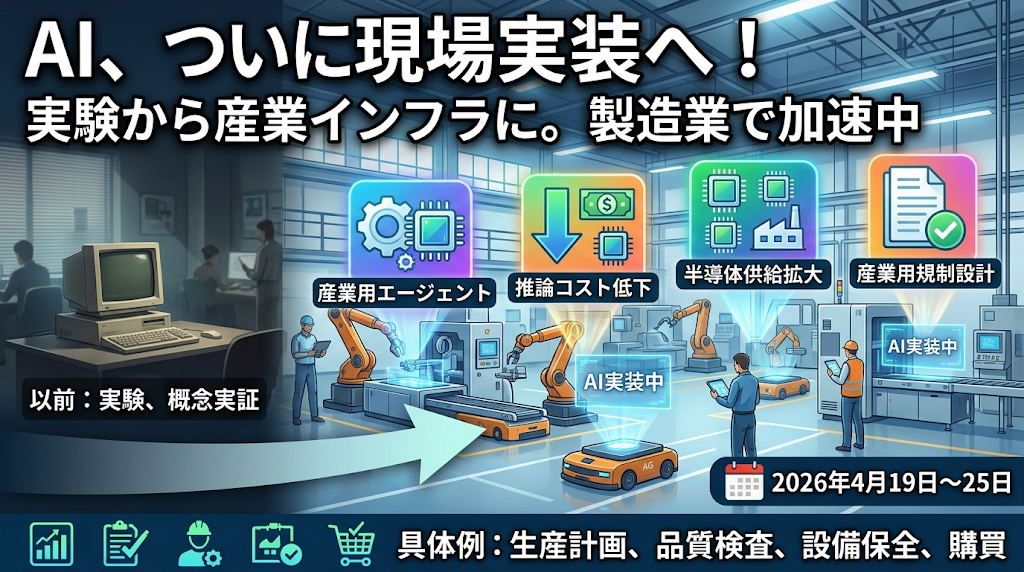
The week of April 19-25, 2026 was a week in which the AI conversation clearly shifted its center of gravity from “whether a new model has emerged” to “who will seize implementation, on what infrastructure, and to what industrial applications? Cloud companies have made agent operation their main battleground for enterprises, semiconductor companies are competing to differentiate themselves not only by learning but also by improving inference efficiency, and discussions have even surfaced in Europe that regulations should be loosened for industrial applications only. In other words, AI is no longer seen as an “experimental generation technology,” but as an “industrial infrastructure that can be used in the field.
From a manufacturing perspective, the changes are extremely practical. AI implementation in factories has tended to stop at the PoC stage, but this week’s news cycle shows that four conditions are starting to come together simultaneously: AI agents supporting decision-making on the shop floor, lower inference costs that are important for equipment and inspection systems, regulatory design suitable for industrial applications, and the expansion of semiconductor supply capacity itself. The following four conditions are beginning to be met at the same time. Functions such as production planning, quality assurance, equipment maintenance, purchasing, and design change management are finally becoming a reality as AI implementation units. Source Source Source Source Source
Topics.
1. Google restructures enterprise AI to be “agent premise
At its annual cloud conference, Google consolidated its AI product line into Gemini Enterprise, redefining its enterprise infrastructure, including Vertex AI, as a “production environment for agent operations. According to Reuters, Google Cloud executives have positioned the “experimentation phase” as “over,” and GE Appliances is now offering its logistics and distribution teams the ability to leverage enterprise data on Google Cloud. This is a symbolic shift in the competitive focus of AI adoption from model performance alone to “whether it can be securely linked to internal data and used in business operations. Source

Implications for the drafting industry: “Authority-controlled agents” are more compatible with drawing searches, BOM matching, checking design change history, and automatic detection of specification deviations than one-shot generated AI. The implementation of operations that safely connect CAD, PLM, and quality documents will make the difference.
Amazon and Anthropic Expand Giant Infrastructure Alliance
Amazon will invest up to an additional $25 billion in Anthropic, and Anthropic has signed a major deal to invest over $100 billion in Amazon’s cloud technology over the next 10 years.According to Reuters, Anthropic expects to secure approximately 1 gigawatt of computing resources on a Trainium2/3 basis by the end of the year. watts, and eventually up to 5 gigawatts of computing resources. It is important to note that the AI race is not only a competition between modeling companies, but also a race to lock in “which cloud and which semiconductor stack to ride. For manufacturing users, the availability of high-performance AI will increase, but at the same time, cloud dependence and price bargaining power will become more problematic. Source
Implications for the drafting industry: When placing drawing generation support or design review AI on an external platform, we have entered a phase in which vendor selection should include not only accuracy comparisons, but also data integrity, future migration, inference unit cost, and long-term contract risk.
TSMC presents next-generation roadmap for AI semiconductors
TSMC has launched the A13, scheduled for volume production in 2029, and the lower-cost N2U, while leveraging existing EUV equipment. more important to the Reuters report is the progress in advanced packaging for AI, rather than miniaturization per se. TSMC expects to be able to integrate 10 large chips and 20 stacks of high-bandwidth memory by 2028. This is a clear indication that the limits of a single die will be exceeded by “connectivity technology,” suggesting that future AI performance improvements will be packaging-driven. Source
Implications for the drafting industry: Computationally demanding applications such as 3D models handled in the field, simulation, image inspection, and process optimization will in the future be able to more easily use higher-performance inference platforms, expanding AI use across the boundaries between design and manufacturing.
Signs of “AI inference returns to CPU” at Intel
According to Reuters, Intel saw very strong demand for CPUs for AI service providers, and even sold products it had once shelved in the first quarter. Until now, the AI boom has been dominated by GPUs for learning, but the role of CPUs has been re-evaluated in inference, or the phase where AI actually provides answers, and AMD and Arm have also been rising. This is evidence that the value of AI is shifting from “creating huge models” to “processing large numbers of queries cheaply and stably. In factories and logistics centers, inference cost and operational stability can make the difference between adoption and non-adoption. Source
Implications for the drafting industry: Applications such as drawing verification, visual inspection, and interactive support of work procedures do not necessarily require state-of-the-art GPUs, and CPU-centric and lightweight inference configurations may be sufficient to lower the hurdle for introduction.
German Chancellor Merz insists that industrial AI be deregulated separately.
At the Hannover Messe, Chancellor Merz argued that consumer and industrial AI should not be treated in the same way and that the EU should allow greater regulatory freedom for industrial AI. Behind this is a sense of crisis that Europe’s AI competitiveness is inferior to that of the U.S. and China, and that if strict regulations are applied to the industrial sector, opportunities to improve productivity and attract investment may be missed. This is a point of contention that strikes at the heart of future manufacturing policy: how to balance “AI safety” and “industrial competitiveness. Source
Implications for the drafting industry: AI that handles drawing, process, and quality data has different risk characteristics than general-purpose consumer services, so there is room for accelerated adoption if audit, responsibility demarcation, and human approval flows are in place for industrial applications.
General Considerations for Manufacturing
To summarize this week’s news, AI for manufacturing has begun to move through three phases simultaneously. First, the unit of use for AI is shifting from “conversation” to “business execution”: the agents highlighted by Google are entities that, on the shop floor, work across a series of tasks, such as reorganizing production plans, arranging for maintenance parts, drafting anomaly reports, and checking the impact of process changes. In the future, the extent to which ERP, MES, PLM, SCM, and quality management systems can be securely connected will determine the success or failure of AI implementation. Source
Second, the infrastructure battleground has expanded from “learning capability” to “inference efficiency”: Intel’s CPU demand recovery, Google’s chip enhancements for inference, and TSMC’s packaging evolution are all milestones for bringing AI into daily operation. On the manufacturing floor, there is an overwhelming amount of inferencing, including image judgment every second, equipment log analysis, abnormality prediction, and operational support, and it cannot be allowed to stop. Therefore, what is really important in a factory is not the “highest performance model” but “inference infrastructure that is cheap, fast, uninterrupted, and auditable. Source Source
Third, the regulatory and procurement perspective has become a management theme: as the large contract between Amazon and Anthropic shows, AI implementation is not a software selection process, but a business decision that includes cloud, semiconductor, contract, data location, and the possibility of future changeover. In addition, in Europe, the policy debate is beginning to address how to frame industrial AI. The attitude that manufacturers should take now is neither full deployment nor a wait-and-see attitude, but rather to proceed with implementation in the following order: (1) select high-frequency, decision-intensive tasks, (2) design the authorization of on-site data, and (3) measure results with semi-automatic operations that still retain human approval. Source Source
Especially in the Japanese manufacturing industry, information tends to be divided between design departments and factory floors, quality assurance and procurement, and domestic bases and overseas factories. The real value of AI lies not in simply generating sentences, but in suggesting “what to do next” across this divide and preparing for implementation. This week’s developments indicate that the foundations for this are rapidly being laid. In other words, the leading role of AI application is steadily expanding from research to field operations, and from field operations to management decisions. Source Source Source
summary
Rather than a week of flashy demonstrations, the AI news of April 19-25, 2026, was a week in which the conditions for AI to become a standard feature of industry became even more concrete. Enterprise agents, huge cloud contracts, inference-oriented semiconductor competition, and a review of industrial AI regulations – all indicate that the use of AI in manufacturing is not a “someday in the future” but rather a “how to design the implementation sequence” phase The focus in the coming week and beyond will be on how each company will design the sequence of implementation. The focus in the coming weeks will be on how far companies can connect this infrastructure race to actual KPI improvements in plant, design, logistics, and maintenance. Source Source
Source List
- Reuters, ” Google puts AI agents at the heart of its enterprise money-making push “
- Reuters, ” Amazon to invest up to $2.5 billion in Anthropic as part of $10 billion cloud deal “
- Reuters, ” TSMC shows smaller, faster chips without a pricey new tool from ASML “
- Reuters, ” Intel soars on signs AI boom for CPUs is here “
- Reuters, ” Germany’s Merz says industrial AI needs less stringent EU regulation “
- Reuters, ” Google in talks with Marvell to build new AI chips, The Information reports “