
The “landing”–the week the AI left the lab and landed in the field.
If I had to describe this week in one word, it would be “landing.”
The air has changed this week in the manufacturing world, where the feeling has been “AI is great, but it’s a long way off”: OpenAI has unleashed GPT-5.4, which can handle not 10,000 tokens but a million tokens of context at will and manipulate computers themselves; Anthropic has collided head-on with state power; and Yann LeCun, with a billion dollars in his pocket, is working on an “AI that understands the physical world”. Yann LeCun, with a billion dollars in his pocket, set out to develop “an AI that understands the physical world. The global market for industrial robots has hit a record high of $16.7 billion, and while 98% of manufacturers are considering the use of AI, research shows that only 20% are confident that it is “really useful. Intelligence that had been left floating in the air finally broke ground this week.
Topic 1|GPT-5.4 is now available–“Thinking” AI comes in Excel and line
On March 5, OpenAI released its new GPT-5.4 model. Over the course of this week, its ripple effects are spreading to the industrial world. The three most important features are. (1) a huge context window of 1 million tokens (which can read entire design documents, specifications, and test data), (2) deep analysis of complex problems with the “Extreme Reasoning” function, and (3) a “computer use” function that allows AI agents to operate real computers. Function. In addition, this week OpenAI announced ChatGPT for Excel (beta), which integrates GPT-5.4 directly into Excel workbooks, allowing AI to analyze and predict financial and production data.
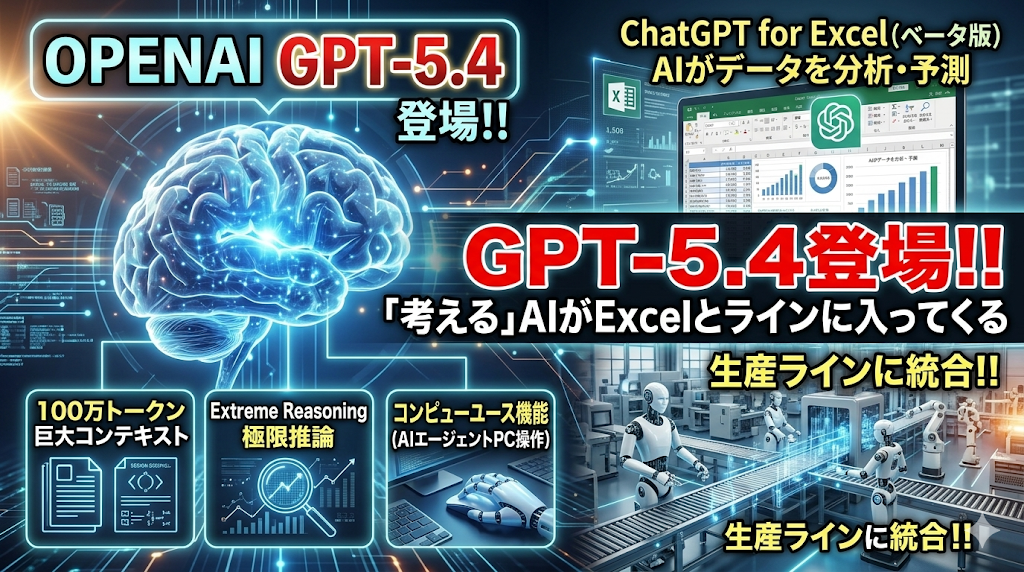
In my experience, the manufacturing industry was riddled with challenges: “We have the data, but we can’t make use of it. Quality inspection data, process logs, equipment alert histories–they only make sense when pieced together in the mind of a single experienced engineer. Once ChatGPT for Excel is fully operational, it will dramatically change the Excel-based planning process in production control departments. A world in which AI can make proactive recommendations on weekly production plan reviews, such as “Delivery risk here” or “Inventory runs out here,” is already within reach.
Topic 2|The Day Anthropic Sues Pentagon–AI Ethics Directly Related to Industry “Risk Management
On March 9, AI startup Anthropic filed a lawsuit against the U.S. Department of Defense (Pentagon). The suit was filed in retaliation for the Trump administration’s designation of Anthropic as a “supply chain risk” in retaliation for Anthropic’s restrictions on military use of Claude, which the company stated in the complaint would “hurt revenues by billions of dollars in 2026.” This is the first time in history that a U.S. AI company has received this designation.
What this incident shows is that the “ethics policy” of AI vendors has now come to the core of corporate risk: Anthropic tried to defend its position of “not letting AI be used to make weapons decisions. This led to an all-out clash with state power. From the perspective of the manufacturing industry, this is not a fire on the other side of the river. For defense and aerospace subcontractors, as well as manufacturers participating in government procurement, the choice of “which AI vendor to use” may have a direct bearing on terms of trade and compliance requirements in the future.
In my experience, in the development of semiconductor manufacturing equipment, the decision of “which components to use” was directly related to the end user’s compliance with export regulations, and AI is becoming the same composition. In planning the introduction of AI in your company, it will become an essential part of procurement decisions in the near future to inspect “which country’s technology the vendor is from,” “what is its ethical policy,” and “are there any regulatory risks?
Topic 3|Yann LeCun’s AMI Labs raises $1 billion–“AI that understands the physical world” will change the future of manufacturing robots.
On March 9-11, AMI Labs (Advanced Machine Intelligence), a Paris-based AI startup led by Yann LeCun, completed $1.03 billion in funding, creating a unicorn with a $3.5 billion valuation. The Turing Award winner and retired chief AI scientist at Meta is working on a concept called ” World Models.
While existing large-scale language models (LLMs) focus on “predicting the next word,” the World Model aims to “predict and understand physical reality,” and LeCuN itself stated in an interview with WIRED that it “wants to work with industries with large amounts of data, such as manufacturing, biomedical, and robotics. The architecture called JEPA (Joint Embedding Predictive Architecture) is the foundation of the system, which has the ability to predict “what will happen next” based on camera images and sensor data.
In my experience, a future in which manufacturing equipment can tell humans “signs of failure” has been a dream of mine for many years. Vibration, temperature, current waveforms–these data are still being obtained. However, there is still no system that can infer the “physical cause-and-effect relationship” between these data in real time. If the world model is put to practical use, equipment will be able to warn itself that “X component will reach its wear limit in 3 hours if it continues to operate at this rate. This is the turning point where the world of predictive maintenance will make the leap from pattern matching to real physical understanding.
Topic 4: AI in the manufacturing industry: 98% are “considering” AI, but only 20% are ready.
Redwood Software’s ” Manufacturing AI and Automation Outlook 2026,” released in March, presents an earful of numbers for small and mid-sized manufacturing executives. Here are the findings of the survey of 300 manufacturing professionals worldwide
- 98% are “considering or exploring” AI-driven automation
- However, only 20% are “fully prepared for large-scale utilization.
- 70% of companies automate less than 50% of key operations
- 78% of critical data transfers still manual
- Only 40% automate exception handling (error handling)
According to Innovation News Network’s analysis, the essence of the challenge is not a “lack of technology” but a ” disconnect between systems. Even though each process and system may be automated individually, as long as the ERP, MES, and supply chain systems are running discretely, AI will not get “real-time context. No matter how good an AI model is brought in, it cannot demonstrate its power in a fragmented execution pipeline.
In my experience, this is truly a matter of “foundation over tools”: 38 years ago, when CNC was introduced in the world of semiconductor manufacturing, even though the machines were state-of-the-art, the situation of having “data from the previous process in a paper ledger” kept dragging the process down. The current introduction of AI is exactly the same situation. The first step is to create a “blood vessel” of data – a prerequisite for AI utilization is to develop an infrastructure that connects ERP, MES, and quality control systems with a single vein of data. Before hastily buying AI tools, we strongly recommend that you take time to redraw your company’s data distribution map.
Redwood Software / PRNewswire | Innovation News Network
Topic 5: Physical AI and Cyber Risk – Lights and Shadows of the Era of Robot “Thinking
The latest report from the International Federation of Robotics (IFR) reveals that the global market for industrial robots has reached a record high of $16.7 billion, and one of the most notable trends for 2026 is the rise of ” Physical AI, ” as Nvidia CEO Jensen Fan declared, “The ChatGPT moment in robotics has arrived. As Nvidia CEO Jens Hwang declared, “The ChatGPT moment of the robot world has arrived,” AI-powered collaborative robots (cobots), humanoid robots, and autonomous guided vehicles (AGVs) are entering the deployment phase on the factory floor. Hyundai has announced plans to bring Atlas humanoid robots to the production floor, and BMW and Audi are piloting them. 58% of manufacturing executives surveyed by Deloitte say they are already using physical AI in some form, with plans to do so within two years. The percentage of those planning to use physical AI within two years reaches 80%.
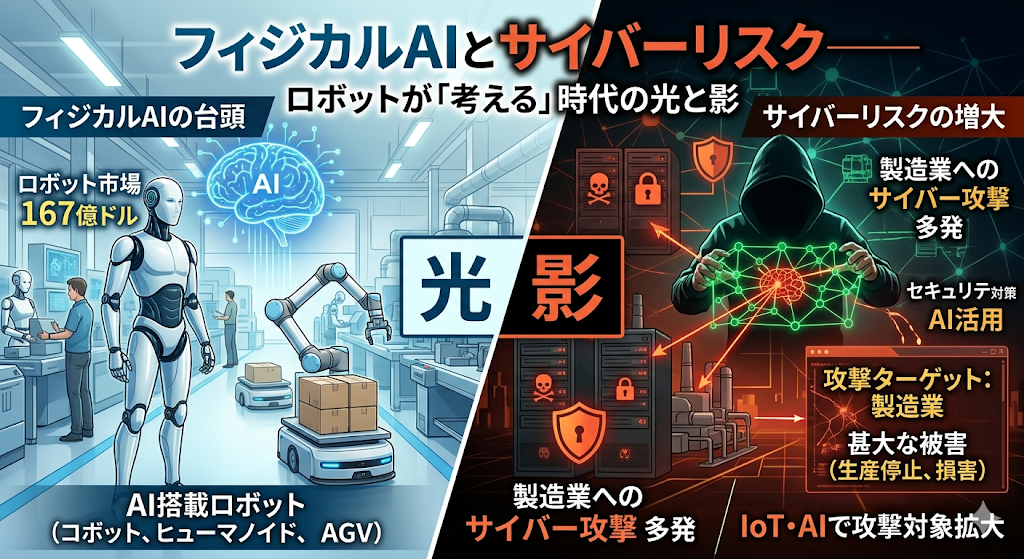
Meanwhile, the week also brought renewed warnings about cybersecurity risks in the manufacturing industry, which, according to IBM’s X-Force report, has been the most targeted industry for cyber attacks for four consecutive years. 2025 saw a cyber attack on the Jaguar Land Rover that shut down global production for five weeks, causing $260 million in damages and a 24% drop in revenue, Jaguar Land Rover suffered $260 million in damages and a 24% drop in revenue after a cyberattack shut down global production for five weeks in 2025. Japan’s Asahi Breweries suffered a similar ransomware attack that forced it to revert to handwritten management. the more IoT devices and AI systems, the wider the attack surface. the WEF’s 2026 Global Cybersecurity Report reports that 59% of manufacturing and supply chain companies have begun using AI have begun to use AI in their security measures, the report states.
In my experience, the digitization of equipment and network connectivity simultaneously draws in “convenience” and “vulnerability”. Remote monitoring of equipment makes invisible problems in the field visible, but the same line can also be the entry point for attacks. Now is the time to treat “OT network security design” as a management issue; it is urgent that manufacturing engineers and information security personnel discuss it at the same table, rather than leaving it to the IT department.
Summary|Perspectives for Next Week
This week has been a combination of news that reminds us that “AI is on the move”: GPT-5.4 is entering the workflow, world models are trying to understand the physical world, and robots are starting to “make decisions” on the factory floor. But on the other hand, the reality of the manufacturing industry is truly demonstrated by the numbers: “98% are interested, only 20% are ready.
Over the next week or so, there are two things to watch. One is the outcome of the Anthropic lawsuit–how the clash between AI ethics and national security is resolved will have a direct impact on AI governance throughout the industry. The other is the progress of AMI Labs’ world model development. The day when AI that understands the physical world will be applied to predictive maintenance and quality control of manufacturing equipment may come sooner than I thought. Waiting for the next wave while laying the groundwork” – I feel that this attitude is strongly demonstrated by this week’s news as a survival strategy for small and medium-sized manufacturing companies.