

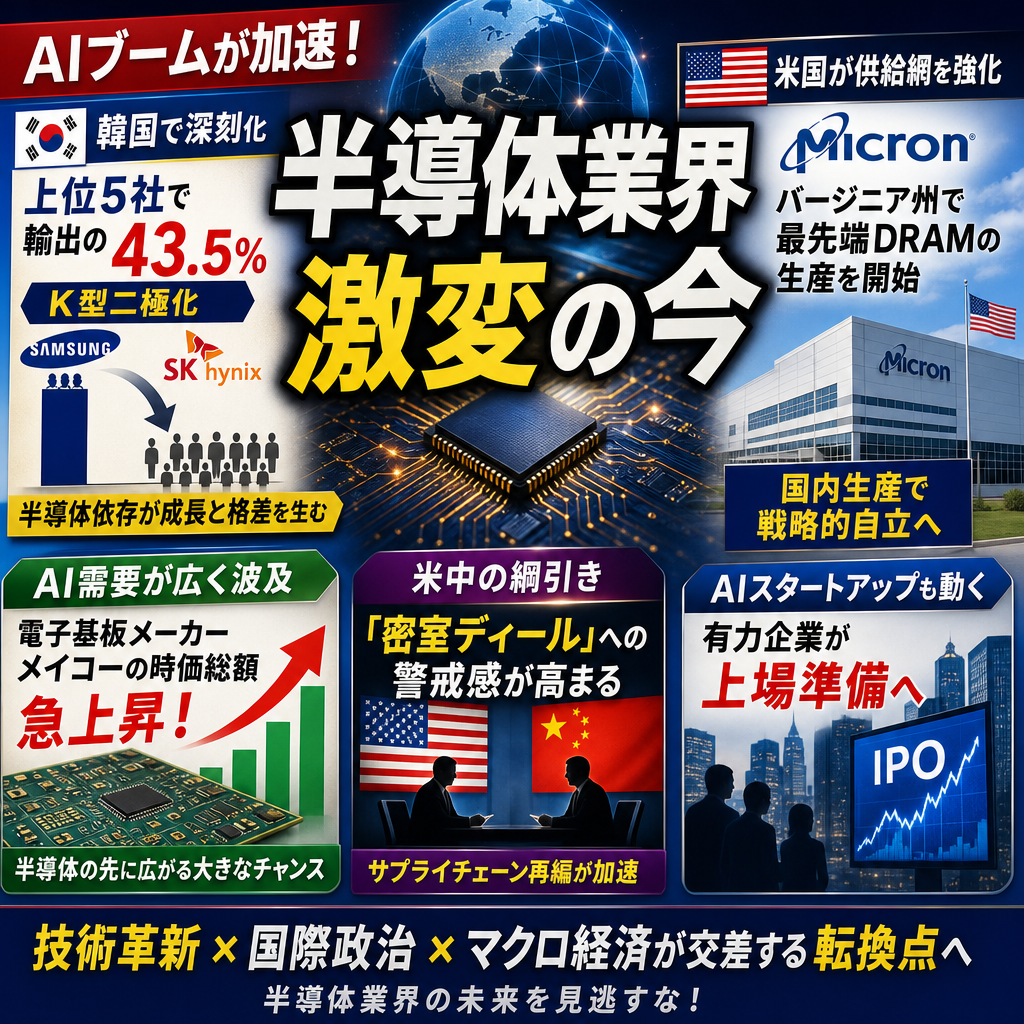
Today’s semiconductor news vividly highlights the transformation of the industrial structure brought about by the AI boom and the resulting economic impact. In South Korea in particular, the “K-type bipolarization” is becoming more serious, with the top five companies such as Samsung Electronics and SK Hynix accounting for 43.5% of total exports, and the semiconductor-dependent economic structure is creating growth and disparities at the same time. At the same time, geopolitical supply chain restructuring is accelerating, with U.S.-based Micron starting production of cutting-edge DRAM in Virginia and strengthening its domestic supply network. In addition, the growing demand for AI-related products is having a broad ripple effect, not only on semiconductors, but also on the market capitalization of electronic circuit board manufacturers such as Mayco, which is rapidly increasing its market capitalization. Combined with the wariness of a “secret deal” between the U.S. and China and the preparations of AI startups to go public, the semiconductor industry is at a critical turning point where technological innovation, international politics, and macroeconomic fluctuations are intricately intertwined.
Main News
- 0.007% dominate 44% of total exports… “K-type polarization” caused by the semiconductor boom
In the Korean economy, the bias in exports, especially semiconductors, is progressing to an extreme degree. In the first quarter of this year, the top five companies, including Samsung Electronics and SK Hynix, accounted for 43.5% of total exports, a significant increase over the same period last year. While the booming semiconductor industry is driving the nation’s overall growth, the “K-type bipolarization,” in which the gap between the semiconductor industry and non-semiconductor sectors and small and medium-sized enterprises is widening, is becoming clear, highlighting structural challenges across industry, employment, and income. - [Editorial] Exports Deepening ‘K-Shaped Bipolarity’…Do not become euphoric over the semiconductor boom
Excessive dependence on semiconductors has been identified as a risk factor in the ROK’s export structure. The fact that the top five companies accounted for 82.8% of the increase in exports in the first quarter suggests the dangers of growth dependent on a specific industry. The editorial notes that the country is fortunate to have a powerful engine in the form of semiconductors, but warns that it should not become enamored with this boom, but should hasten structural reforms to diversify its industries and correct the disparities. - U.S.-China “Secret Deal” World Wary of AI, Currency, Taiwan, and Fate for Two Powers
With the U.S.-China summit coming up, countries around the world are wary of a “secret deal” between the two countries. The possibility of a major agreement on trade and investment by the end of the year has emerged, and decisions by the two powers on AI technology, currency, and Taiwan issues could drastically change the framework of the global economy. Japan and Europe are watching the upcoming negotiations closely, concerned that their interests could be undermined. - AI Stock Gains Spill over into Electronic Components Mid-sized Meiko also Joins the “1 Trillion Yen Club” in Market Capitalization
The benefits of the AI boom are spreading not only to semiconductor manufacturers, but also to the surrounding electronic components industry. The market capitalization of Meiko Corporation, a manufacturer of high-performance printed circuit boards, has surged 4.1 times compared to the end of last year, surpassing the 1 trillion yen mark. In particular, demand for multilayer build-up substrates, which are indispensable for AI servers and other applications, is rapidly increasing, and the entire supply chain is being re-evaluated, with mid-sized manufacturers with strong technological capabilities receiving high praise from the market. - Micron Begins Production of U.S.-Made Advanced DRAM at Virginia Plant to Expand Domestic Memory Supply
Micron announced today that it has begun mass production of U.S.-made advanced DRAM at its Virginia plant. This is part of the company’s strategy to strengthen its semiconductor supply network in the U.S. The move is aimed at establishing a stable domestic memory supply system in the face of growing geopolitical risks. This move marks an important milestone in the U.S. efforts to become more self-sufficient in semiconductors. - SpaceX, Anthropic, and Open AI Prepare to Go Public A milestone in the AI boom
AI industry leaders Open AI, Anthropic, and SpaceX are preparing to go public one after the other. The move by these three of the most high-profile startups in history to become trillion-dollar market cap companies is a major milestone that symbolizes that the current AI boom is not just a matter of anticipation, but has entered a mature phase with a massive influx of capital into the real economy. - Why AI Can’t Lower Prices Now
While there are hopes that the AI revolution will increase productivity and suppress prices, the reality is that prices continue to rise. ai has the potential to increase supply capacity over the long term, but in the short term the cost of implementation and increased energy demand are affecting prices. There is a time lag before AI permeates the economy as a whole and truly functions as a productivity enhancer, and the disconnect from the current high interest rate and high price environment is causing market uncertainty. - Why CATL is betting on deep chics…Targeting the power needs of AI data centers
CATL, the world’s largest battery manufacturer, is stepping up investment in energy storage systems and related technologies in anticipation of the huge power needs of AI data centers. CATL sees the “AI power problem” as a new growth market, and aims to expand its market share by approaching the problem from the energy supply side. - How the Spread of AI Will Change Japan’s Semiconductor Industry “Semiconductor Wars” Chris Miller considers
Chris Miller, best known for his book “Semiconductor Wars,” discusses the impact of the spread of AI on Japan’s semiconductor industry. He analyzes the role of Japan’s semiconductor industry, which once dominated the world, in the age of AI, and the strengths and challenges Japan faces in the technological competition among nations, both from a historical background and from a contemporary geopolitical perspective. - AI for patient psychiatric care… “still at an apprentice level”
AI technology is beginning to be applied in the medical field, particularly in psychiatric care. While attempts are underway to analyze symptoms from patient interactions, at this point it is considered to be at an “apprentice level” and has yet to reach a high level of empathy or make complex clinical decisions. Although technological advances are expected, the introduction of AI in the medical field requires a cautious approach.
News List (44 items)
This article is delivered every morning by an automatic collection and AI generation system. Number of collected articles : 44 | Update date : 20260525
Editor’s Note: This article utilizes AI to summarize and organize news content. While every effort has been made to be as accurate as possible, it may contain errors in background explanation or interpretation of causal relationships. Please always check the source article for details and accurate context.