

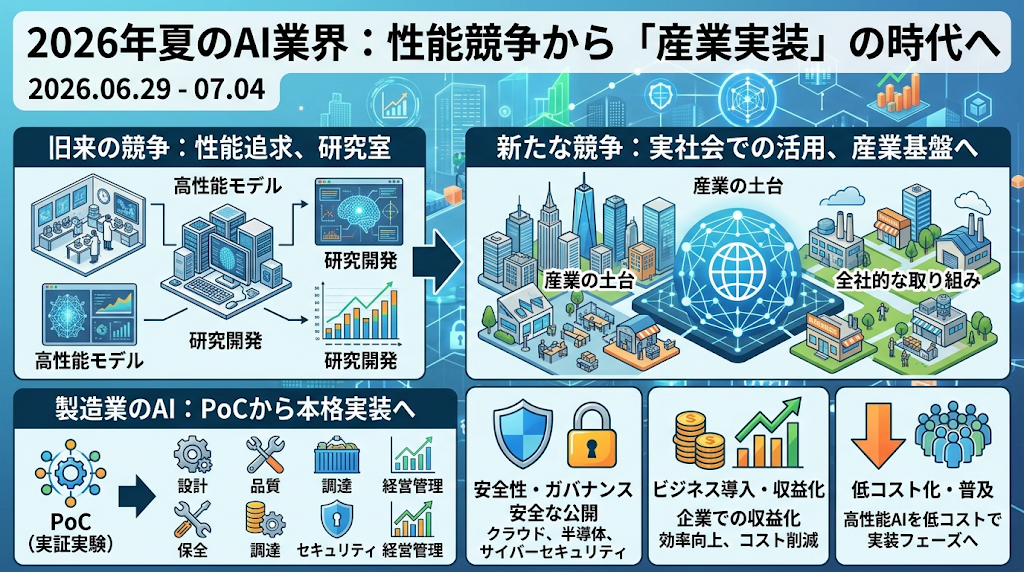
For the AI industry, the week of June 29 through July 4, 2026, was not merely a “race for high-performance models.”Rather, it was a week in which it suddenly became clear who could safely release cutting-edge models, who could monetize enterprise adoption, and to what extent high-performance AI could be brought down to a low enough cost to enter the implementation phase.Generative AI is no longer confined to the lab; it has entered a battle for “industrial infrastructure” that simultaneously involves governance, cloud computing, semiconductors, cybersecurity, and corporate operations.From a manufacturing perspective, this week’s news indicates that AI adoption is shifting from a proof-of-concept (PoC)-centric phase to a race for implementation that spans design, quality, maintenance, procurement, security, and business management. Reuters
Topics.
1. Anthropic Revives Fable 5; New Rules on Security and Model Disclosure Come into Focus
On June 30, Anthropic announced that, following the lifting of U.S. government export restrictions, it would begin global rollout of “Fable 5,” one of its cutting-edge models, starting July 1. According to Reuters, the U.S. government had temporarily restricted access to the company’s models in June due to national security concerns, but access was restored after Anthropic implemented additional security measures.In addition to enhancing classifiers that detect dangerous cyber uses and analyzing misuse patterns, Anthropic is collaborating with Amazon, Microsoft, Google, and others to develop evaluation criteria for AI “jailbreaks.”This development symbolizes how future cutting-edge AI will be judged not only on performance but also on “how accountable it is to the government and society,” which will determine whether it can be brought to market. Anthropic Reuters
Implications for the Manufacturing Industry: When using advanced AI in factories, R&D, and maintenance departments, procurement requirements will no longer be limited to “accuracy” but will also include access management, usage logs, prevention of hazardous operations, and compliance with internal regulations. In particular, for applications involving design data, OT environments, and vulnerability information, it is necessary to incorporate guardrail design into standard operations at the same time as model selection.
2. Microsoft Establishes New “AI Implementation Division”; Focus Shifts from Model Performance to Implementation ROI
On July 2, Microsoft announced the launch of Microsoft Frontier Company, a new subsidiary designed to support AI adoption in enterprises, and said it would invest $2.5 billion in the venture. With clients such as Unilever and Novo Nordisk, the company aims to select and integrate AI solutions—including not only Microsoft’s own but also third-party AI—and combine them with clients’ proprietary internal data to deliver results.According to Reuters, a Microsoft executive acknowledged that “it was a mistake to tie Copilot exclusively to OpenAI models,” explaining that what customers are seeking is not dependence on a single model, but a “swappable” configuration that allows them to switch to the optimal model for each specific use case.This development indicates that the competitive focus in the AI market is shifting from the models themselves to implementation design, operational design, and results generation. Reuters
Implications for the Manufacturing Industry: In manufacturing, too , the crux of generative AI is not “which model is the smartest , ” but rather how it connects with PLM, MES, ERP, maintenance history, quality records, and design standards—and how it improves on-site KPIs.Rather than relying on a single vendor, an architecture based on a multi-model approach —where the optimal model can be selected for each process—is increasingly becoming the practical solution.
3. Meta is considering selling its excess AI computing resources, and the competitive landscape of the AI cloud market has begun to shift
According to Reuters, it was reported on July 1 that Meta is considering a cloud business to sell surplus AI computing resources to third parties. The envisioned model would allow developers to use AI models (including Muse Spark) on Meta’s infrastructure and pay for the computing resources they need—a structure similar to AWS Bedrock. Meta is projected to invest up to $145 billion in AI infrastructure by 2026, and the pressure to recoup such massive investments is driving the social media giant toward becoming a “cloud service provider.” This demonstrates that AI is not only fueling competition in software but is also triggering an industry-wide restructuring in the fields of GPUs, data centers, power, and cloud services. Reuters
Implications for the Manufacturing Industry: A key point for the manufacturing industry is that the costs associated with AI adoption are likely to shift further away from model licensing fees and toward computing resources, inference infrastructure, and data storage costs.For high-frequency inference tasks such as image inspection, voice preservation support, and process optimization, comparing the costs of in-house environments, dedicated cloud services, and edge inference—not just API fees —will directly impact competitiveness.
4. The UN and national authorities warn of a “governance vacuum in the age of agent AI”; regulation will move toward an integrated approach combining national security and industrial policy
A report by an independent United Nations panel released on July 1 warned that advances in AI are outpacing scientific understanding and government policy responses, noting that as AI evolves into agent-based systems capable of autonomously performing real-world tasks, catastrophic risks cannot be ruled out.According to Reuters, the report stated that the complexity of tasks AI can handle is doubling every 4 to 7 months. That same week, it was also reported that the U.S. government was discussing new standards for the release of new models with AI companies, and that the Bank of England was considering new regulations and even “kill switches” to address agent AI.In other words, AI regulation is shifting from abstract ethical debate to practical measures that encompass pre-release assessments, early access management, financial stability, cyber defense, and the protection of critical infrastructure. Reuters Reuters Reuters
Implications for the Manufacturing Industry: When using AI agents on the manufacturing floor, the essential criteria going forward will no longer be simply “implementing them because they’re convenient,” but rather “Can they be stopped in the event of a malfunction?,” “Who authorizes their use?,” and “Can their actions be explained?” For autonomous AI that spans multiple business functions—such as procurement, automated quoting, inventory ordering, maintenance instructions, and anomaly detection—it is all the more important to clearly define the point of ultimate human responsibility and the conditions under which the system can be shut down.
5. Low-cost, high-performance models from China are making their presence felt; demand for AI is now reaching the point where it is driving up the manufacturing index for the real economy.
On July 2, Reuters reported that GLM-5.2, released by Beijing-based Z.ai, is drawing attention for its coding and agent capabilities—which are closing the gap with U.S. models— while costing about one-sixth as much as leading U.S. closed-architecture models.Additionally, on June 30, it was reported that China’s manufacturing PMI recovered to 50.3, with demand for semiconductors, computers, and AI-related products supporting factory activity.What is important here is that the decline in AI costs is not limited to price disruption in the software market but is spreading to the real economy—including semiconductors, electronic devices, exports, and factory operations. AI has entered a cycle in which it has evolved from a “technology to be used” to a “manufacturing industry,” and is now returning to “capital investment in industrial equipment.” Reuters Reuters
Implications for the Manufacturing Industry: Future competition will shift from whether or not to use AI to how it is used— specifically , at what cost level, under what security conditions, and within what supply chain. While low-cost open-weight models significantly lower the barriers to adoption for applications such as internal document search, work standard support, and design review assistance, it is essential to assess data sovereignty and supply chain risks.
General Considerations for Manufacturing
If we summarize the news from the past week from a manufacturing perspective, four major points emerge.
First, the main focus of AI adoption has shifted from proof-of-concept (PoC) to operational implementation. As evidenced by Microsoft’s establishment of a new company, businesses are no longer in the stage of simply “testing generative AI”; they are now being asked to determine which models to apply to which business processes, on which data infrastructure, and how much profit they will generate.In the manufacturing sector, full-scale deployment is expected to proceed starting with areas where benefits are relatively easy to measure, such as design support, root cause analysis of quality defects, maintenance knowledge retrieval, procurement document processing, and speeding up technical responses to sales inquiries. Reuters
Second, we need to prepare for the era of multi-models. With OpenAI, Anthropic, Meta, and Chinese open-source players all competing side by side, a strategy that bets everything on a single model from a single company is becoming increasingly risky. A practical approach is to design a portfolio tailored to specific use cases —such as high-precision models for process design, low-cost models for internal FAQs, and lightweight models for closed environments within factories. The strength of the manufacturing industry lies not in the models themselves, but in the process knowledge, drawings, quality records, and equipment history accumulated over many years.Competitive advantage depends not on “which model to use,” but on how to securely integrate a company’s proprietary data. Reuters Reuters
Third, AI governance is no longer the sole responsibility of the IT department. The UN and national authorities are concerned about agent AI interfering with real-world decision-making and operations.In the manufacturing sector, there are many decisions that affect people, equipment, and customers—such as supplier selection, price proposals, order placement, maintenance instructions, and responses to abnormalities—and the cost of AI malfunctions is high. Therefore, for future implementations, it will be crucial to go a step beyond mere terms of use and design operational frameworks that include approval authorities, suspension authorities, log auditing, accountability, and manual recovery procedures for exceptions. Reuters Reuters
Fourth, the AI boom has already begun to transform the demand structure in the manufacturing sector. As indicated by the improvement in China’s PMI, demand for AI-related semiconductors, computing equipment, and related electronic components has reached a level that is boosting the overall business conditions of the manufacturing sector itself.In other words, the manufacturing sector is not only a “user” of AI but can also become a “supplier” of AI infrastructure. For companies that produce electronic components, control devices, industrial power supplies, cooling systems, inspection equipment, and factory automation (FA) equipment, capturing demand for AI-related capital investment —in addition to AI adoption itself —will become a key business priority. Reuters Reuters
summary
To summarize the AI news from June 29 to July 4, the essence of this week lies not in the emergence of “smarter AI,” but in the fact that AI has become a core industry that simultaneously drives national security, cloud computing, regulation, corporate adoption, and manufacturing demand. The implications for the manufacturing industry are clear.Going forward, success will hinge on how quickly companies can establish the following four capabilities: (1) the design capability to tailor AI for specific applications; (2) the integration capability to monetize internal data; (3) the governance capability to manage the use of AI agents; and (4) a business perspective focused on capturing AI-related demand itself. AI is no longer merely a “tool for operational improvement”; it is becoming a fundamental competitive factor for the manufacturing industry.
Source List
Editor’s Note: This article utilizes AI to summarize and organize news content. While every effort has been made to be as accurate as possible, it may contain errors in background explanation or interpretation of causal relationships. Please always check the source article for details and accurate context.