

The following is a summary of AI trends for the week of May 24-30, based on major announcements and press reports available as of May 29. This week was a strong reminder that AI is moving toward “execution systems” that run actual business operations, rather than the performance race of generative AI itself. Video generation is moving to interactive editing environments, foundational models are turning into agents that carry out long-running tasks, and AI vendors are beginning to compete on overall design, including safety, sovereignty, and infrastructure. What is important for manufacturers is that they have moved from the stage of testing AI to how to incorporate AI as a business infrastructure that links design, quality, maintenance, procurement, and sales support.
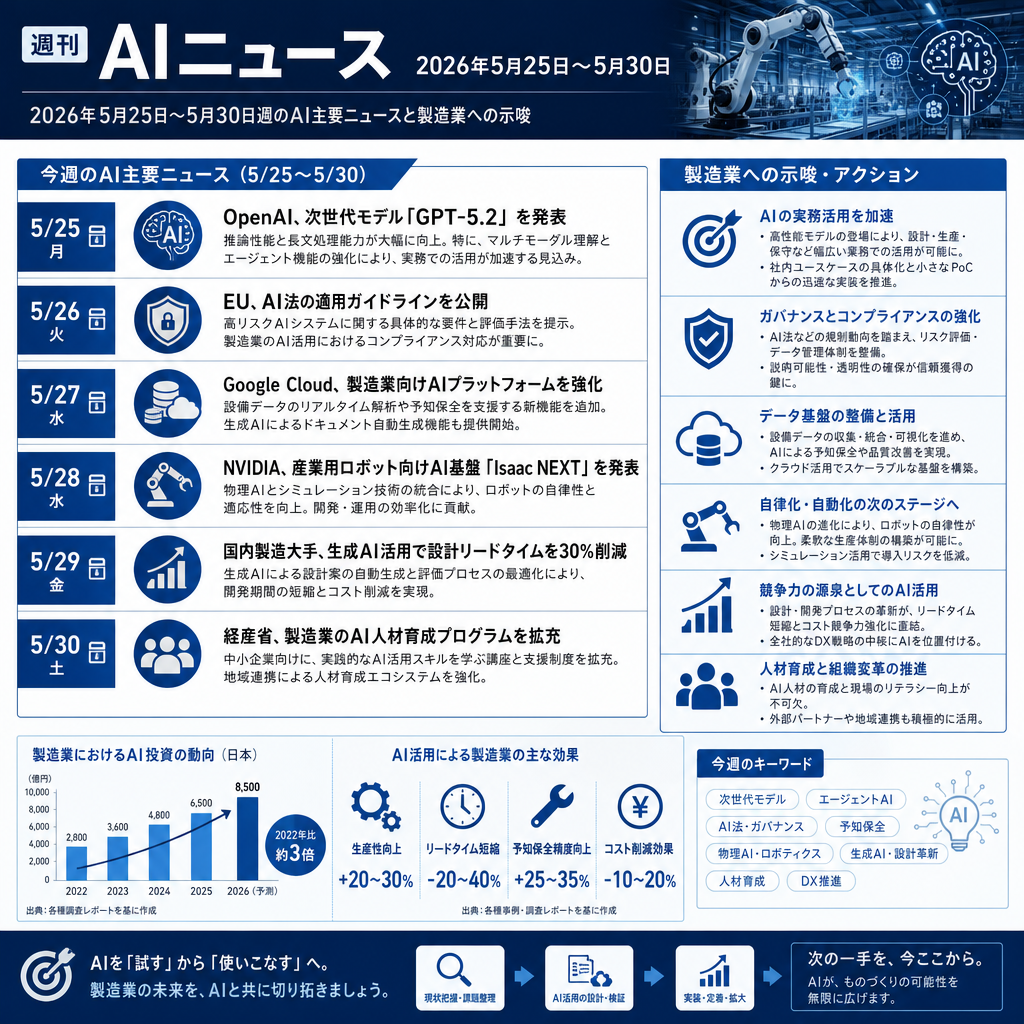
Topics.
Google Deploys Gemini Omni Flash Video Generation AI Moves Toward “Conversational Editing Environment
Google DeepMind announced the deployment of Gemini Omni Flash on May 29. The feature is the ability to generate and edit high-quality video in a conversational format, using video as the starting point and handling images, audio, video, and text as input. Rather than simply generating video from text, the direction has been clarified to enable continuous editing, such as “change only the lighting in this scene,” “replace only the movement,” or “create another cut with the same character settings.
In addition, it is important to note that by expanding into Gemini apps, Google Flow, and YouTube Shorts, Google is quickly expanding the point of contact for real-world use, rather than technology in the research phase. Google is emphasizing video generation that leverages its understanding of physical behavior and knowledge of the real world, not just to create good-looking videos, but to generate explanatory and demo videos that “look more natural”. In addition, the generated videos were watermarked with SynthID, bringing to the forefront a mechanism for verifying authenticity and provenance.
This indicates that multimodal AI is gaining “editorial consistency that can be used in business” rather than “being able to generate anything”. This is a meaningful development for operations that involve video, such as education, marketing, design review, and maintenance support.
Implications for the manufacturing industry: While there is a great demand for video on the manufacturing floor for work procedures, maintenance manuals, videos that reproduce equipment problems, safety training, product descriptions for sales, etc., the cost of production has been a barrier to adoption. The direction of Gemini Omni Flash encourages the trend to create content for education, maintenance, and sales in a short period of time by combining CAD images, site photos, inspection audio, and existing videos. This is particularly promising for applications where the tacit knowledge of skilled workers is visualized and passed on. On the other hand, there is a risk of generating incorrect procedures or inaccurate behavior in a plausible manner, so a supervision flow before publication is essential.
2. Anthropic Raises $65 Billion and Announces Claude Opus 4.8, AI to be “Longtime Colleague
On May 28, Anthropic announced $65 billion in Series H funding, bringing its valuation to $965 billion. In addition, the company’s annualized run-rate revenue exceeded $47 billion, and Claude is available on all three major clouds (AWS, Google Cloud, and Microsoft Azure), which strongly indicates its widespread adoption by enterprises. The company is clearly positioning itself as a huge business infrastructure player, not just a promising startup.
Also important is Claude Opus 4.8, released on the same day, which Anthropic describes as having improvements in coding, agent work, and professional work, as well as dynamic workflows that allow for long tasks with many sub-agents running in parallel. In addition, effort control allows users to adjust the balance between response time and deep inference. Even more noteworthy is the improvement in “integrity. It is said to have reduced the number of poorly supported claims and missed flaws in the code it wrote, and countermeasures against AI’s “apparent fallacies” have become the axis of competition.
We can read from this presentation that the value of AI models is shifting from the quality of one-shot responses to whether they can safely be entrusted with longer tasks.
Implications for manufacturing: In manufacturing, there are many long contextual tasks such as checking the impact of design changes, reconciling bills of material with drawings, performing primary analysis of quality anomalies, organizing maintenance history for multiple sites, etc. Models such as Claude Opus 4.8 are not just chatbots, but are more suited as design, quality, and maintenance Models such as Claude Opus 4.8 are more suited to be “assistants” in design, quality, and maintenance, rather than mere chatbots. Dynamic workflows are particularly suited for automating survey work that spans multiple processes, multiple forms, and multiple systems. However, what really matters in manufacturing is not average performance but reliability during exceptions. The trend toward improved integrity is welcome, but log storage, rationale display, and approver design are prerequisites for field implementation.
3. OpenAI and Frontier Governance Framework released AI utilization has entered a stage where not only “performance” but also “governance” is required.
On May 28, OpenAI published its Frontier Governance Framework. This is a public document that organizes the company’s approach to safety, security, and risk management, while keeping in mind future laws and regulations such as the EU AI Act and the California Transparency in Frontier AI Act. The significance of this document is that it is based on the existing Preparedness Framework, but has been prepared as a public governance document.
Targeted risks include cyber attack support, CBRN (chemical, biological, radiological, and nuclear) related, harmful operations, and loss of control. In addition, the framework includes model reporting, security risk management, incident response, use of outside experts, and a policy for updating the framework itself. This indicates that the safety of AI is no longer just a matter of “researcher conscience” but also a matter of corporate governance, accountability, and auditability.
In the future, when companies select an AI, it is likely that procurement requirements will include not only performance and price lists, but also “what evaluation criteria are used to look at hazards” and “how they report in the event of an accident.
Implications for the Manufacturing Industry: The manufacturing industry handles sensitive information such as product design information, factory networks, supplier information, and customer specifications. Therefore, in selecting an AI, not only model performance but also visibility into data handling, access control, accident response, and external audit response are important. In the future, it will not be a question of “which AI to use,” but rather “which governing model to use” that directly affects competitiveness. In particular, in regulated industries such as defense, medical devices, automobiles, and chemicals, the first question will be how to design an implementation that is accountable, rather than how to use AI itself.
Mistral AI, a major step toward industrial applications “Sovereign AI” and “physics AI” are approaching the manufacturing industry.
On May 28, Mistral AI rebranded its consumer assistant to Vibe and launched an enhanced AI stack for industrial engineering. Of particular interest is the company’s industrial expansion, which includes physics AI, and its vision to use AI to assist in the design, analysis, and operation of advanced industrial products such as aircraft, automobiles, and semiconductor equipment through partnerships with Airbus, BMW, ASML, and others.
The point is that it is not a stand-alone LLM, but a full-stack strategy that includes physical simulation, on-premise support, data centers, and even inference infrastructure. As is typical of European companies, the context of “sovereign AI” that does not rely on the U.S. hyperscaler is front and center, with a clear appeal to companies that want to handle sensitive manufacturing data on their own or intra-regionally.
physics AI is not a complete replacement for first-principles simulation, but it is promising as a means to speed up the early stages of design iterations and increase the number of explorations. The role of AI in the design field is moving from document summary to closer to the heart of manufacturing.
Implications for the manufacturing industry: This is very suggestive for the manufacturing industry, as AI applications are not limited to clerical work and inquiry response, but extend to design development itself. In particular, there is room for applications such as condition search at the CAE stage, hypothesis generation for the cause of anomalies, failure diagnosis support for service personnel, and equipment software review. In addition, the emphasis on on-premise and in-region installation is realistic for companies that value data sovereignty and export control. In the future, it will be important to use hybrid configurations for different applications, rather than a choice between cloud AI and on-premise AI.
Foxconn is bullish on AI demand growth AI is moving from software competition to “industrial infrastructure competition
On May 29, Foxconn expressed strong confidence in future growth on the back of rising demand for AI. Foxconn is also a key player in manufacturing servers for Nvidia and plans to increase its capex by 30% this year to expand its AI server manufacturing capacity. Foxconn is also a key player in server manufacturing for Nvidia, and plans to increase capital spending by 30% this year to expand its AI server manufacturing capacity. The impact of the memory shortage is also limited at this time, he said.
The importance of this news is that the competition in AI is not just about model performance and app usability, but has entered the race for supply capacity, including servers, memory, power, data centers, cooling, etc. AI is no longer a function in the cloud, but an industry with huge real investments.
For manufacturers, this means that the prerequisite for AI utilization will change to “can we secure computing resources when we want to use them? Securing computing resources may become as important a management theme in the future as power contracts and semiconductor procurement.
Implications for manufacturing: AI deployments in the manufacturing industry tend to be successful in PoC but face costs and processing waits in production deployments Foxconn’s statement indicates that we are now at the stage where AI is not a question of “can it be used?” but “can it be stably supplied? “We are now at the stage of “whether it can be used or not. In the future, GPU utilization planning, inference cost management, role sharing with edge inference, and priority design of critical tasks will be necessary. In particular, for high-frequency inference such as image inspection and acoustic diagnosis, it will be more valuable to consider in-factory inference infrastructure as well as cloud dependence.
General Considerations for Manufacturing
Across the news this week, AI is clearly moving through three distinct phases. First, from “interactive tools that answer questions” to “execution-based agents” that handle long-running tasks. Second, from individual business support to “business operating systems” that span search, documents, video, design, purchasing, and maintenance. Third, from cloud functions to “industrial infrastructure” including data centers and semiconductor investments.
When considered in the manufacturing industry, this change will greatly expand the application areas. In design development, design support that traverses specifications, past drawings, and defect information, and initial search using physics AI will advance. In quality assurance, AI that bundles inspection images, defect reports, and process conditions to generate causal hypotheses will become a reality. In maintenance, predictive failure and recovery support that integrates inspection records, sound, vibration, and video will grow. In procurement, the organization and comparison of supplier information, quotation terms, and contract documents will be easier to automate. In sales and after-sales service, automatic generation of product instruction videos and fault response guides will become a weapon in the field. Furthermore, it becomes easier to structure the knowledge of skilled personnel in the form of videos, documents, and dialogue logs, and to create a mechanism for passing them on to the next generation.
On the other hand, the issues of implementation are more stringent. How to protect data sovereignty? Where to place the security perimeter? How do we keep inference costs down? How do we measure ROI in the field, and how far do we hold AI proposals accountable? And how to integrate it with existing systems such as PLM, MES, ERP, and CRM? If these questions are left unclear, even if a high-performance AI is introduced, it will not take root in the business.
In future practice, rather than aiming for “one AI for the entire company,” architectural thinking to determine the optimal model and deployment for each business will become more important. AI implementation is approaching a redesign of business design and information governance, rather than software implementation.
summary
AI news for the week of May 24-30, 2026, showed that the evolution of AI is moving not only toward “smarter conversations” but also toward “working longer,” “getting deeper into operations,” and “requiring greater infrastructure. “Google pushed multimodal generation into conversational editing, Anthropic has pushed for longer work runs and improved integrity, OpenAI has put governance in place as a public framework, Mistral is differentiating itself with sovereign AI and industrial AI, and Foxconn has once again demonstrated the enormity of AI infrastructure demand.
For the manufacturing industry, the essence is not “whether to use AI” but “in which business, in which form, and under which governance. In the coming weeks and beyond, it will be necessary to continue to follow not only the performance of the models, but also the implementation format, operational responsibility, and infrastructure security.
Source List
- Google DeepMind: Introducing Gemini Omnihttps://deepmind.google/blog/introducing-gemini-omni/
- Google DeepMind: Gemini 3.5: frontier intelligence with actionhttps://deepmind.google/blog/gemini-3-5-frontier-intelligence-with-action/
- Google Blog: 100 things we announced at I/O 2026https://blog.google/innovation-and-ai/technology/ai/google-io-2026-all-our-announcements/
- Anthropic: Anthropic raises $65B in Series H funding at $965B post-money valuationhttps://www.anthropic.com/news/series-h
- Anthropic: Introducing Claude Opus 4.8https://www.anthropic.com/news/claude-opus-4-8
- OpenAI: OpenAI’s Frontier Governance Frameworkhttps://openai.com/index/openai-frontier-governance-framework/
- VentureBeat: Mistral AI launches Vibe, expands into industrial AI and announces data center push to challenge OpenAIhttps://venturebeat.com/ technology/mistral-ai-launches-vibe-expands-into-industrial-ai-and-announces-data-center-push-to-challenge-openai
- Yahoo Finance / Reuters: Foxconn has immense confidence in growth momentum due to AI, chairman sayshttps://finance.yahoo.com/sectors/technology/ articles/foxconn-immense-confidence-growth-momentum-014351654.html
- The Hindu / Reuters: Microsoft to release new coding model next week: report
https://www.thehindu.com/sci-tech/technology/microsoft-to-release- new-coding-model-next-week-report/article71035798.ece/amp/
Editor’s Note: This article utilizes AI to summarize and organize news content. While every effort has been made to be as accurate as possible, it may contain errors in background explanation or interpretation of causal relationships. Please always check the source article for details and accurate context.