

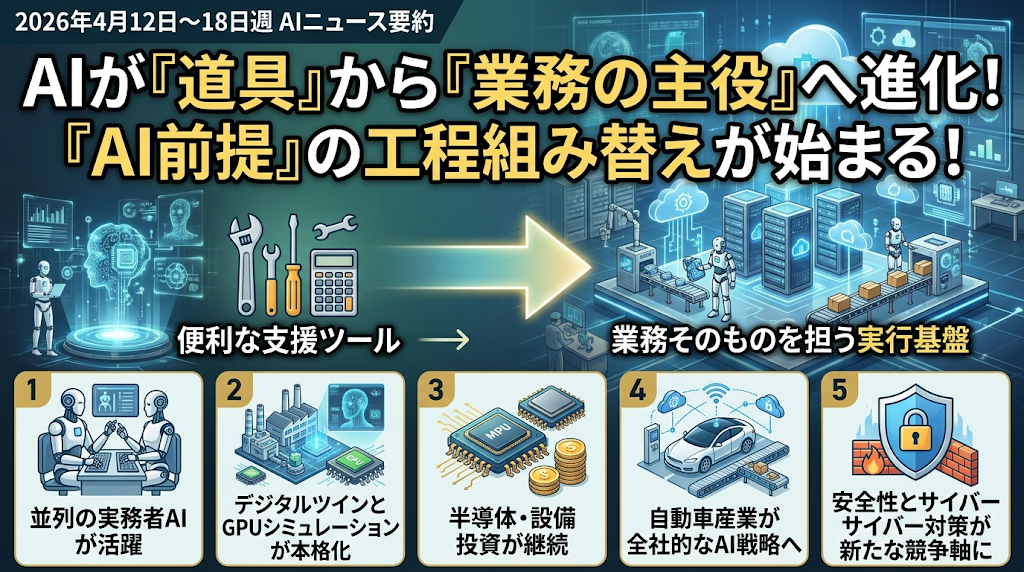
The week from April 12 to 18, 2026, was a week in which companies once again demonstrated that AI has moved from being a “convenient support tool” to an “execution platform that handles the business itself. Not only improvements in model performance, but also moves to link design, verification, simulation, maintenance, and cyber defense in a single integrated system were noticeable, and for the manufacturing industry, the shift from the stage of “AI implementation” to the stage of “reconfiguring processes based on AI The transition from the “AI implementation” stage to the “reconfigure processes based on AI” stage is becoming a reality for the manufacturing industry. OpenAI Anthropic NVIDIA Reuters
Looking at the news this week, there are five major points of focus. First, AI agents are approaching “parallel practitioners” in software development and design assistance. Second, digital twin and GPU simulations are now in full swing in design, manufacturing, and logistics. Third, investment in semiconductors and equipment, which form the basis for these technologies, remains strong. Fourth, the introduction of AI, particularly in the automotive industry, has shifted from individual experiments to company-wide strategies. Fifth, safety and cyber countermeasures have come to the forefront as the axis of competition, along with higher performance. OpenAI Anthropic Reuters Reuters
Topics.
1. OpenAI ‘s Codex gets a major update, AI agents are now “part of the development team”.
This week, OpenAI announced a major update to Codex, integrating PC operation, browser usage, image generation, memory, continuous tasks, and automatic proposals. It is important to note that Codex is now positioned as a “working agent running in parallel” that does not simply assist in writing code, but also handles PR verification, multiple terminal operations, SSH connections, and various business tool integration. In the manufacturing industry, this indicates the direction of continuous improvement of software assets around the shop floor by AI, such as modification of MES linked screens, prototyping of equipment monitoring dashboards, maintenance of internal tools, and automation of forms. Source
Implications for the drafting industry: Peripheral tasks in the design department, such as modification of CAD peripheral tools, drawing review assistance, checking consistency between specifications and implementation, and automatic generation of prototype UI, may shift from “human creation from scratch” to “continuous maintenance by AI agents” in the future. Source
2. Anthropic ‘s Claude Opus 4.7 Advances Reliability for Long-Time, Precision Tasks
With the general availability of Claude Opus 4.7, Anthropic has introduced improvements in challenging software engineering tasks, long-running multi-step processing, high-resolution image understanding, and tight instruction following. Of particular note is the “long run” stability and reduction of tool errors. In the manufacturing industry, the more ambiguity is avoided in tasks such as summarizing equipment abnormality reports, reconciling maintenance history with drawings, matching inspection reports and regulatory documents, and drafting complex change management documents, the greater the benefit will be. Source
Anthropic has also put forward safeguards to detect and block high-risk cyber applications, indicating that while the race for higher performance AI continues, “whether it can be safely deployed in the field” has become a critical point in actual operation. Source
Implications for the drafting industry: Reading and checking consistency across drawings, wiring diagrams, process sheets, and technical documents is an area that is highly dependent on human skill. Once high-resolution reading and long-form reasoning are stabilized, it will be feasible to detect oversights during design changes and automate pre-review processing. Source
NVIDIA accelerates “industrial AI” in design, manufacturing, and logistics
Perhaps the most directly relevant news of the week for manufacturing is NVIDIA’s announcement: industrial software companies such as Cadence, Dassault Systèmes, PTC, Siemens, and Synopsys designed around NVIDIA’s CUDA-X, Omniverse, NeMo, and others, With names like FANUC, Honda, Mercedes-Benz, TSMC, PepsiCo, and KION, we are no longer in the PoC phase, but in the implementation competition phase. It is no longer in the PoC phase, but in the implementation competition phase. Source
The presentation showed concrete examples of AI entering core manufacturing processes, including faster aerodynamic analysis for automobiles, faster verification of semiconductor designs, digital twins with physical accuracy in factories and warehouses, and bridging from robot design to simulation. In particular, the trend of “using GPUs to drastically shorten calculations that would take days or weeks on a CPU” could fundamentally change the number of prototypes, development lead time, and quality improvement cycles. Source
Implications for Draftsmen: Drawings are no longer finished products, but rather “live input data” for AI, simulation, and digital twin. Drafting departments will be asked to provide not only drafting quality, but also attribute information, 3D integration, and connectivity with OpenUSD and PLM. Source
4. bullish outlook for ASML and TSMC as reported by Reuters; AI investment to continue
According to Reuters, ASML and TSMC’s outlooks this week showed that the AI capex boom is still on track, with TSMC raising its full-year sales forecast and indicating that it will ramp up capex to meet AI demand, and ASML raising its full-year sales forecast. Furthermore, major U.S. cloud computing companies are expected to invest over $600 billion in data centers this year, confirming that the foundation for AI demand remains strong. Source
On the other hand, the same report also emphasizes that increased demand is dependent on a very small number of suppliers and that production capacity is tight. In other words, AI is not a cheap and inexhaustible commodity, and for the time being, “how to secure computing resources” will be the competitive edge itself. If manufacturers are to expand their use of AI, they need to address not only software implementation but also cloud contracts, GPU procurement, inference cost design, and prioritization as management issues. Source
Implications for Draftsmen: 3D design, rendering, fluid analysis, and image inspection AI all consume computing resources. Design departments are now at the stage where AI should be considered in combination with “management of computing budgets” rather than “introduction of applications”. Source
5. Reuters reported Stellantis and Microsoft partnership, AI in the automotive industry to be implemented company-wide.
Reuters reported on April 16 that Stellantis and Microsoft have formed a five-year strategic alliance to jointly develop AI, cybersecurity, and engineering capabilities, targeting over 100 AI initiatives to advance product development and validation, predictive maintenance, testing, and rapid deployment of digital capabilities. The plan also calls for IT infrastructure modernization on Azure, with the goal of reducing the data center footprint by 60% by 2029. This is symbolic news for automakers that AI is no longer a sales promotion or chatbot, but a core infrastructure that spans development, factory, and service. Source
The essence of this partnership is that AI is not a single application, but rather a bundle of engineering, maintenance, security, and cloud operations at the same time. Even in the manufacturing industry, introducing AI only in the quality department, maintenance department, or design department will have only limited effect. Source
Implications for the drafting industry: The value of utilizing drawings and BOMs is not limited to the design office. The more a company can treat AI as a “common language” that extends to maintenance, quality, procurement, and service, the easier it will be to increase the return on investment of AI. Source
General Considerations for Manufacturing
Synthesizing this week’s news, the use of AI in manufacturing is progressing in a three-tiered structure. On the upper tier, high-performance models like OpenAI and Anthropic are boosting productivity in document understanding, software development, and agent operations. At the mid-tier, NVIDIA and industrial software companies are making AI native to design, analysis, simulation, and robotic verification, transforming operations directly related to the field. At the lower tier, as ASML and TSMC show, semiconductor supply and capital investment are the foundation for all of this. In other words, AI implementation has become an all-out effort that involves not only application selection, but also the simultaneous design of models, business design, computing resources, and data connectivity. OpenAI Anthropic NVIDIA Reuters
In manufacturing practice, it is important to view AI not as a tool to replace the shop floor, but as a mechanism to increase the number of trials, accelerate decision making, and reduce rework between departments. In design, it will eliminate many problems before prototyping, in quality, it will catch the signs of defects earlier, in maintenance, it will take action before stoppages, and in management, it will speed up investment decisions. This chain of events ultimately improves cost, delivery, and quality simultaneously. More than the accuracy of AI, it is the maturity of a company’s data infrastructure that will make the difference between success and failure. NVIDIA Reuters Anthropic
summary
AI news over the past week has not been about whether or not to use AI for manufacturing, but rather about which processes, with which data, and on which infrastructure to put it on. In particular, accelerating design and simulation, automating software development, implementing AI across the entire company, and a strategy for computational resources based on supply constraints are likely to determine future competitiveness. The point of following the news on a weekly basis is not just to sort through the topics, but to think ahead about which of your company’s operations will be redesigned next. This week was a pretty strong reminder of that need. OpenAI NVIDIA Reuters
Source List
- OpenAI, “Codex for (almost) everything “
https://openai.com/index/codex-for-almost-everything/ - Anthropic, “Introducing Claude Opus 4.7 “
https://www.anthropic.com/news/claude-opus-4-7 - NVIDIA Newsroom, “NVIDIA and Global Industrial Software Giants Bring Design, Engineering and Manufacturing Into the AI Era “
http://nvidianews.nvidia.com/news/nvidia-and-global-industrial-software-giants-bring-design-engineering-and- manufacturing-into-the-ai-era - Reuters, “Strong ASML, TSMC forecasts signal AI spending boom is intact “
https://www.reuters.com/business/strong-asml -tsmc-forecasts-signal-ai-spending-boom-is-intact-2026-04-16/ - Reuters, “Stellantis, Microsoft sign five-year partnership for AI push ,”
https://www.reuters.com/business/autos- transportation/stellantis-microsoft-sign-five-year-partnership-ai-push-2026-04-16/