

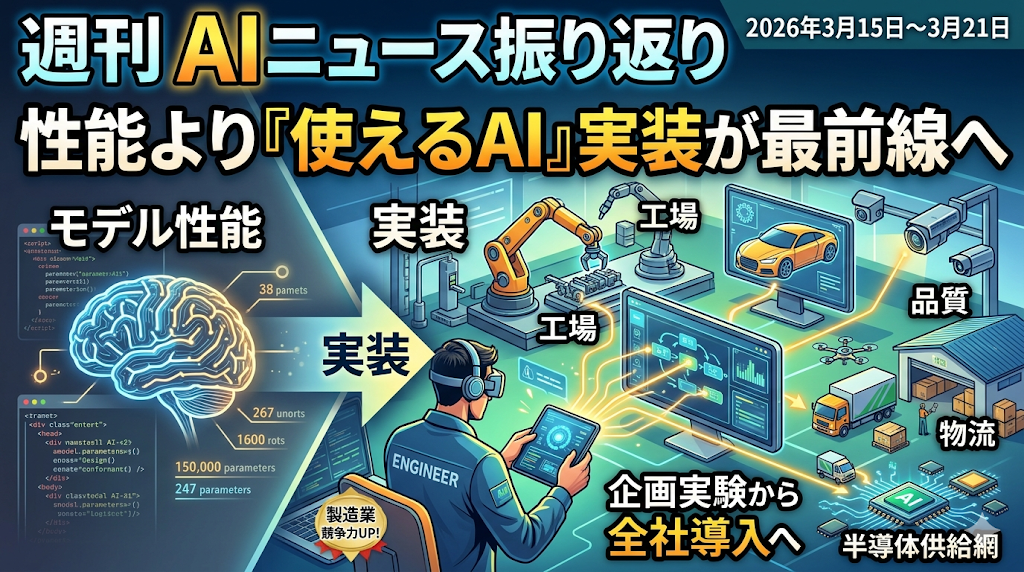
Looking back at AI-related news for March 15 – 21, 2026, this week was less about the “model performance race” itself and more about how AI can be implemented in operations, design, factories, and supply chains. While the evolution of large-scale models continues, when looking at the announcements from various companies side by side, the focus has clearly shifted to “usable AI,” “working AI,” and “AI that goes into the shop floor. For manufacturers in particular, this week’s news clearly shows that the introduction of generative AI has moved beyond the experimental stage of planning and information systems departments and has become an issue of competitiveness for the entire company, including design, quality, maintenance, logistics, and the semiconductor supply network. This article is based on key information that was publicly available at the time of writing during the week covered in this report.
1. NVIDIA collaborates with industrial software giants to fully accelerate AI in design and manufacturing
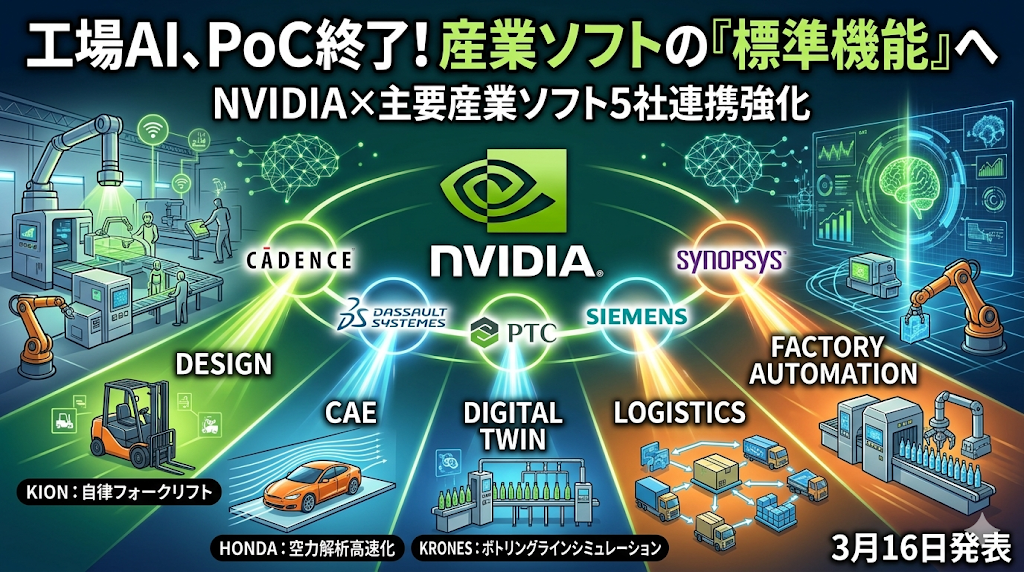
The biggest topic of the week was NVIDIA’s March 16 announcement of enhanced collaboration with Cadence, Dassault Systèmes, PTC, Siemens, and Synopsys. The announcement clearly showed the direction of AI integration into design, CAE, digital twin, semiconductor design, logistics, and factory automation, building on technologies such as CUDA-X, Omniverse, NeMo, and Nemotron; autonomous forklift training from KION; aerodynamic analysis acceleration from Honda, It is important to note that there are already concrete examples of implementation, such as Krones’ high-speed simulation of bottling lines. This is news that should be read as “AI for factories has passed the PoC stage and is starting to become a standard feature of industrial software.
Implications for the drafting industry:
In design drafting, CAD data, CAE results, bills of materials, and process conditions tend to be fragmented. In the future, AI will increasingly reference not only drawing creation, but also the scope of influence of design changes, manufacturability, material flow lines, and equipment constraints in a cross-functional manner. The drafting department may be reevaluated as a hub for product definition, rather than just a drawing output function.
NVIDIA GTC 2026 shows the shift from “Digital AI” to “Physical AI
Key words such as Vera Rubin, IGX Thor, AI Factory, and OpenClaw/NemoClaw lined up throughout GTC 2026, strongly implying that the center of gravity of AI is shifting from chat and search assistance to robotics, industrial edges, and always-on agents. NVIDIA has laid out a worldview that connects factories, distribution centers, robotics, and AI factories through simulation and actual operations, redefining the digital twin as a foundation for learning, verification, and operation, rather than mere visualization. This was a week in which the use of AI in factories shifted from individual camera inspections and demand forecasting to a broader trend toward on-site autonomy.
Implications for the drafting industry:
In the future, it will no longer be sufficient for draftsmen to simply create static drawings; “moving drawings” that include 3D models, layouts, equipment layouts, conveyor routes, and maintenance spaces will become valuable, and drawing data will become input assets for simulation and robot control. Drawing data will become an input asset for simulation and robot control. In other words, drawings will no longer be documents for back-end processes, but the starting point for structured data to support physical AI.
3. OpenAI announces GPT-5.4, AI moves from “reading and writing” to “advancing work” phase.
OpenAI’s GPT-5.4, released on March 20, integrates inference, coding, and agent functionality, with native computer-use capabilities in the API and Codex, and a long context of up to 1 million tokens. Additionally, GPT-5.4 mini / nano, released on March 17, is a fast, low-cost, compact model optimized for classification, extraction, ranking, auxiliary coding and sub-agent use. It is important to note that OpenAI’s emphasis is on “real-world” applications such as spreadsheets, documents, presentations, cross-processing of multiple tools, etc. AI is gradually becoming less of a consultant and more of a processor. OpenAI openai.com
Implications for the drafting industry:
In the drafting department, there are many tasks that cross documents and systems, such as reading specifications, comparing change notices, checking consistency with past drawings, checking design rules, and checking against bills of materials. These peripheral tasks are areas that can easily benefit from agent-type AI such as the GPT-5.4 system. In the future, not only “people who draw drawings” but also “people who can automate processes before and after drawings” will be highly valued.
4. Alibaba andXiaomi accelerate agent competition in China
On March 17, Alibaba announced its “Wukong” AI platform for enterprises, which is oriented toward multiple agents to handle document editing, spreadsheet updating, meeting transcription, research work, and more. Alibaba announced on March 17 its “Wukong” enterprise AI platform. Reuters further reported on the following day (March 18) that the company was cutting its AI business out of the cloud and restructuring it to be more agent-centric. On March 19, Xiaomi also announced that it will invest at least 60 billion yuan in AI over the next three years, clearly stating that it will increase AI competitiveness across its entire device portfolio, including smartphones and EVs.
Implications for the drafting industry:
The Chinese movement indicates that AI is becoming an entity that reorganizes the entire workflow, rather than an addition to the functionality of an application. In the drafting industry, it is necessary to think of the drafting process as a series of workflows, from drafting, approval, revision, quotation linkage, arrangements, and maintenance documentation, and to think of AI as a line rather than a dot. Especially for mid-sized manufacturers, the integration of drawing management and peripheral operations will be a differentiating factor.
5. the main battlefield of AI is not only models, but also semiconductors, electric power, and institutional design
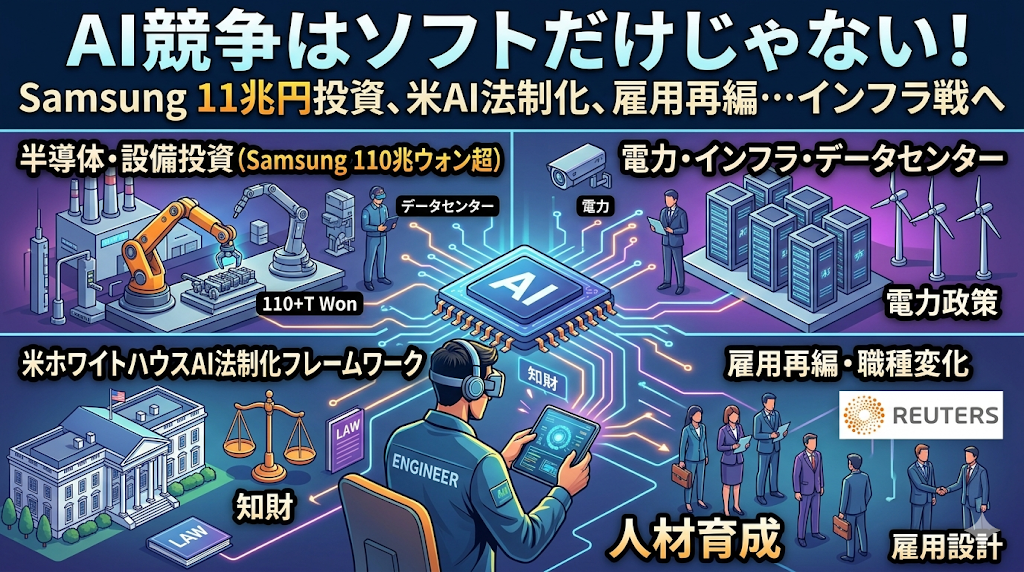
This week also showed once again that the AI race is not complete with software alone: on March 19, Samsung Electronics announced plans to invest over 110 trillion won in R&D and capital expenditures by the end of the year in order to lead the AI semiconductor field. In the U.S., the White House on March 20 released the National AI Legislative Framework, which outlines policy issues such as powering data centers, intellectual property, child protection, promoting AI adoption, and human resource development. In addition, Reuters reports that job restructuring and occupational changes are already surfacing as AI investment grows. In other words, AI is not only a technology trend, but also a capital investment, power policy, human resource strategy, and employment design issue. Reuters White House Reuters Reuters
Implications for the drafting industry:
AI use of drawings and design data will ultimately not expand without the development of computing resources, security, rights handling, and in-house training. If AI is to be used in drafting departments, it is necessary not only to introduce tools, but also to institutionalize which data will be used for learning and reference, how confidential drawings will be protected, and who will have ultimate responsibility. We are entering a phase where the effectiveness of the implementation will be determined more by the skillful design of the operation than by the selection of the technology.
General Considerations for Manufacturing
Synthesizing this week’s AI news from the perspective of the manufacturing industry, the biggest change is not whether to use generative AI or not, but rather which processes, with which data, and to what extent AI is entrusted to become competitive issues. In the design department, the cross-utilization of drawings, specifications, and analysis results; in the quality department, the checking of non-conformance reports and audit documents; in the maintenance department, the integrated reference of equipment history and manuals; and in the logistics department, transportation optimization and warehouse autonomy are beginning to be viewed as a continuous transformation rather than as separate themes. Investor Relations OpenAI
In addition, in the manufacturing industry of the future, it will not be the “company that introduced AI” that wins, but rather the “company that can incorporate AI into its operational design” that will likely win. On-site, there will remain values that cannot be replaced by simple automation, such as tacit knowledge, exception handling, quality culture, and veteran’s intuition. Therefore, the goal should not be total unmanned operation, but rather a division of labor in which AI is entrusted with routine processing and searching, and people concentrate on decision-making and responding to abnormalities. In the manufacturing industry in particular, AI implementation without knowledge of the workplace is likely to fail, whereas companies with knowledge of the workplace and data maintenance will be able to quickly extract the benefits of AI.
In addition, the perspective of the entire supply chain is also important: AI application is affected not only by software implementation, but also by semiconductor supply, power security, computing resources, regulatory compliance, and human resource development. Therefore, manufacturing executives need to discuss AI not only as a topic for the information systems department, but also in conjunction with capital investment plans, design standards, quality assurance systems, and human resource strategies. Reuters Reuters
summary
What emerged through the major AI news from March 15 to March 21, 2026, is the reality that AI is changing from a “convenient generative tool” to an “implementation platform that drives industry”: NVIDIA has sharpened the composition of Physical AI, including factories, logistics, and robotics; OpenAI is advancing agent-based AI for intelligent cross-processing of business operations; and Chinese companies have entered the race for enterprise AI platforms that support the entire workflow. OpenAI is advancing agent-based AI for intelligent cross-processing, and Chinese companies have entered the race for enterprise AI platforms that support the entire workflow. The key for manufacturers is not to view these as mere foreign news, but to translate them into questions about how they can connect to their own design, quality, maintenance, logistics, and procurement. The future of AI will be determined not by the speed at which it is tested, but by the depth at which it is distilled into a form that works in the field.
Source List
- OpenAI – Introducing GPT-5.4
- OpenAI – Introducing GPT-5.4 mini and nano
- NVIDIA Investor Relations – NVIDIA and Global Industrial Software Giants Bring Design, Engineering and Manufacturing Into the AI Era
- NVIDIA Blog – GTC 2026: Live Updates on What’s Next in AI
- Reuters – Jensen Huang wants every company to have an OpenClaw plan
- Reuters – Alibaba launches AI platform for enterprises as agent craze sweeps China
- Reuters – Alibaba’s AI strategy shift comes into focus with big bets on agents
- Reuters – Xiaomi to invest at least $8.7 billion in AI over next three years, CEO says
- Reuters – Samsung Electronics plans over $73 bln investment to lead AI chip sector
- White House – President Donald J. Trump Unveils National AI Legislative Framework
- Reuters – White House releases national AI framework
- Reuters – Companies cutting jobs as investments shift toward AI