

Introduction.
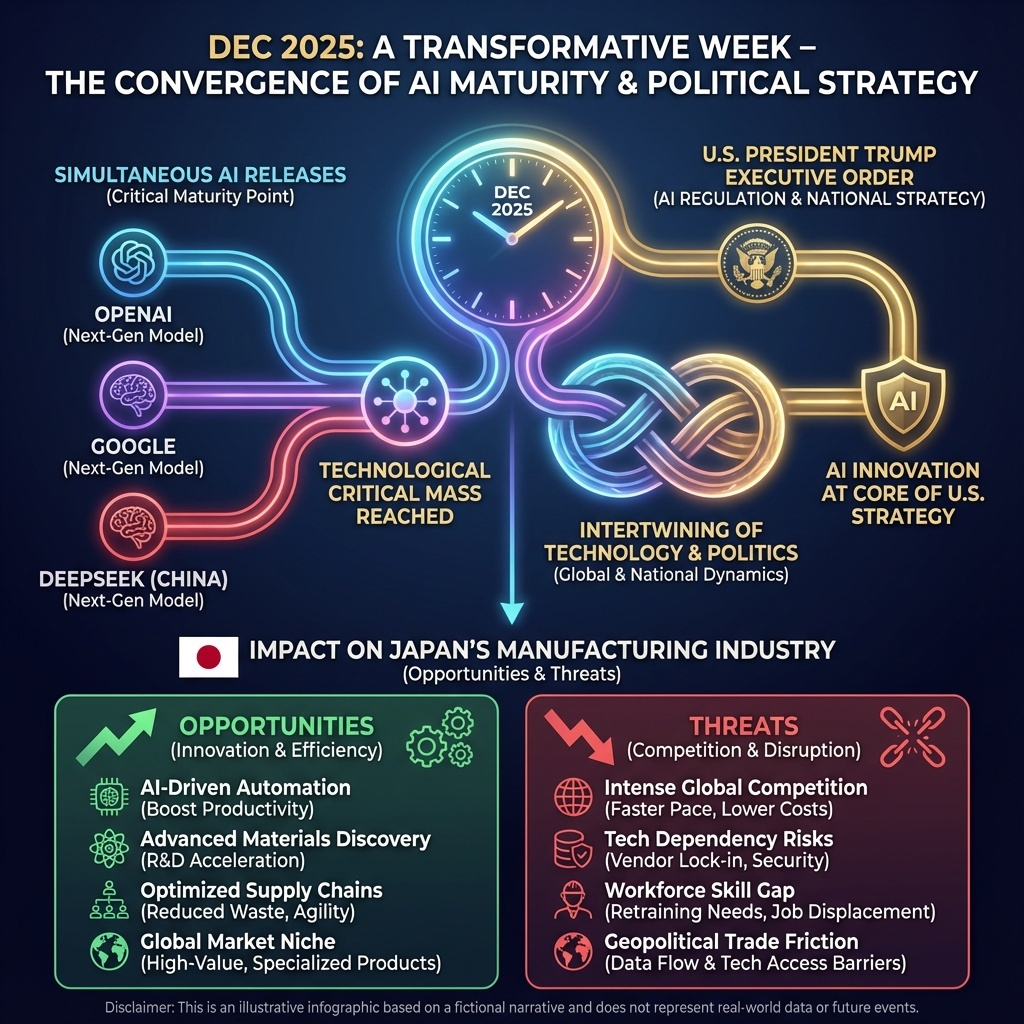
In December 2025, the race to develop AI entered a new dimension: OpenAI, Google, and China’s DeepSeek. This is not a mere coincidence. Furthermore, the signing of an executive order by President Trump on AI regulation confirms that this technological innovation has been placed at the center of the nation’s strategy. We will organize this turbulent week, in which technology and politics are intricately intertwined and accelerating, and take an in-depth look at the new opportunities and threats facing Japan’s manufacturing industry.
1. announcement of OpenAI “GPT-5.2”: the most advanced model specialized for professional work
summary
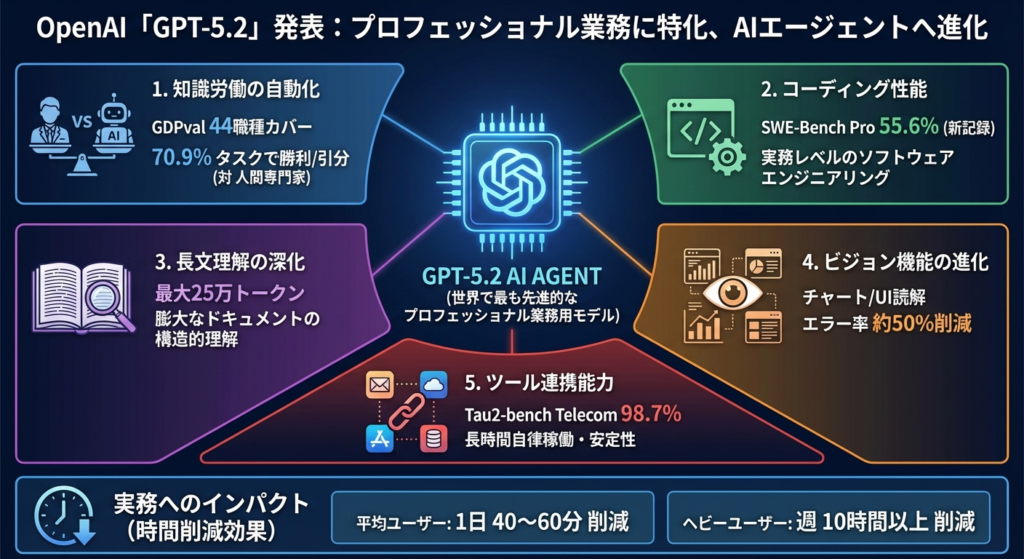
On December 11, OpenAI broke its silence and officially announced GPT-5.2. Defined by CEO Sam Altman as “the world’s most advanced model for professional work,” the model goes beyond chatbots and focuses on the ability to be an “AI agent” that operates autonomously for extended periods of time.
Main Features
GPT-5.2 hits performance indicators that set it apart from previous models.
- Automated knowledge work: covered 44 occupations in the specialized task evaluation (GDPval), recording a win or a draw in 70.9% of tasks compared to human experts.
- Coding performance: A new record of 55.6% in SWE-Bench Pro for working-level software engineering.
- Deeper understanding of long documents: context windows of up to 250,000 tokens allow for structural understanding of large documents.
- Advancements in vision functionality: Reduced reading error rate of complex charts and software UI by approximately 50%.
- Tool integration capability: 98.7% achieved with Tau2-bench Telecom. Demonstrated stability in accurately using external tools even in long and complex processes.
Notably, the impact on practice is significant: ChatGPT Enterprise users report an average reduction of 40-60 minutes per day, and heavy users report a reduction of more than 10 hours per week.
Manufacturing Applications
The characteristics of GPT-5.2 bring the following innovations to the manufacturing workplace
- Advanced Quality Control and Defect Detection
Enhanced vision capabilities complement and replace human visual inspection. It detects with high accuracy minute defects and complex misalignments between parts that were previously overlooked, leading directly to yield improvement. - Dynamic Optimization of Production Planning
With a processing capacity of 250,000 tokens, the system collectively processes a vast array of variables, such as the operating status of multiple plants, supply chain delay information, and market demand fluctuations. It derives optimal production schedules and inventory strategies with accuracy beyond human knowledge. - Automatic generation and multilingualization of technical documents
dramatically reduces the man-hours required to create product manuals, maintenance procedures, quality control reports, etc. Especially for companies with global operations, simultaneous multilingual generation can significantly reduce lead time. - Implementing a predictive maintenance system
Utilizing the tool linkage function, various sensor data, maintenance history, and environmental values are analyzed in an integrated manner. It is possible to build an autonomous system that captures signs of failure and directs planned maintenance before downtime occurs.
2. Google’s “Gemini 3”: A New Frontier in Multimodal Reasoning
summary
Following the announcement of Gemini 3 on November 18, Google introduced an additional inference-specific Gemini 3 Deep Think mode in early December. This rewrote the industry standard in all aspects of reasoning, multimodal comprehension, and coding.
Main Features
- LMArena tops the LMArena rankings: 1501 Elo score and reigns at the top in user ratings.
- Doctoral-level reasoning skills: 91.9% on the difficult benchmark GPQA Diamond and 37.5% on Humanity’s Last Exam.
- Unparalleled multimodal performance: MMMU-Pro (81%) and Video-MMMU (87.6%) outperform others in image and video understanding.
- Deep Think mode: Responds to complex thinking tasks through a deeper reasoning process; 45.1% on ARC-AGI-2.
These features are available in the search engine, Gemini app, and development environment, as well as in the newly established agent development platform, Google Antigravity.
Manufacturing Applications
- Multi-objective optimization of complex designs
The “Deep Think” mode is powerful in resolving trade-offs between conflicting conditions (strength, weight reduction, cost, ease of manufacturing, etc.). The search for optimal solutions that would take a skilled designer weeks to find can be performed and proposed in a short period of time. - Multimodal Data Integration Analysis
Integrated analysis of “unstructured data” (abnormal noise, vibration waveforms, thermographic images, etc.) and numerical data unique to manufacturing sites. It visualizes correlations and abnormal patterns that are impossible to detect with conventional methods. - Real-time management of global supply chains
Leverages the vast context of 1 million tokens to simultaneously monitor contracts, delivery responses, and logistics status from suppliers around the world. Supports risk detection and alternative proposals. - Acceleration of R&D cycle
Cross-sectional analysis of past experimental data, academic papers from around the world, and patent information. AI presents promising hypotheses in the search for new materials and process improvement, dramatically increasing the speed of R&D.
3. DeepSeek “V3.2”: Open Source Forces Strike Back
summary
A stone thrown by China’s DeepSeek in early December shook the industry: the release of DeepSeek-V3.2, with 68.5 billion parameters, under the MIT license. This move has had such an impact that it evokes a “code red” (emergency) for OpenAI, which continues to develop in a closed manner.
Main Features
- Disruptive cost performance: Inference costs $0.28 per million tokens of input and $0.48 per million tokens of output. This is a fraction of the cost of the competition.
- Sparse Attention Technology (DSA): Proprietary algorithm reduces long-text processing costs by 70% compared to conventional methods.
- World-class reasoning skills: gold medal level accuracy in answering International Olympiad-level questions in mathematics and information.
- Open source for commercial use: Few license restrictions, allowing companies to freely customize and use the system for commercial purposes.
Manufacturing Applications
- Democratizing AI in Small and Mid-Size Manufacturing
The arrival of DeepSeek V3.2 has removed the cost barrier. Small and medium-sized companies that have been hesitant to adopt AI because of the lack of return on investment can now incorporate state-of-the-art models into their workflow. - Building your own dedicated AI (on-premise)
Because it is open source, data that cannot be released to the cloud for confidentiality reasons can be learned and operated within your own servers. Dedicated AI” filled with each company’s quality standards and proprietary know-how can be built at a low cost. - Implementation in Edge Computing
Lightweight and efficient architecture is suitable for running on industrial PCs and edge devices in factories. It enables real-time control without communication delays and the use of AI in environments with unstable Internet connections.
4. establishment of the Agent AI Infrastructure (AAIF): movement toward industry standardization
summary
In December, OpenAI, Anthropic, Block, and others joined forces to form the Agentic AI Foundation (AAIF) under the Linux Foundation umbrella. This is a historic effort to create a “common language” for AI agents to talk and collaborate with each other.
Main Contributing Technologies
- Model Context Protocol (MCP): A standard (like USB) that connects AI models to external data sources and tools.
- AGENTS.md: Manifest format definition for AI agents.
- Goose: An agent development framework that runs in the local environment.
Hyperscalers such as AWS, Google, and Microsoft are also participating, and it is expected to become the de facto industry standard.
Manufacturing Applications
- Seamless integration of the manufacturing ecosystem
Connects different vendor systems such as CAD, ERP, and MES (Manufacturing Execution Systems) using standard protocols. Eliminates data silos and enables true automation. - Agent collaboration across the supply chain
We are approaching a future where AI agents on the ordering side and AI agents on the receiving side (suppliers) negotiate directly with each other, automating the coordination from order placement to delivery. - Secure Local Operation
Utilizing the Goose framework, advanced AI agents can be securely operated on a closed network within the plant without elevating extremely sensitive manufacturing data to the cloud.
5. AWS re:Invent 2025: Enhancing Industrial AI Infrastructure
summary
AWS announced the Nova 2 model family and Frontier Agents at re:Invent 2025. It presented a comprehensive stack for implementing agent AI at the industrial level.
Main Presentations
- Nova 2 model range: 4 types (Lite, Pro, Sonic, and Omni) depending on the application.
- Frontier Agents: a group of autonomous agents specialized in development (Kiro), operations (DevOps) and security audits (Security).
- Trainium3 UltraServers: AI chip servers boasting 4.4x the computing performance and 4x the energy efficiency of the previous generation.
Manufacturing Applications
- Factory DevOps/NetOps Automation
DevOps Agent constantly monitors production line systems. It performs everything from abnormality detection to recovery autonomously, minimizing the risk of line stoppages. - Automated ICS Security Audits
Security Agent continuously audits Industrial Control Systems (ICS) and IoT devices for vulnerabilities. AI acts as a shield against the growing risk of cyber attacks. - Dramatic Reduction of AI Inference Costs
Trainium3’s highly efficient computing power can significantly compress the running costs of AI processing, such as image inspection and predictive maintenance, which generate large numbers of transactions.
6. geopolitical trends in AI regulation
President Trump’s AI Executive Order
The National AI Policy Framework Presidential Decree, signed on December 11, aims to unify regulations and protect industries in the United States.
- Unify disparate regulations from state to state at the federal level and reduce compliance costs for companies.
- Permitted to export advanced AI chips (H200) to China, with a 25% tariff.
India Royalty Proposal
On the other hand, the Indian government has proposed a “pay-per-use” model for AI training data. The Indian government, on the other hand, has taken a hard-line stance, refusing to recognize “fair use” and demanding compensation for the use of data.
Impact on manufacturing
- Reduced cost of regulatory compliance (U.S. market)
For companies expanding in the U.S., this eliminates the need for complex state-by-state compliance and increases the predictability of business development. - Risks of Raising China’s Manufacturing Technology Capabilities
The lifting of the ban on H200 chips may accelerate the use of AI in China’s manufacturing facilities. In global competition, strategies must be based on the assumption that Chinese companies will raise the level of their technological capabilities. - Rethinking Data Governance
India’s case suggests that the “free ride on data” may be coming to an end. Global companies will be forced to restructure their AI strategies to accommodate country-specific data sovereignty and copyright laws.
7. accelerating corporate alliances: the last mile to practical application
Accenture x Anthropic Accenture has trained 30,000 employees on the Claude architecture. Our expertise in implementing Claude in highly regulated industries such as finance and healthcare can be directly applied to the rigorous standards of the manufacturing industry.
Snowflake x Anthropic Announces a collaboration to run Claude agents directly within the data environment on Snowflake. This model of using AI without moving data is ideal for security-conscious manufacturers.
8. progress in cutting-edge research: lightening the load and eliminating data shortages
Universal Weight Subspace Hypothesis (UWSH) The discovery that neural networks converge on “low-dimensional subspaces” allows for dramatic compression (up to 100x) of AI models. This promises a future of advanced AI running even on unpowered edge devices in factories.
PretrainZero Technology to learn inference skills from raw text such as Wikipedia without human labeling data. In manufacturing sites, where high-quality data is often in short supply, this technology opens the way to efficiently train AI with unique domain knowledge.
A Comprehensive Study of AI Applications in the Manufacturing Industry
Short-term application (1 to 2 years): thorough efficiency improvement
- Quality Inspection: Establishment of an automated inspection line with ultra-high accuracy, utilizing the “eyes” of GPT-5.2 and Gemini 3.
- Documentation: Shift to value-added work for engineers by automating the creation of technical documents and reports.
- Predictive Maintenance: The first step toward “unstoppable factories” through data integration.
Medium-term outlook (3-5 years): Transformation toward autonomy
- Fully Autonomous Factories: Autonomous systems such as Frontier Agents play a central role in factory operations.
- Completing the Digital Twin: Multimodal AI reproduces events in the physical world in real-time and in high-resolution in virtual space.
- Generative Design: Deep Think mode leads to design solutions that cannot be conceived by humans.
Challenges and Countermeasures in Introduction
- Data Security: Adopt open source (DeepSeek) and on-premise technologies (Goose) in the right places to protect core data.
- Cost management: Do not implement on a large scale out of the blue, but rather run a PoC with an inexpensive model and scale up after determining the ROI.
- Human resource development: Develop engineers on the “user” side of AI through external partnerships and internal reskilling.
- Legacy Integration: Adopt AAIF recommended standard protocols (MCP) to gradually integrate AI with existing systems.
Conclusion.
The second week of December 2025 will be remembered as the decisive moment in which AI has broken out of its “magical experimental technology” and into a “reliable industrial machine. “The new standards set by OpenAI, Google, and DeepSeek have reached a level from which there is no turning back.
For the manufacturing industry, this is not a fire on the other side of the river. AI is beginning to provide practical solutions for quality, production, design, logistics, and all other processes. Standardization efforts, especially by the AAIF, are creating an environment that prevents vendor lock-in and allows systems to be built in any combination.
Meanwhile, geopolitical risks remain. The United States under the Trump administration, India asserting data sovereignty, and China increasing its technological power. What is required of global companies is not only the technological capability to introduce the latest models, but also the “management adaptability” to operate AI successfully in a standardized ecosystem while adapting to the regulations and circumstances in each country.
The “pilot era” is over. Now is the era of implementation and competition.
Source List
- OpenAI. “Introducing GPT-5.2” (December 11, 2025) https://openai.com/index/introducing-gpt-5-2/
- Google Blog. “A new era of intelligence with Gemini 3” (November 18, 2025) https://blog.google/products/gemini/gemini-3 /
- DeepSeek. “DeepSeek-V3.2: Pushing the Frontier of Open Large Language Models” arXiv:2512.02556v1 https://arxiv.org/ html/2512.02556v1
- Block. “Block, Anthropic, and OpenAI Launch the Agentic AI Foundation” (December 2025) https://block.xyz/inside/block- anthropic-and-openai-launch-the-agentic-ai-foundation
- Amazon Web Services. “AWS re:Invent 2025: Amazon announces Nova 2, Trainium3, frontier agents” (December 2025) https:// www.aboutamazon.com/news/aws/aws-re-invent-2025-ai-news-updates
- The White House. “Ensuring a National Policy Framework for Artificial Intelligence – Executive Order” (December 11, 2025). h ttps:// www.whitehouse.gov/presidential-actions/2025/12/eliminating-state-law-obstruction-of-national-artificial-intelligence- policy/
- Erhan K. “State of Artificial Intelligence Report: December 2025” LinkedIn (December 11, 2025) https://www.linkedin.com /pulse/state-artificial-intelligence-report-december-2025-erhan-kaya-mba-bgw5e
- DEV Community. “AI News Roundup – December 07, 2025 ” https://dev.to/edjere_evelynoghenetejir/ai-news-roundup- december-07-2025-1jnn
- Anthropic. “Accenture and Anthropic launch multi-year partnership” (December 2025) https://www.anthropic.com/news/ anthropic-accenture-partnership
- Anthropic. “Snowflake and Anthropic announce $2 million partnership” (December 2025) https://www.anthropic.com/ news/snowflake-anthropic-expanded-partnership
- McKinsey & Company. “The State of AI: Global Survey 2025” (November 5, 2025) https://www.mckinsey.com/capabilities/ quantumblack/our-insights/the-state-of-ai
- Deloitte Insights. “2025 Smart manufacturing survey” (May 1, 2025) https://www.deloitte.com/us/en/insights/industry /manufacturing/2025-smart-manufacturing-survey.html
- Reuters. “OpenAI launches GPT-5.2 after ‘code red’ push to counter Google’s Gemini 3 ” (December 11, 2025) https://www.reuters.com/technology/openai-launches-gpt-52-ai-model-with-improved-capabilities-2025- 12-11/
- TechCrunch. “OpenAI fires back at Google with GPT-5.2 after ‘code red’ memo” (December 11, 2025). h ttps:// techcrunch.com/2025/12/11/openai-fires-back-at-google-with-gpt-5-2-after-code-red-memo/
- Nikkei, “AI Designers Are ‘Person of the Year’ in 2025,” Time Magazine (December 11, 2025) https://www.nikkei.com/article/DGXZQOGN11D2E0R11C25A2000000/