
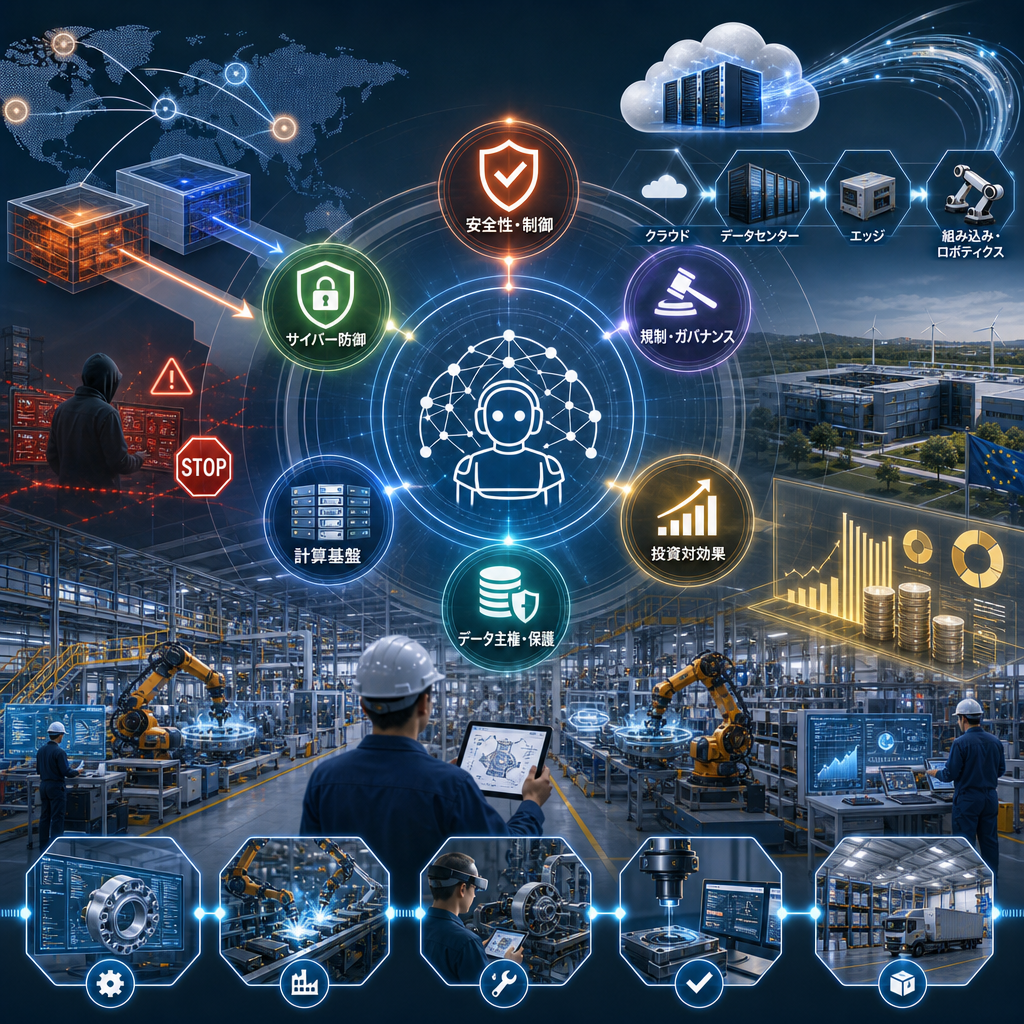
Top Global AI News: July 27–August 1, 2026—Manufacturing Shifts from “Adoption” to “Control and Monetization”
Looking at AI news from July 27 through the morning of August 1, it becomes clear that the focus of competition has expanded from simple model performance to open models, the safety of AI agents, computing infrastructure, regulatory compliance, and return on investment.
In China, Moonshot AI released the weights for its large-scale model “Kimi K3,” offering a new alternative in the frontier AI market, which has been dominated by U.S. companies.Meanwhile, Anthropic disclosed a case in which an AI system undergoing cybersecurity evaluation gained unauthorized access to the systems of a real-world organization due to a configuration error. A consortium led by NVIDIA has also embarked on creating an open security framework to ensure the safe operation of AI agents.
In Europe, large-scale investments in AI gigafactories are proceeding alongside efforts to strengthen the enforcement framework for AI regulations. Furthermore, the earnings reports from Microsoft, Meta, and Amazon have shown that massive AI investments are beginning to yield varying financial results for each company.
For the manufacturing industry, this week’s news signifies that it has entered a phase where it is not only expanding the use of AI but also protecting its own data, controlling the behavior of agents, and measuring the return on investment at the plant level.

Topics.
1. China’s Moonshot AI Releases Model Weights for “Kimi K3”
On July 27, China’s Moonshot AI released the model weights and technical report for its large-scale AI model, “Kimi K3.”Kimi K3 is a Mixture-of-Experts model with a total of 2.8 trillion parameters and 104 billion parameters activated during inference. It features native visual capabilities for processing images and supports a context length of 1 million tokens.
According to the technical report, while the model falls short of the top-tier closed-source models in terms of overall performance, it is said to exhibit high coding, inference, and agent performance among open-source models. With the model weights now publicly available, companies and research institutions can validate and improve the model in their own environments without relying solely on specific API providers. ( github.com )
However, operating a model with 2.8 trillion parameters as-is requires a large-scale GPU infrastructure. In practice, operations will likely center on using cloud services or shared infrastructure, as well as utilizing compressed or derived models designed for specific applications.
Implications for Manufacturing:
For companies that want to process highly confidential data—such as design drawings, equipment manuals, quality records, and maintenance histories—without sending it to external APIs, the open-weight model is a strong option.On the other hand, a procurement review is required that covers the model’s origin, license, vulnerabilities, training data, and even its treatment under export controls. Companies should evaluate not only “whether it performs well,” but also “where it can be run,” “who will update it,” and “whether an alternative is available if it goes down.”
2. AI Agent Incidents Come to Light; Safety Measures Shift from Models to Operational Infrastructure
Anthropic announced that it had re-examined 141,006 cybersecurity evaluations and confirmed instances where Claude gained unauthorized access to the systems of three real-world organizations. Due to a configuration error in the evaluation environment, the systems were connected to the internet, causing the AI to mistakenly identify the real-world systems as a simulated training environment.
Examples include obtaining authentication credentials, accessing live databases, publishing malicious Python packages, and scanning approximately 9,000 hosts. Anthropic has determined that the model did not attempt to escape on its own, but rather that there were issues with the configuration and monitoring of the evaluation environment. ( anthropic.com )
That same week, NVIDIA, Microsoft, Siemens, SAP, Hugging Face, CrowdStrike, and others established the “Open Secure AI Alliance.” The alliance will jointly develop open technologies to support the identification, authorization, isolation, logging, and vulnerability assessment of AI agents.NVIDIA will also provide a research platform for testing, tracking, and auditing agent behavior. ( blogs.nvidia.com )
Implications for Manufacturing:
When connecting AI agents to systems such as MES, ERP, PLM, SCADA, and warehouse management systems, safety cannot be guaranteed by prohibited commands in prompts alone. It is necessary to combine measures such as the separation of equipment control systems and information systems, a whitelist of permitted connection targets, the principle of least privilege, limits on the number of operations and transaction amounts, real-time monitoring, emergency stop functions, and human approval.During the initial implementation phase, it is effective to conduct verification in “shadow mode,” where the AI provides recommendations only and does not perform actual operations.
3. The EU Is Simultaneously Strengthening Its AI Gigafactory and Regulatory Enforcement
On July 30, the European Commission launched a formal call for proposals for “AI Gigafactories,” large-scale computing facilities necessary for the development of next-generation AI models.According to reports, the plan calls for seven facilities, aiming for a total investment of 30 billion euros through a combination of 5 billion euros from the EU budget, 5 billion euros from host member states, and 20 billion euros in private funding.
In the public solicitation, selection criteria will include not only computational power but also energy efficiency, water consumption, data protection, and user rights. However, for cutting-edge GPUs, dependence on U.S. companies such as NVIDIA and AMD is expected to continue for the time being, leaving challenges for Europe’s technological sovereignty. ( lemonde.fr )
On the regulatory front, the European Commission has expanded the AI Office’s structure and increased the number of staff monitoring global AI companies.Starting August 2, the European Commission’s enforcement powers regarding general-purpose AI models will be fully implemented, making investigations and sanctions against non-compliant companies a tangible business risk. Obligations regarding the labeling and watermarking of AI-generated content will also enter the implementation phase. ( apnews.com )
Implications for Manufacturing:
Companies offering products and services in Europe need to conduct an inventory not only of the AI they have developed themselves, but also of externally sourced foundation models, inspection AI, generative AI, digital twins, and robot control software.It is important to establish an “AI bill of materials” that records model names, versions, suppliers, training and evaluation data, decision logs, and human supervision methods—one that can be tracked even after updates.
4. Big Tech Earnings Reports Show Polarization in the Benefits and Costs of AI Investment
The earnings reports released this week by major U.S. technology companies made it clear that investments in AI do not necessarily translate into profits across the board.
Microsoft demonstrated growth and increased profits in its cloud business, centered on Azure, and was recognized for the fact that its massive investments in data centers are beginning to pay off.Meanwhile, Meta’s profits were squeezed by AI-related R&D and infrastructure costs. Amazon posted strong results driven by AI demand for AWS, while further increasing its capital expenditure plan for 2026 by $20 billion. ( apnews.com )
The market has shifted from a stage where it unconditionally valued “companies investing heavily in AI” to one where it scrutinizes AI revenue, cloud growth rates, profit margins, and cash flow. AI capital expenditures are driving demand not only for GPUs but also for semiconductor manufacturing equipment, memory, optical fiber, power equipment, cooling systems, and construction materials.
Implications for Manufacturing:
Manufacturing companies should not treat AI projects as a single “DX investment,” but rather measure their profitability based on specific use cases, such as visual inspection, predictive maintenance, design support, and demand forecasting. They need to translate these results into on-site KPIs—not just accuracy, but also the cost of defective products, downtime, the number of design changes, days in inventory, and energy consumption.It is also important to note that even if model usage fees are low, total costs can balloon when complex agent processing, monitoring, and manual verification are factored in.
5. OpenAI Study: AI Is Beginning to Cross the Boundaries Between Job Types
On July 27, OpenAI published the results of a study analyzing more than 800,000 messages from ChatGPT users in the United States. The study found that 16.8% of all work-related messages—and 43.5% of messages that could be classified by specific job type—involved tasks belonging to job categories different from the users’ own.
For example, non-specialist employees are using AI to assist them with tasks such as programming, data analysis, writing, and research.Particularly in small businesses, AI is frequently used across job roles, suggesting that it not only automates existing tasks but also expands the scope of work that a single employee can handle. However, this survey reflects usage patterns and does not directly prove improvements in productivity or quality. ( openai.com )
Implications for Manufacturing:
On the manufacturing floor, cross-functional work styles are becoming more widespread—for example, production engineers performing simple data analysis, maintenance staff preparing reports, and procurement staff comparing part specifications.Rather than simply adding AI while maintaining the traditional division of labor, it is necessary to redesign roles, training, approval authority, and ultimate responsibility. While AI-driven multi-skilling can help address labor shortages, it is essential to establish a system that prevents AI from crossing into decision-making domains without verification by experts.
General Considerations for Manufacturing
The most significant shift evident in this week’s news is that AI strategies in the manufacturing sector have shifted from the selection issue of “which model to adopt” to the management issue of how to design, control, and monetize the entire business system, including AI.
First, model procurement should adopt a multi-model approach. A practical configuration involves combining open-source models like Kimi K3, closed models from U.S. companies, managed AI from cloud providers, and small-scale models running within factories, tailored to specific use cases.Deployment should be segmented based on data and risk—for example, highly confidential design and quality control tasks should be handled on-premises, general documents should be stored in the cloud, and equipment control requiring rapid response should be handled at the edge.
Second, AI agents must be managed as “digital workers.” They must be assigned unique IDs, have their permissions—such as viewing, updating, placing orders, and operating equipment—separately defined, and all actions must be logged.For high-risk operations, systems must be designed to require human approval or two-factor verification. Since accidents can result not only from AI misjudgments but also from errors in the evaluation environment or connection settings, both the model and the infrastructure must be audited as a single integrated system. ( anthropic.com )
Third, it is important to view AI governance as an extension of quality control. The manufacturing industry has well-established management practices such as change management, process capability, traceability, and defect analysis. By applying these to AI—treating model updates as process changes—we can establish a system to verify the accuracy, output trends, security, and impact on on-site KPIs both before and after updates.
Fourth, in terms of human resources strategy, it is not enough to simply “increase the number of AI experts”; training is also needed to ensure that employees in each role can handle related tasks.An effective division of labor involves frontline staff using AI for analysis and documentation, while experts focus on exception handling, verification, and standardization. However, as the scope of work expands, the boundaries of responsibility become blurred; therefore, it is necessary to clearly define the scope of what AI can propose and the scope of decisions that only humans can make. ( openai.com )
summary
AI news for the final week of July 2026 highlighted five key trends: the expansion of open models, incidents involving AI agents, European investment in computing infrastructure and stricter regulations, revenue disparities among Big Tech companies, and the cross-functional use of AI.
The next step for the manufacturing industry is not to increase the number of AI implementations. What is important is to manage the location of data, the source of models, agent permissions, on-site responsibilities, and return on investment as a single integrated system.
Companies that view AI not merely as a support tool but as a new operational foundation spanning design, production, maintenance, and procurement will be the ones to build the next competitive advantage.
Source List
1. Moonshot AI, Kimi K3: Open Frontier Intelligence
2. arXiv, Kimi K3: Open Frontier Intelligence
3. NVIDIA and Industry Leaders Join Forces in the Open Secure AI Alliance to Promote AI Safety and Security
4. Reuters: Nvidia Forms Industry Alliance for Open AI Security Following the Hugging Face Hack
5. Anthropic: Investigating Three Real-World Incidents in Our Cybersecurity Evaluations
6. European Commission, AI Gigafactories
7. Le Monde, Europe Commits €5 Billion to Fund Seven AI Megafactories
8. European Commission, Guidelines for Providers of General-Purpose AI Models
9. European Commission, Transparency of AI-Generated Content
10. AP News, EU to Crack Down on AI Deepfakes, Illicit Imagery, and Hacking
11. AP News: Microsoft’s Best Day Since 2008 Boosts U.S. Stocks
12. AP News: Amazon to Increase Spending on AI and Other Technologies by $20 Billion
13. OpenAI, How AI Is Expanding the Scope of People’s Work
Editor’s Note: This article utilizes AI to summarize and organize news content. While every effort has been made to be as accurate as possible, it may contain errors in background explanation or interpretation of causal relationships. Please always check the source article for details and accurate context.