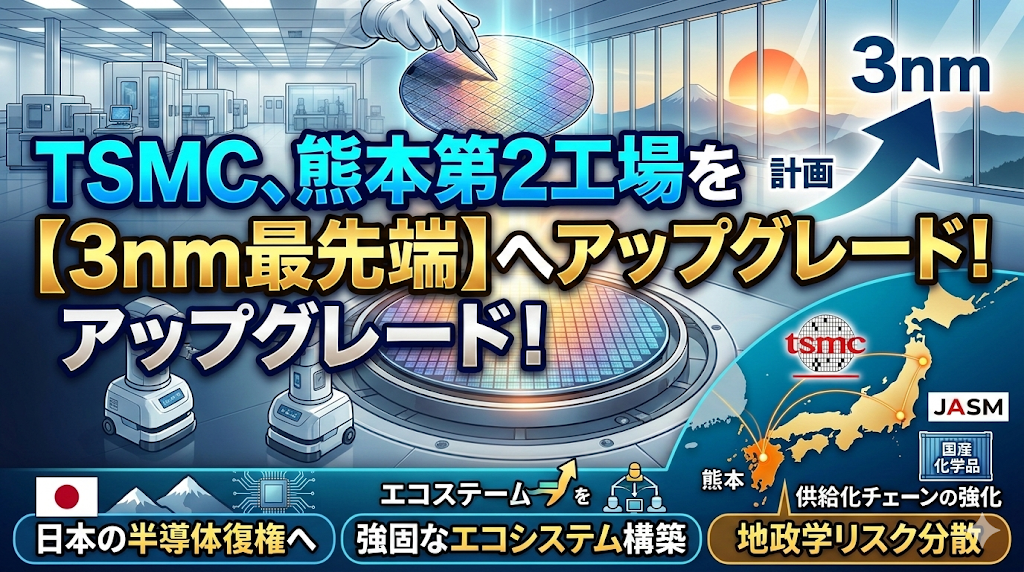
TSMC Upgrades Kumamoto Japan Plant to Cutting-Edge 3nm Process, Strengthening Manufacturing Base in Japan Taiwan’s TSMC, the world’s largest semiconductor foundry, has decided to upgrade its second plant in Kumamoto from its original plan to the cutting-edge 3nm process in order to dramatically increase semiconductor production capacity in Japan. This massive investment plan is expected to boost the company’s global semiconductor production capacity. TSMC has notified the Japanese government of the planned change, and the ability to manufacture state-of-the-art processes in Japan will be a powerful boost to the revival of Japan’s semiconductor industry. TSMC has notified the Japanese government of the change in plans. TSMC is also deepening its technology agreement from Taiwan to Japan, and is building a strong ecosystem by encouraging Japanese suppliers to locally manufacture electrolytic plating additives and other products. This “Kumamoto Master Plan” is attracting global attention not only as a mere expansion of production capacity, but also as a move to diversify geopolitical risks and symbolize the strong technological alliance between Taiwan and Japan.
Japanese Next-Generation Semiconductor Maker Rapidus Successfully Raises $1.7 Billion to Accelerate 2nm Mass Production Plan Rapidus, a Japanese company aiming to domestically manufacture the next generation of advanced logic semiconductors, is strongly advancing its 2-nanometer generation mass production plan through 2027 by raising approximately $1.7 billion in public-private combined funding (about The company has successfully raised approximately $1.7 billion (approximately 267.6 billion yen) in public and private funding to power its plan for mass production of 2-nanometer generation by 2027. Of this amount, 100 billion yen in public support has been received from the Information-Technology Promotion Agency (IPA) and another 167.6 billion yen has been raised from 32 private companies, with Rapidus’ CTO revealing that the company expects to begin production of 2-nanometer generation test chips by the end of 2026, if all goes well. The company is also working on a new chip production facility in the US. The company is also looking to develop processes further beyond the 1.4-nano-generation, retaining half of its engineers at its New York base, backed by a strong technology partnership with IBM of the US. While the Japanese government has put in place an enormous subsidy and support structure, Rapidus is taking on the daunting challenge of starting from scratch, and this latest round of funding means that the company has cleared a very important milestone on the road to mass production. This move is expected to be a major national project to regain Japan’s lost advantage in semiconductor manufacturing and to establish a self-sufficient system for cutting-edge chips essential in the age of AI.
NVIDIA Sets Record Sales, Dispels AI Bubble Fears, While Next-Generation Chip Competition Intensifies NVIDIA, the dominant force in the AI semiconductor market, posted record profits for the fourth quarter of fiscal year 2026, with sales up 73% year over year and an incredible 65% for the full year! NVIDIA is proud to announce that it has achieved record revenue growth of 73% year over year and 65% for the full year! These very strong quarterly results and better-than-expected future guidance from the market have temporarily allayed investors’ whispered fears of an “AI investment bubble.” Meanwhile, the race for AI chips is entering a new phase, with NVIDIA CEO Jensen Huang suggesting that the upcoming GTC 2026 event will feature new surprise chip announcements, integration of silicon photonics technology, and even solutions to power limitation challenges NVIDIA has also indicated that it will present a At the same time, NVIDIA has begun to make serious inroads into areas previously dominated by Intel and AMD, including the sole sale of its Grace server CPU to Meta. However, some in the market remain concerned that expectations are too high, as evidenced by a temporary drop in stock prices, and the future of the battle for supremacy will remain a focus of attention.
Competition between Samsung and SK Hynix to develop and mass-produce next-generation AI memory “HBM4” is in full swing. To dramatically improve memory bandwidth, which is the biggest bottleneck for AI semiconductor performance, the development and mass production competition over the next-generation standard, HBM4 (6th generation broadband memory), is intensifying in South Korea. The competition over the development and mass production of HBM4 (6th generation broadband memory), the next generation standard, is intensifying between the two major memory companies in South Korea. Samsung Electronics was the first in the world to ship its first commercial HBM4, successfully raising its data transfer rate from 11.7 Gbps to 13 Gbps. The company is aiming to regain market leadership by further expanding its investment in HBM4 and quickly responding to strong demand from NVIDIA. Meanwhile, SK Hynix has also developed its own system-level test equipment and plans to ship HBM4 for NVIDIA’s next-generation Vera Rubin chip this month, while further deepening cooperation with TSMC. NVIDIA is adopting a phased HBM4 supply strategy to spread the supply risk and is sourcing from both companies. In order to survive the fierce development competition, companies are offering unbeatable salaries to their best engineers, and the race for talent is becoming an industry-wide battle.
Rummageddon” due to exploding AI demand, severe memory shortages and price spikes hit the hardware market The rapid growth in global demand for AI servers has put extreme pressure on general-purpose memory production capacity, causing DRAM and NAND flash memory prices to skyrocket in parabolic fashion, a serious “Rummageddon” This memory shortage and soaring costs are causing a serious situation known as “Rummageddon”. This memory shortage and soaring costs are having far-reaching ripple effects throughout the electronics industry. For example, even Apple, with its powerful purchasing power, has been forced to change its contractual structure to a quarterly basis, agreeing to double the price of NAND procurement from Keoxia in order to ensure a stable supply. It was also reported that the launch of Sony’s next-generation PlayStation 6 game console may be delayed until after 2028 due to soaring memory costs, while Valve’s Steam Deck is out of stock and major PC makers have been forced to raise product prices. According to some estimates, DRAM prices could jump nearly fourfold by mid-2026, and component inflation triggered by special demand for AI is fundamentally shaking the price structure of all hardware.
U. S. Department of Defense Removes Chinese Memory Giants YMTC and CXMT from Blacklist, New Ripple in U.S.-China Friction The U.S. Department of Defense has updated its list designating Chinese military-related companies, removing Chinese memory giants YMTC and CXMT from the list. Meanwhile, it has added Alibaba, Baidu, and BYD to the list, increasing its vigilance against AI and self-driving tech giants. The unexpected removal of the two memory giants from the list is widely viewed as a pragmatic bailout to make it easier for U.S. OEMs to access inexpensive Chinese memory against the backdrop of an escalating global memory shortage. CXMT, for example, which has been rapidly expanding its production capacity despite yield challenges, hopes to use this deregulation as an opportunity to expand its share of the global market. However, this short-term lifting of the blacklist is in part inconsistent with the overall policy direction of the U.S. hard-line stance toward China, and could become a new source of friction in future trade negotiations. Global high-tech companies are under pressure to restructure their supply chains while being buffeted by policy uncertainty.
U.S. and Taiwan Sign New Trade Agreement, Significantly Reducing Tariff Risks for Semiconductor Supply Chain The United States and Taiwan have agreed to a new trade and tariff agreement that will have a significant impact on the global high-tech supply chain. The agreement will reduce reciprocal tariffs between the two countries from 20% to 15%. The agreement will serve as an “effective tariff truce” for Taiwan’s semiconductor industry amid concerns about the high tariff policies and hard-line trade measures being pursued by the United States. The Taiwanese government has welcomed the 15% tariff rate as setting a ceiling on risk in the worst-case scenario, and in exchange Taiwan has committed to purchase crude oil, energy-related products, and other goods from the United States to the tune of about 13 trillion yen. In addition, the agreement coincides with the U.S. Supreme Court ruling that the administration’s non-discriminatory reciprocal tariff policy is illegal, a major relief to U.S.-dependent Asian allies and exporters. The agreement further solidifies Taiwan’s position as a major supplier of electronic components and semiconductors to the United States and provides an important framework for maintaining economic resilience between the two countries.
SoftBank G to Invest an Additional 4.6 Trillion Yen in OpenAI to Lead Global AI Infrastructure Competition The SoftBank Group has decided to invest an unprecedented additional 4.6 trillion yen in OpenAI, the world leader in generative AI. The two companies already have a strategic partnership, but this massive investment will decisively solidify their ties in the development of next-generation foundational models for the realization of general-purpose artificial intelligence and the creation of AI infrastructure to support vast computational resources. This is a symbolic move in the “AI all bets” strategy, which aims to establish itself as a core player in the battle for the AI market waged by giant tech companies such as NVIDIA, Microsoft, and Google, leveraging its overwhelming financial strength. In conjunction with this, SOFTBANK’s semiconductor memory subsidiary is collaborating with Intel to commercialize a new AI memory, and is also moving forward with the verification of AI model control using CPUs, thereby going beyond mere funding and rapidly forming its own AI ecosystem.
ASML Increases Output Power of Next-Generation EUV Lithography System to 1000W, Dramatically Improving Semiconductor Manufacturing Yield and Efficiency ASML, the Netherlands’ exclusive supplier of exposure systems essential for cutting-edge semiconductor manufacturing, has exceeded its previous limits to increase the light source output of its extreme ultraviolet (EUV) exposure systems to 1000W with a revolutionary new ASML has developed and demonstrated a revolutionary new technology that raises the light source output of extreme ultraviolet (EUV) lithography equipment beyond the conventional limit to 1000W. ASML expects this technology to increase global production of advanced chips by up to 50% by 2030. ASML expects this technology to increase global production of advanced chips by up to 50% by 2030. ASML’s technological breakthrough is a fundamental technology that will enable high-volume production of AI chips and next-generation processors, and will strongly advance the semiconductor industry’s overall roadmap. ASML’s technological breakthrough is a game changer that will powerfully advance the roadmap for the semiconductor industry as a fundamental technology enabling the mass production of AI chips and next-generation processors.
Rising Costs Spark Rush of Price Increases in Power Semiconductor Market, Accelerating Technology Migration to SiC and GaN An unprecedented rush of price increases is underway in the power semiconductor market, which is essential for electric vehicles, power management in AI data centers, and industrial infrastructure, with industry leaders such as Infineon Following in the footsteps of industry leaders such as Infineon’s decision to raise prices starting in April 2026, a number of Chinese power semiconductor manufacturers have simultaneously announced product price increases of at least 10% or more starting in March. This is due to structural factors such as rising maintenance costs for old 8-inch wafer fabs and soaring raw material prices, in addition to tight production capacity caused by strong downstream demand. While this upward cost pressure is driving industry-wide restructuring, companies are rushing to transition to more efficient and profitable next-generation materials. Bosch, a major component manufacturer, has announced that it aims to commercialize SiC (silicon carbide) power semiconductors and vertical GaN (gallium nitride) devices with a unique new structure by 2031. Japanese company ROHM has also signed a technology license agreement with TSMC to establish an integrated production system for GaN power semiconductors, and other moves are underway with an eye toward the next generation.