

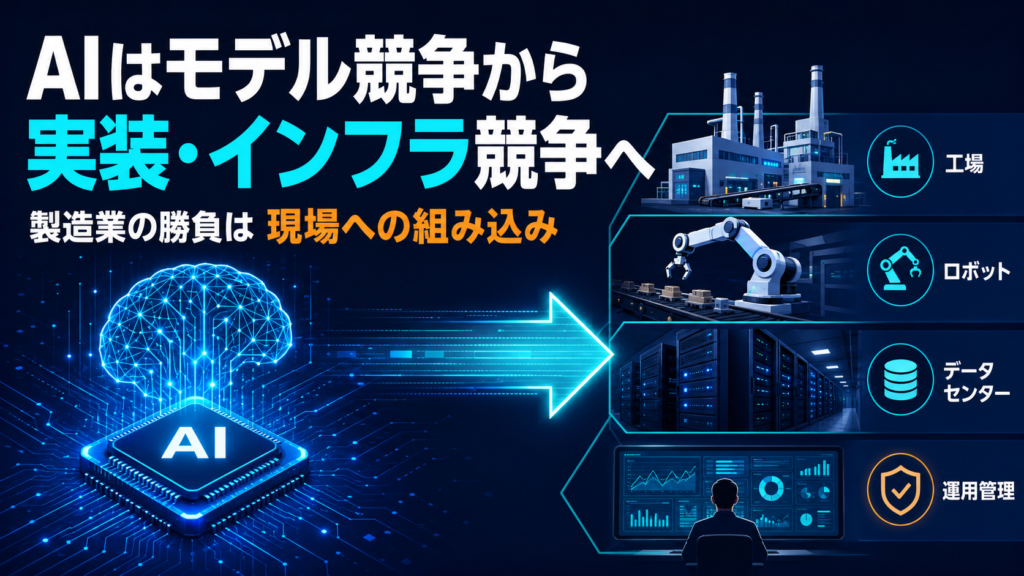
In the latter half of last week, with the opening of the World Artificial Intelligence Conference (WAIC) in Shanghai and the launch of Google Gemini 3.5 Pro on July 17, the trend in the AI industry toward shifting its focus from “model competition” to “ecosystem competition” became even more pronounced.At the same time, this was a week marked by a series of developments that are shaking up the very foundations of manufacturing design—including the launch of the “Physical AI Initiative” by NVIDIA and the Japanese government, the application of agents to semiconductor design by Intel and Google Cloud, and South Korea’s $880 billion national investment in AI.In this article, we will summarize the five major topics from this period and examine how each will impact Japan’s manufacturing sector.
Topic 1: NVIDIA and the Japanese Government Launch the “Physical AI Initiative”; FANUC, Yaskawa Electric, and Kawasaki Heavy Industries Also Participate
On July 15, NVIDIA CEO Jensen Huang and Minister of Economy, Trade and Industry Akazawa took the stage in Tokyo to officially launch the government-led “Physical AI Initiative.”The initiative aims to develop open, multimodal foundation models for AI agents, digital twins, and robotics using Japanese industrial data, with FANUC, Yaskawa Electric, Kawasaki Heavy Industries, and Fujitsu listed as implementation partners.At the same time, it was announced that Mizuho Financial Group has begun operating one of the financial industry’s largest on-premises AI factories (based on NVIDIA DGX B200), while RIKEN has started operations of its new supercomputer “RIKYU,” consisting of 1,600 Blackwell GPUs.Toyota is also expanding its collaboration on factory simulations using NVIDIA DRIVE AGX and Omniverse. NVIDIA Blog
Implications for the Manufacturing Industry: The establishment of a national policy framework—the first of its kind—enabling major Japanese manufacturers to align their efforts through a “common foundation model” is of great significance. This development has the potential to effectively distribute across the entire industry the training costs associated with on-site data (vibration, visual, and force data) that each company previously bore individually.For mid-sized and small manufacturers, a viable path has emerged: they can build digital twins on Omniverse and fine-tune and implement the common foundation model without having to train their own large language models (LLMs). The starting point for considering implementation will likely be determining “which process data to contribute to the shared pool and at what level of granularity.”
Topic 2: Google to Launch “Gemini 3.5 Pro” on July 17; Capable of Analyzing Entire Technical Documents Using a 2 Million-Token Context
Google DeepMind’s new flagship model, “Gemini 3.5 Pro ”—which had been delayed for quite some time—became generally available on July 17, the same day as the Shanghai WAIC.Key features include a 2-million-token context window (equivalent to about 30 novels), a new inference mode called “Deep Think” for the paid “Ultra” plan, and competitive pricing at approximately $1.25 per 1 million tokens for API input.On the same day, Google Cloud also announced the enterprise rollout of “Gemini Enterprise Agents,” highlighting the ability to build agent-oriented workflows. Build Fast with AI | Unrot.co
Implications for the Manufacturing Industry: A context length of 2 million tokens brings the operational mode of “batch-loading design specifications, bills of materials, work instructions, and failure histories ” into practical use for the first time in the manufacturing industry.It will now be possible to feed long technical documents—which previously had to be split and summarized using RAG (Retrieval-Augmented Generation)—into the model in their entirety for cross-document analysis.This is particularly valuable for tasks where cross-document analysis is essential—such as plant maintenance, mold design, and recall root cause analysis. An effective first step would be to narrow down the scope of the PoC and develop prompt design templates based on the assumption of a 2 million token input.
Topic 3: Intel and Google Cloud Begin Full-Scale Deployment of Agent-Based AI in Semiconductor Design
On July 16, Intel and Google Cloud announced that they were expanding their existing strategic partnership to integrate Gemini Enterprise and Google Cloud infrastructure into Intel’s company-wide AI transformation.There are two main objectives. The first is to deploy line-of-business (LOB) agents across engineering, supply chain, and corporate departments using the Gemini Enterprise Agent Platform.The second is to elastically scale on-premises HPC capacity using Google Cloud C4/N4 instances to accelerate the silicon design cycle itself with agents. Initial pilots for coding assistance and multi-channel content generation are already underway. Intel Newsroom
Implications for the Manufacturing Industry: This is a landmark case for R&D departments in the manufacturing sector. The trend of the semiconductor industry—often described as “the manufacturing sector with the most complex processes”—entrusting its design processes to AI agents is a sign that this shift will spread to the machinery, electrical equipment, and chemical sectors.Within Japan’s manufacturing sector as well, the adoption of agents for engineering-related tasks —such as CAD/CAE, simulation, procurement, and quality documentation—is expected to advance rapidly over the next two to three quarters. The key to successful implementation lies in designing a governance framework based on the premise of a “chain of agents spanning multiple processes,” rather than a “one-off copilot.”
Topic 4: South Korea to Invest $880 Billion in AI Over 10 Years; Aims for 20% Share in Semiconductor Factories and Humanoid Robots
On July 15, South Korean President Lee Jae-myung announced a 10-year national AI plan totaling approximately 1,350 trillion won (about $880 billion). The breakdown includes approximately $518 billion for memory semiconductor factories operated by Samsung and SK Hynix,approximately $550 billion for AI data centers, securing 8.4 GW of power for data centers by 2029, and specific targets to increase South Korea’s global market share of humanoid robots from the current 1% to 20% by 2028.During the same period, Taiwan’s TSMC reported record-high quarterly revenue (NT$1.27 trillion, approximately $39.6 billion), confirming the materialization of demand for AI chips.China’s Unitree has also received approval for a $619 million IPO on the Shanghai STAR Market, and competition in the East Asian manufacturing equipment sector is heating up rapidly. Unrot.co (July 15) | Build Fast with AI
Implications for the Manufacturing Industry: Competitiveness in manufacturing in the AI era is increasingly determined by a nation’s ability to secure the three key elements: GPU supply, power, and humanoid robot manufacturing.Japan’s manufacturing sector needs to re-examine its strategy from three perspectives: (1) reaffirming its position in the value chain as a supplier of humanoid robot components (gearboxes, force sensors, motors); (2) identifying business opportunities arising from the demand for power equipment, cooling systems, and wiring associated with the construction of AI data centers;(3) the need to adjust the timing of equipment exports to align with the capital investment cycles of China and South Korea.
Topic 5: At the Shanghai WAIC, President Xi Jinping Unveils the “International AI Cooperation Organization” Initiative; Boston Dynamics’ “Spot” Equipped with Gemini Robotics Technology
At the World Artificial Intelligence Conference (WAIC) , which opened in Shanghai on July 17, Chinese President Xi Jinping proposed the establishment of an “International AI Cooperation Organization” in his keynote address, declaring his intention to promote open AI access , including in developing countries. Against the backdrop of China’s open weight models (DeepSeek V4, Kimi K2.6, GLM-5, Qwen 3.5) rapidly closing the performance gap with US proprietary models, Goldman Sachs has issued an unusual report recommending its clients evaluate and adopt Chinese open models. In the field of industrial robotics, Boston Dynamics, in collaboration with Google DeepMind, has integrated ” Gemini Robotics-ER 1.6 ” into its quadruped robot “Spot,” improving its practicality in factory inspection tasks involving spatial reasoning. Reuters | Build Fast with AI
Implications for the Manufacturing Industry: We have now fully entered an era where a model’s “nationality” influences procurement decisions. Going forward, a practical solution for Japan’s manufacturing sector will be to adopt a multi-model strategy —one that allows for switching between U.S., Chinese, and European LLMs based on specific use cases—for the LLMs used in-house.At the same time, the trend of foundational models —such as Gemini Robotics-ER— being integrated into the robot control hierarchy will bring about structural changes to the business models of existing industrial robot system integrators (SIers).This marks a turning point where the very method of skill transfer is being redefined—shifting from “PLC + robot programming” to “foundational model + natural language instructions + simulation training.”
A Comprehensive Look at the Manufacturing Industry: An Overview of Four Trends
Looking at the news from the past week as a whole, the impact on the manufacturing industry can be summarized by the following four trends.
First, “national sharing of foundational models.” Japan’s public-private Physical AI Initiative, South Korea’s $880 billion plan, and China’s open-weight model strategy all represent moves to position “models as national assets.”The competition among individual companies to train foundational models has effectively come to an end, and the practices surrounding fine-tuning and data provision on shared platforms will become the watershed for competitiveness.
Second, “the practical implementation of Physical AI (AI in the physical world).” Following the “99% correlation between simulation and actual hardware” (RobotStudio HyperReality) achieved by ABB and NVIDIA in March, Gemini Robotics was integrated into Boston Dynamics’ Spot in July. ABB claims this reduces setup and commissioning time by up to 80% and cuts costs by up to 40 %. For mid-sized manufacturers engaged in high-mix, low-volume production in particular, this represents a disruptive factor that effectively shortens the payback period for robot investments. Medium (technologai)
Third, “the reorganization of engineering operations through agents.” We are seeing a steady stream of organizations forming “specialist teams dedicated to embedding AI into enterprises,” such as the Intel×Google Cloud semiconductor design agent, Anthropic’s “Ode” (an enterprise deployment company established in partnership with Blackstone and Hellman & Friedman), and OpenAI’s acquisition of Northslope.Going forward, the “ability to break down business processes into agent-compatible units” will become a greater bottleneck than model selection, and the gap between companies that can develop this design capability in-house and those that outsource it is likely to widen.
Fourth, “The Emergence of AI Safety Disparities.” According to the 2026 AI Safety Index released by the Future of Life Institute on July 15, even Anthropic—which received the highest rating—scored only a C+, while xAI, DeepSeek, and Mistral effectively failed.As the manufacturing industry adopts AI for embedded applications (in-vehicle systems, medical devices, and industrial equipment), the trend of incorporating “vendor safety scores” into procurement criteria is likely to spread in the near future, in step with the implementation of the EU’s AI Act.
summary
What has become clear through this series of announcements is that the main battleground for AI has shifted from “the smartest model” to “the ecosystem most deeply embedded in the field.” Of particular note for Japan’s manufacturing sector is: (1) securing access to a common foundation model by participating in government-led physical AI initiatives;(2) launching a pilot program for cross-document analysis of technical documents using Gemini 3.5 Pro’s 2 million-token context, (3) establishing governance frameworks for multi-vendor, multinational model operations, and (4) realigning supply chains in response to the integration of AI into humanoid and industrial robots.Starting next week, we expect further announcements related to the manufacturing sector, including Anthropic’s October IPO, the scheduled release of DeepSeek’s next-generation model (July 24), and a report on the full-scale operation of the Siemens-NVIDIA Erlangen electronics plant. We will continue to monitor these developments closely.
Source List
- NVIDIA Blog — *NVIDIA and Japan Bring Full-Stack AI and Robotics to Industry, Science, and Society*
https://blogs.nvidia.com/blog/japan-ecosystem-2026/
- Intel Newsroom — *Intel and Google Cloud Announce Collaboration to Accelerate Intel’s AI-Enabled Enterprise Transformation (July 16, 2026)*
- Reuters — *Xi positions China as the leader of a new global AI order, challenging U.S. dominance (July 17, 2026)*
- Reuters — *Apple Overtakes Nvidia to Become the World’s Most Valuable Company as AI Trends Shift (July 17, 2026)*
https://www.reuters.com/business/apple-closes-nvidia-race-worlds-most-valuable-company-2026-07-17/
- Reuters — *AI startup Thinking Machines launches an open-weight AI model (July 15, 2026)*
- Build Fast with AI — *AI News Today, July 13, 2026: The 15 Biggest Stories*
https://www.buildfastwithai.com/blogs/ai-news-today-july-13-2026
- Build Fast with AI — *AI News Today, July 14, 2026: The 15 Biggest Stories*
https://www.buildfastwithai.com/blogs/ai-news-today-july-14-2026
- Unrot.co — *Top 10 AI News, July 13, 2026*
https://unrot.co/blogs/today-top-10-ai-news-july-13-2026
- Unrot.co — *Top 10 AI News, July 15, 2026: AI Labs Get Graded*
https://unrot.co/blogs/today-top-10-ai-news-july-15-2026
- LinkedIn (Simran Sran) — *AI News of the Day – July 16, 2026*
https://www.linkedin.com/pulse/ai-news-day-july-16-2026-simran-sran-tqcvc
- Medium (Neural Notes / TechnologAI) — *The Rise of AI-Powered Robotics: How 2026 Is Reshaping Manufacturing and Automation*
- InfoWorld — *Thinking Machines Lab Offers Enterprises a U.S. Alternative in Open-Source AI*
- NVIDIA News — *Siemens and NVIDIA Expand Partnership to Build the Industrial AI Operating System*
Editor’s Note: This article utilizes AI to summarize and organize news content. While every effort has been made to be as accurate as possible, it may contain errors in background explanation or interpretation of causal relationships. Please always check the source article for details and accurate context.
Looking back at this week’s AI trends, we can see that the focus of the discussion is beginning to shift from “how to use AI” to “what to feed to AI.”
In the free “Extended Brain” introductory seminar, we’ll spend 90 minutes exploring the question of “What should we feed to AI?”—specifically, the methodology for transferring the judgment of experienced professionals to AI.
📅 Wednesday, July 29, 8:00–9:30 p.m. Online (Zoom) • Free admission