
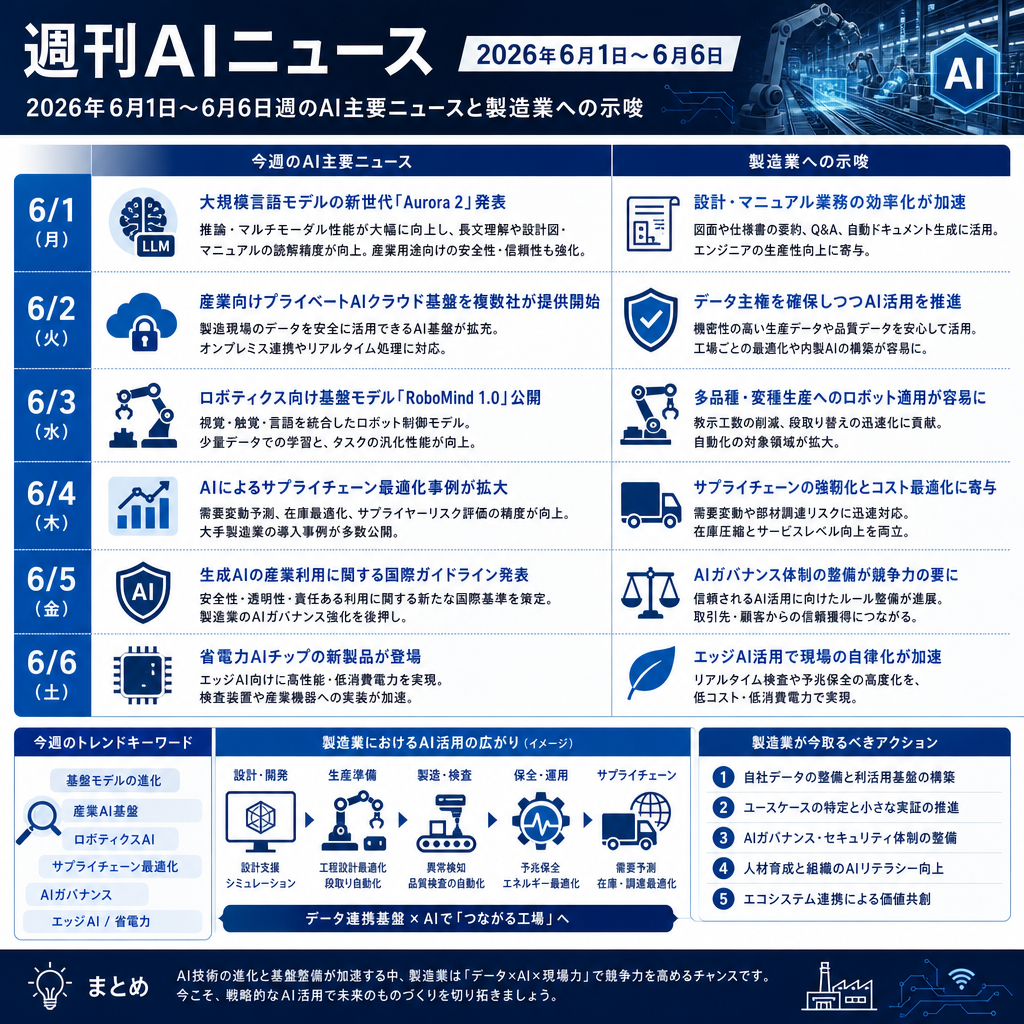
Early June 2026 marked a tumultuous week in the AI industry, with a series of historic milestones: a tectonic shift in the capital markets with Anthropic’s IPO filing, NVIDIA’s entry into the PC market to launch “edge AI” in earnest, Microsoft’s simultaneous launch of seven of its models, and even Siemens’ announcement of its industrial AI orchestration platform, and even Siemens’ announcement of an industrial AI orchestration platform. These developments are more than just tech industry news; they have redefined the manufacturing workplace, the supply chain, and the “human-machine collaboration model” itself. In this article, we summarize the five key topics announced between June 1 and June 6, and examine the practical implications of each for Japan’s manufacturing industry.
Anthropic Files for Secret IPO – Valuation to $965 Billion; Capital Market Era of AI Industry Begins in Earnest
On June 1, 2026, Anthropic, the developer of Claude, announced that it has filed confidential S-1 documents with the U.S. Securities and Exchange Commission (SEC) for its initial public offering (IPO). The company raised $65 billion in a Series H round just days ago, bringing its valuation to $965 billion. The annual sales run rate reportedly reached approximately $30 billion as of April 2026, surpassing OpenAI (approximately $25 billion as of February of the same year). On the same day, Alphabet also announced a total of $80 billion in funding, including a $30 billion equity issuance ($10 billion of which was a third-party allocation to Berkshire Hathaway), spurring the race to expand AI infrastructure. In addition, OpenAI has broken its Microsoft Azure exclusivity and is now offering its GPT model and Codex on AWS.
Implications for the manufacturing industry: The shift of the capital structure of AI infrastructure model providers to the public market will improve long-term price stability and service continuity. Manufacturing companies have been hesitant to adopt AI on a large scale due to the “start-up risk” of AI vendors, but the financial transparency and governance enhancements of going public will make it feasible to incorporate AI into production lines, quality management, and supply chain optimization at the mission-critical system level. In addition, OpenAI’s multi-cloud deployment will enable major Japanese manufacturing companies that use both Azure and AWS environments to choose the most appropriate model while avoiding vendor lock-in.
NVIDIA Announces RTX Spark – PC to Become “24/7 Base of Operations” for AI Agents
On June 1, NVIDIA announced the RTX Spark (code name N1X), a system-on-chip (SoC) for PCs, at the Computex 2026 keynote in Taipei. Developed in collaboration with MediaTek of Taiwan, this chip integrates a Blackwell architecture GPU with an Arm-based CPU, and uses “integrated memory” where the CPU and GPU access the same memory. This will enable large-scale AI models to run in a local environment without relying on the cloud. compatible PCs from Microsoft, Dell, HP, ASUS, Lenovo, and MSI are scheduled to be available from fall 2026 onward. stock prices of AMD, Intel, and Qualcomm fell immediately after the announcement, NVIDIA gained over 6% to reach a market cap of $5.4 trillion, with CEO Jensen Huang saying “this is the biggest reinvention since the birth of the smartphone” and declaring a new era in which PCs will run AI agents 24 hours a day CNBC. on the same day, 550B parameters (55B active) open-weight MoE model, the Nemotron 3 Ultra, was also announced, setting a new standard for frontier models from the US.
Implications for Manufacturing: The full-scale implementation of edge AI will simultaneously solve the challenges of “data sovereignty” and “real-time performance” on the manufacturing floor. AI agents will be able to run constantly on PCs and workstations in the field without sending confidential data such as drawing information, quality data, and inspection images to the cloud. Designers can interactively review confidential drawings locally, quality controllers can analyze inspection images in real time, and maintenance personnel can operate agents that monitor equipment logs 24 hours a day “without the worry of meter charges (pay-as-you-go). This is an extremely important option for Japanese manufacturers who want to enjoy the benefits of generative AI while reducing the risk of information leakage.
Microsoft Build 2026 – Launch of 7 in-house models at once, declaration of transformation into a “Frontier Participating Company
At Microsoft Build 2026, held June 2-3 in San Francisco, Mustafa Suleyman, CEO of the company’s AI division, announced the MAI Family, a family of seven in-house developed AI models. The flagship, MAI-Thinking-1, is the first inference model with 35 billion parameters (active) and a context length of 256,000 tokens, and features full-scratch learning from commercially licensed clean data with no distillation from third-party systems. A version tuned for McKinsey outperforms OpenAI’s GPT-5.5 in quality and is reported to be 10 times more cost-effective. The code generation model, MAI-Code-1-Flash, has also begun deployment via GitHub Copilot and Visual Studio Code, with CEO Satya Nadella stating that “the time has come for all companies to move from being consumers of frontier models to fully participating in the frontier.” At the same time, Euronews announced a 1,000x improvement in the reliability of its Majorana 2 quantum chip, paving the way for commercial quantum computing in 2029.
Implications for Manufacturing: Microsoft’s strategic shift from “single vendor dependence” to “strategic combination of multiple models” is also encouraging manufacturers. 256K context length in MAI-Thinking-1 means the ability to process long documents unique to manufacturing, such as complex specifications, lengthy FMEA documents, and complete sets of equipment manuals, all at once. complex specifications, lengthy FMEA documents, and complete equipment manuals. If the claim of 10X cost efficiency is true, it will begin to make economic sense to deploy AI in small and medium-sized plants and line units that have been put off by budget constraints. The Japanese manufacturing industry, which is already using Azure, has an opportunity to incorporate the latest AI capabilities while maintaining compatibility with existing IT assets.
Siemens “Intelligence Center X” Announced – Industrial AI Agents Become Standard Workers in the Field
On June 1 in Detroit, Siemens unveiled Intelligence Center X, its industrial AI orchestration software. This is the foundation for integrating industrial shop floor personnel and AI agents as a “hybrid workforce,” a full-fledged production-ready platform that integrates Mendix (low code), Graph Studio, and Rapidminer-derived AI Studio. Already in use, Brazilian flat glass giant Vivix Vidros Planos has successfully created a “virtual engineer” using Amazon Bedrock and Claude, reducing production issue resolution time by 85%, eliminating 6,000 hours of manual labor per year, and reducing customer complaint response time from 5 days to less than 1 day. customer complaints from 5 days to less than 1 day. Axiz in South Africa achieved a 95% reduction in manual work and 100% data capture accuracy** in pricing operations PR Newswire. and is positioned as a “governed agent execution environment” that integrates enterprise data and industrial ontologies.
Implications for the Manufacturing Industry: Intelligence Center X is a direct answer to the “proof-of-concept (PoC) stop problem,” which is the biggest barrier to implementing manufacturing AI. Many Japanese manufacturers have been piloting generative AI for the past three years, but in the majority of cases, they have failed to reach full scale. The causes are data fragmentation, governance inconsistencies, and the disconnect between AI insights and actual business workflows. By providing IT-OT data integration, human-mediated workflows, and a complete audit trail on a single platform, the platform paves the way for deploying AI agents as an “embedded workforce” in core operations such as quality trouble-shooting, equipment maintenance, supply chain anomaly detection, and site improvement activities. The company’s AI agents are also used in the following areas. In particular, multi-agent execution in conjunction with the digital twin is highly compatible with the “inheritance of artisan knowledge” that Japanese manufacturing sites are aiming for.
President Trump Signs Executive Order “Promoting Advanced AI Innovation and Security” – Toward a Public-Private Cooperation Model with a Voluntary Framework
On June 2, President Trump signed an Executive Order entitled ” Promoting Advanced Artificial Intelligence Innovation and Security. This is a clear shift from the previous administration’s emphasis on regulation, explicitly rejecting mandatory licensing and pre-licensing, while directing the establishment of a voluntary framework for AI developers to voluntarily share a “covered frontier model” with the government at least 30 days prior to commercial release. The NSA has also directed the creation of a voluntary framework for AI developers to voluntarily share their “covered frontier models” with the government 30 days before commercial release. It also ordered the National Security Agency (NSA) to develop a classified cyber capabilities benchmarking methodology and establish an “AI Cybersecurity Clearinghouse” led by the Treasury Department to provide AI defense tools to critical infrastructure, local governments, and community hospitals in the United States White House. The order strikes a balance between strengthening the “America First” cyber strategy while not stifling innovation with excessive regulation NY Times.
Implications for the manufacturing industry: As the U.S. AI governance policy swings toward a “self-regulation + public-private cooperation” model, the cost of regulatory compliance for Japanese manufacturers expanding globally will decrease in the short term. On the other hand, the importance of “abuse-resistant design” and maintenance of audit logs for AI systems deployed by the manufacturing industry will increase, given that the new law stipulates stronger criminal prosecution for unauthorized access using AI agents. The parallel response to “three different sets of rules” will require new compliance architecture design for Japanese manufacturers with global production networks. While benefiting from enhanced supply chain security measures, understanding the pre-shared process will be essential to leverage the frontier model in North American locations.
General Considerations for Manufacturing: Three Strategic Axes in the “Hybrid Workforce” Era
A bird’s-eye view of the five developments announced this week shows that the manufacturing AI debate has clearly moved into a new phase. The three key strategic axes are ” hybrid workforce,” ” edge sovereignty,” and ” orchestration.
First, the shift to a hybrid workforce is in full swing, as evidenced by the Siemens Vivix deployment, where AI agents have been repositioned from “convenient search tools” to “standard workers embedded in field operations. These figures, 85% problem-solving time reduction and 95% manual labor reduction, mean that AI is no longer a productivity tool, but a workforce that can change staffing plans and organizational design itself. Japan’s manufacturing industry faces the structural challenge of a shortage of skilled workers, but it needs to change its mindset to “integrate AI agents into the organizational chart.
Second, edge AI restores data sovereignty: with the arrival of the NVIDIA RTX Spark, there is no longer a need to send sensitive data to the cloud to benefit from generative AI. This is a move of tremendous strategic value for Japanese manufacturing industries such as automotive, semiconductor, and precision machinery, where the confidentiality of design data is a source of competitive advantage. The concept of deploying locally running AI agents on PCs in the design, quality assurance, and maintenance departments from this fall onward is becoming a reality.
Third, multi-model orchestration capability is the new differentiator: the financial stability of Anthropic’s IPO, OpenAI’s AWS deployment for multi-cloud, Microsoft’s own models for more choice, and NVIDIA’s open-weighted models ( The presence of NVIDIA’s open-weight model (Nemotron 3 Ultra) heralds an era in which manufacturers will actively design “which models are best deployed in which operations”. Platforms like Siemens’ Intelligence Center X, which invoke Claude via Amazon Bedrock, are emblematic of this new wave.
In addition, the voluntary cooperative governance by the U.S. Presidential Decree and the parallel EU/Japan regulations underway will create a need for new specialized personnel (AI compliance architects) in the AI sector of the manufacturing industry. The development of human resources across legal, information security, field improvement, and data science will be a theme that should be placed at the top of the management agenda for the next three years.
summary
The first week of June 2026 was a symbolic week, marking the AI industry’s full transition from the “experimental phase” to the “industrial infrastructure phase”: the connection to capital markets through the Anthropic IPO, the edge revolution with the NVIDIA RTX Spark, the increasing competition with the Microsoft MAI model suite, the standardization of industrial AI implementation with the Siemens Intelligence Center X, and the U.S. policy of voluntary and collaborative AI – these are not independent events, but rather reinforce each other in the larger trend of digital transformation of manufacturing. The intensifying competition from Microsoft MAI models, the standardization of industrial AI implementation with Siemens Intelligence Center X, and the U.S. policy of voluntary and collaborative AI – these are not independent events, but rather mutually reinforcing developments within the larger trend of digital transformation in manufacturing. These are not independent events.
What is required of Japan’s manufacturing industry is a strategic restructuring that goes beyond tactical discussions on “which AI model to use,” to “organizational design based on collaboration between humans and AI agents,” “hybrid architecture of edge and cloud,” and “a parallel response system to global regulations. The evolution of industrial AI will continue to accelerate in the coming weeks, with the latest developments in robotics and AI integration at Automate 2026 (June 22-25, Chicago).
We will continue to bring you the latest developments next Saturday.
Source List
- Anthropic IPO filing: Reuters – Anthropic moves toward IPO, stepping up race with OpenAI (June 1, 2026)
- Anthropic IPO details: CNBC – Anthropic confidentially files IPO prospectus with SEC
- Alphabet Raises $80 Billion / OpenAI on AWS: LinkedIn– AI News Highlights from 2nd of June, 2026
- NVIDIA RTX Spark Announced: CNBC – Nvidia’s new PC chips are CEO’s bid to ‘own’ every part of the AI stack
- NVIDIA RTX Spark (Reuters): Reuters– Nvidia launches new chip to bring AI directly to personal computers
- NVIDIA Nemotron 3 Ultra: ArtificialAnalysis – Nemotron 3 Ultra launch announced
- Microsoft Build 2026 / MAI models: Euronews – Microsoft launches its own AI models to take on OpenAI and Anthropic
- Microsoft Build 2026 Official: Microsoft Blog – Microsoft Build 2026: Be yourself at work
- Siemens Intelligence Center X Announced: PR Newswire – Siemens powers the next phase of industrial AI with Intelligence Center X (June 1, 2026)
- Trump Executive Order (original text): The White House – Promoting Advanced Artificial Intelligence Innovation and Security (June 2, 2026)
- Presidential Order Commentary: The New York Times – Trump Signs Executive Order Seeking Oversight of A.I.
- AI News Weekly Summary: Radical Data Science – AI News Briefs Bulletin Board for June 2026
- Presidential Order Legal Analysis: Mayer Brown – President Trump Signs Executive Order on Advanced AI Innovation and Security
Editor’s Note: This article utilizes AI to summarize and organize news content. While every effort has been made to be as accurate as possible, it may contain errors in background explanation or interpretation of causal relationships. Please always check the source article for details and accurate context.