
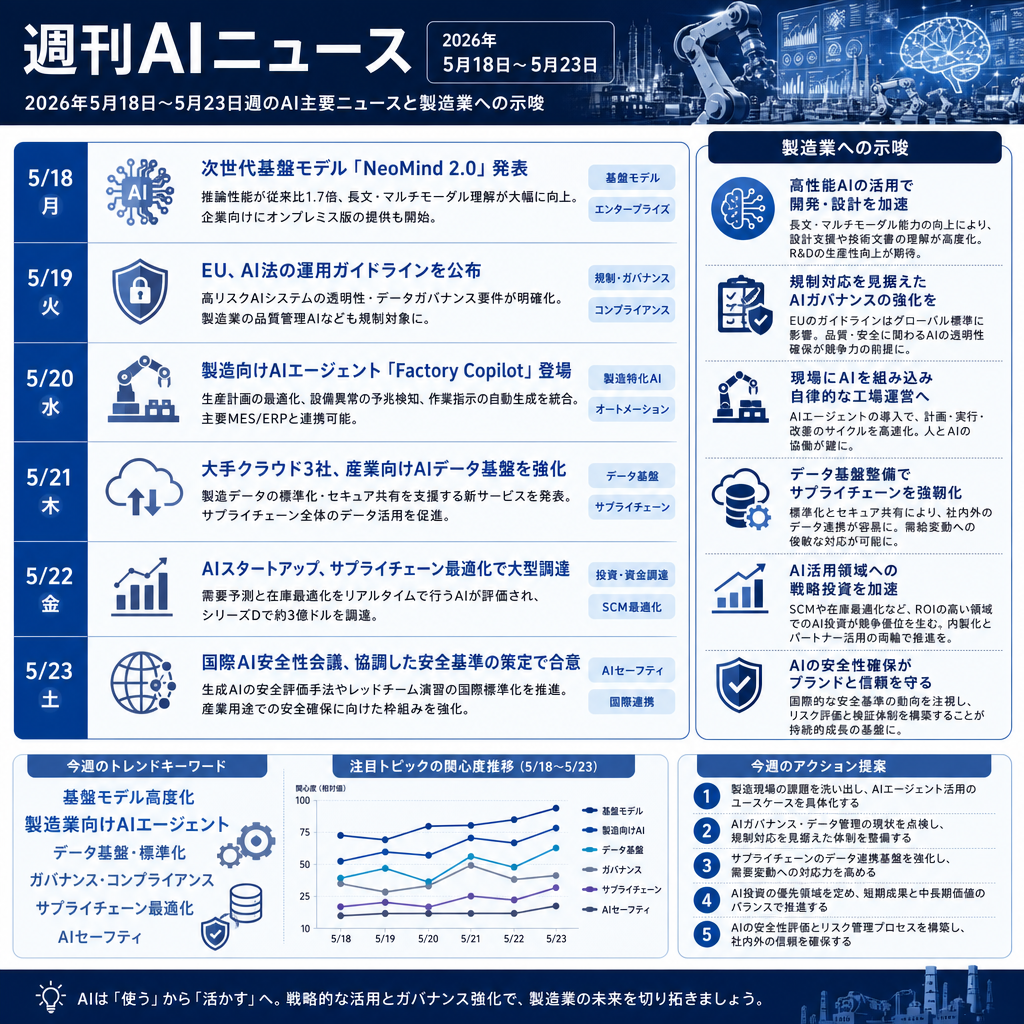
The week of May 18-23, 2026, was a week in which the AI industry was not only “racing to launch high-performance models,” but also the next battleground of “who will implement AI in society, in which regions, under which infrastructure and institutions? NVIDIA continues to see outsized demand, OpenAI has begun full-scale deployment in Asia, and Anthropic has strengthened its presence in both security and infrastructure diversification. Furthermore, the U.S. government has taken a stronger stance to treat AI as an export, security, and industrial competitiveness target, rather than just a civilian technology. What is important for the manufacturing industry is that AI is no longer a “cutting-edge tool to be introduced on a trial basis,” but rather a “management infrastructure” that is effective across procurement, design, maintenance, quality, cyber defense, and human resource development. This report is based on publicly available information as of May 22. Reuters Google Blog Reuters
Topics.
Google declares the “agent age” in earnest, and AI will move from being a search aid to being an executioner.
According to Reuters, Google has directly integrated AI agents into search, pushing forward the ability to perform autonomous tasks such as purchasing, ticket monitoring, and schedule coordination. Google has directly integrated AI agents into its search, and has brought to the forefront the ability to autonomously make purchases, monitor tickets, and schedule appointments, according to Reuters. In addition, the company introduced Gemini 3.5 Flash and explained that 3.5 Pro will be launched the following month. The top-of-the-line AI Ultra plan was reduced from $250 to $200 per month, and a new $100 business plan was added. It can be read that the competitive axis of AI has shifted from model performance alone to the agent experience that continuously performs tasks on behalf of the user. Furthermore, Google indicated a scale of 900 million monthly Gemini users, 2.5 billion monthly AI Overviews, and approximately 1 billion AI Mode users, and forecasted capital expenditures of $180-190 billion for this year. Reuters Google Blog
Implications for the manufacturing industry: In the manufacturing field, the main battleground for AI utilization will shift from the “asking questions via chat” phase to the “suggesting and executing next actions across drawings, procedures, equipment history, and procurement information” phase. Agent-based business design, such as automatic drafting of maintenance plans, proactive detection of material shortages, and corrective action flow reporting in the event of quality anomalies, will be the difference in competitiveness.
NVIDIA’s record financial results show the “seriousness” of demand for AI infrastructure.
On May 20, NVIDIA announced record revenue of $81.6 billion and record data center revenue of $75.2 billion, both for the quarter ending April 26, 2026; Reuters reported that next quarter revenue estimates of $91 billion beat market expectations, and Alphabet, Reuters also reported that next quarter sales are expected to exceed market expectations at $91 billion, and that AI infrastructure spending by major tech companies such as Alphabet, Amazon, and Microsoft is expected to total more than $700 billion in 2026. Meanwhile, CEO Jensen Huang emphasized the opening of new markets with the new Vera CPU, but also acknowledged the possibility of continued supply constraints in the Vera Rubin generation. In short, demand for AI has not slowed, but rather compute resources themselves remain one of the biggest constraints, even as inference demand grows and competitors develop their own chips. NVIDIA Investor Relations Reuters
Implications for the manufacturing industry: The real bottleneck for full-scale introduction of AI in the manufacturing industry is not a lack of PoC ideas, but inference costs, GPU availability, data transfer, power, and response latency. Rather than converting all operations to LLM at once, it will be essential to prioritize “high-frequency operations that can easily see ROI,” such as design support, visual inspection, predictive failure detection, and on-site QA, and design a system that uses both cloud and on-premise edges.
3. OpenAI to Singapore, AI adoption race enters “local implementation” phase
OpenAI has announced the establishment of its first Applied AI Lab outside the U.S. in Singapore, and according to Reuters, plans to increase its local workforce to approximately 200 people and invest in excess of S$300 million in the next few years. According to the Singapore government, this is part of the “OpenAI for Singapore” initiative, which covers areas such as public services, finance, healthcare, digital infrastructure, as well as startups, SME support, and human resource development programs. The program also includes training of Forward-Deployed Engineers, OpenAI Academy, and educational programs using Codex, and should be seen as an investment in establishing AI implementers and use cases in the region, rather than simply opening a base. This move is symbolic of the shift in the AI competition from the phase of “creating a model in the U.S. headquarters” to the phase of “how deeply can we implement AI in the industry in each region? Reuters MDDI Singapore
Implications for the manufacturing industry: For companies that are expanding production, procurement, and sales in Asia, it is not enough for the headquarters to take the initiative in implementing AI by standardizing the entire process. They need to have “regional implementation capabilities” that include multilingual support, local regulations, collaboration with local suppliers, and on-site training. It is likely that manufacturers will also find it effective to introduce AI for maintenance, education, and quality support at their ASEAN bases ahead of others, and to develop the strategy horizontally.
4. Anthropic reflects new focus of AI competition on “chip diversification” and “cyber defense
This week’s news surrounding Anthropic very much illustrates where the center of gravity of the AI race is shifting. First, Reuters reported that Anthropic is in talks to rent servers with Microsoft-designed AI chips to meet growing demand. If this happens, it would align the interests of AI companies that want to reduce their dependence on NVIDIA and Microsoft, which wants to sell its own semiconductors externally. In addition, on May 18, it was reported that Anthropic has changed its policy to allow participating companies to more widely share vulnerability information obtained through Mythos, a specialized cybersecurity model. The program aims to increase the defensive ripple effect by allowing the knowledge gained from the program to be shared with other companies’ security departments, regulators, government agencies, and others. In other words, the AI front is no longer just about “producing smart models,” but is now a two-tiered structure of “which computational infrastructure to run on” and “how to control and share dangerous capabilities. “How to control and share risky capabilities. Reuters Reuters
Implications for the manufacturing industry: The era of AI vendor selection based solely on model accuracy is ending for the manufacturing industry. In the future, it will be necessary to evaluate the stability of semiconductor supply, cloud dependence, inference cost, safety evaluation, and vulnerability information sharing system. In particular, when connecting AI to factory networks and OT environments, “defensibility” should be incorporated into the design concept before “convenience.
5. the U.S. government has begun to treat AI as a subject of industrial policy and security
On the policy front, too, we saw a major shift this week: according to Reuters, the Trump administration is preparing an executive order that would include a voluntary framework for consulting with the government before releasing advanced AI models to the public, and a proposal that would also require eligible companies to provide models 90 days before release and advance access to banks and other critical infrastructure providers was under consideration The following day, the U.S.-made AI was announced as the first step in the process. The following day, it was also reported that the government plans to launch an “ExportAI Initiative” to leverage insurance, loan guarantees, and direct financing by the Export-Import Bank of the United States (EXIM) to encourage the overseas adoption of U.S.-made AI tools. The key point here is that AI policy is shifting from “how to regulate AI domestically” to “which country’s AI infrastructure will become the global standard” in the export race. AI is already at the core of national strategies that unite semiconductors, cloud computing, finance, and diplomacy. Reuters Reuters
Implications for manufacturing: For global manufacturers, AI implementation will not be a software selection process, but a geopolitical response that includes procurement, export control, cyber regulations, and customer requirements. Design decisions such as which country’s cloud to use, which model to use for which operations, and how much to store locally will become management issues that span legal, information systems, and factory operations.
General Considerations for Manufacturing
The news over the past week has made it clear that the priorities for AI applications in the manufacturing industry have become much clearer. First, it is not general-purpose chatbots that are likely to be of value, but rather “business agents” tied to field data. Applications that connect routine tasks, such as checking the impact of design changes, summarizing maintenance history, isolating the first sign of abnormality, and proposing procurement alternatives, will emerge first. Second, the competitiveness of AI applications will be determined by implementation rather than model selection, and Google and OpenAI’s moves have shown that the depth of connection to internal data, human resource training, and implementation support will make the difference between winning and losing, more so than the quality of the UI and model performance. Third, as the moves around NVIDIA and Anthropic have shown, computational resources, power, safety, and supply chain will become fundamental conditions for AI strategies in the future. Google Blog Reuters Reuters Reuters
Therefore, there are three realistic steps to take in the manufacturing industry. First, select an agent project that is easy to see the effect in one factory and one operation, and measure the operational KPI in a short period of time. Secondly, the data base must evolve from a “searchable document repository” to an “actionable knowledge base” by preparing drawings, equipment ledgers, quality records, maintenance histories, SOPs, and other data in a form that AI can handle. Finally, AI governance at the management level should include security, accountability, export control, vendor lock-in, and GPU procurement, as well as a model performance comparison chart. They will be companies that can design implementation, operation, and control at the same time.
summary
The week of May 18-23, 2026, marked the qualitative shift of AI from “model competition news” to “industrial implementation news”; Google moved forward with agentification, NVIDIA with computational resources, OpenAI with regional deployment, Anthropic with security and infrastructure diversification, and the US government moved forward with its institutional and export strategies. It is important for manufacturers to see this trend not as an “IT department story” but as a reorganization of design, production, maintenance, quality, procurement, and human resources. The success or failure of AI implementation depends not on the choice of tools, but on how to redesign the work in the field.
Source List
- Reuters: Google courts coders and consumers at I/O, touts cheaper AI model
- Google Blog: I/O 2026: Welcome to the agentic Gemini era
- Reuters: Nvidia bets on new data center chips for growth as sales outlook tops estimates
- NVIDIA Investor Relations: Financial Reports
- Reuters: OpenAI to open its first applied AI lab outside of the U.S. in Singapore
- Singapore MDDI: Singapore signs first Memorandum of Understanding with OpenAI to develop “OpenAI for Singapore”
- Reuters: Anthropic in talks to use Microsoft’s AI chips
- Reuters: Anthropic to let partners share Mythos cybersecurity findings with others
- Reuters: Trump to sign order on AI oversight as security fears mount among supporters
- Reuters: Trump administration seeks to supercharge US AI exports with billions in financing
Editor’s Note: This article utilizes AI to summarize and organize news content. While every effort has been made to be as accurate as possible, it may contain errors in background explanation or interpretation of causal relationships. Please always check the source article for details and accurate context.