
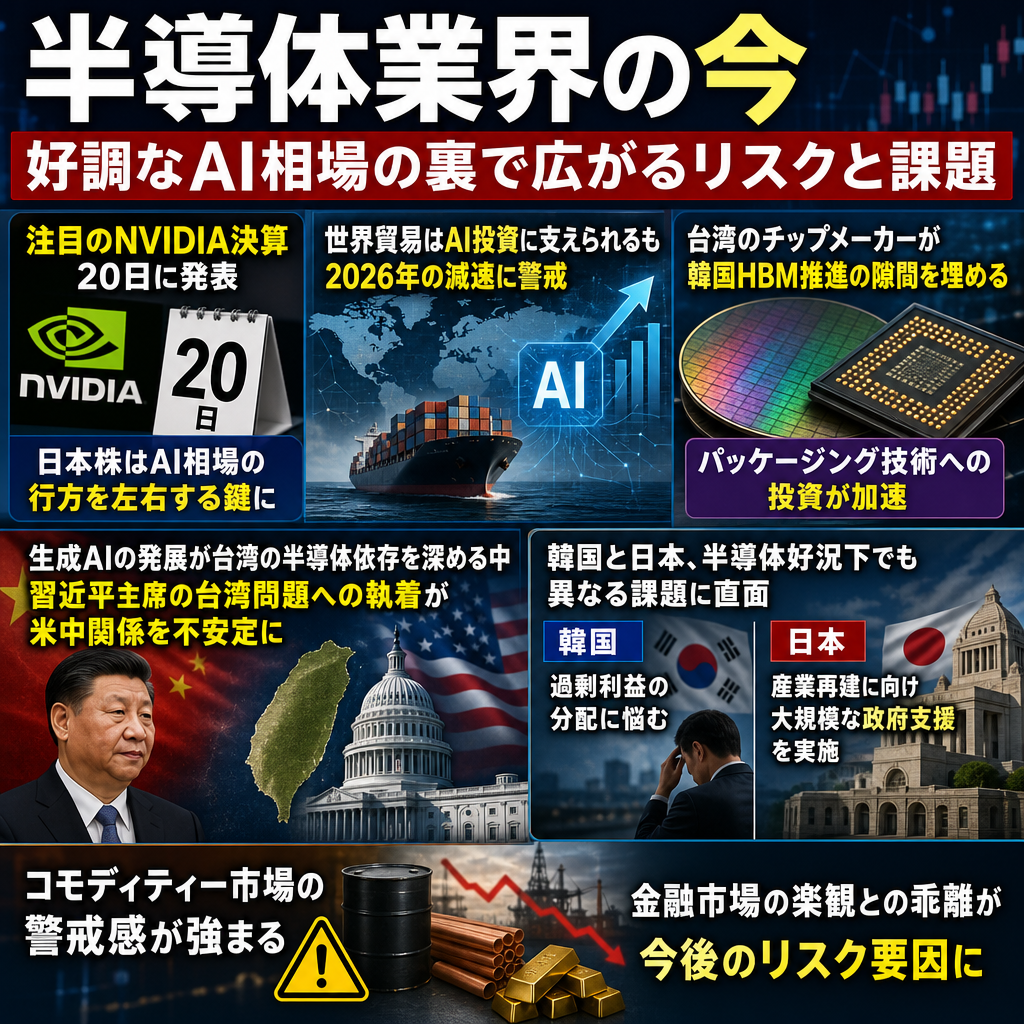
Today’s semiconductor industry news shows the juxtaposition of geopolitical risks and market overheating fears against the backdrop of a strong AI market; with NVIDIA’s earnings due on the 20th, Japanese stocks are positioned to be a major factor in the future of the AI market, and global trade, while saved by AI investment, is also concerned about a slowdown in 2026. There are concerns that global trade, while being saved by AI investment, will slow down in 2026. Meanwhile, Taiwanese chipmakers are filling in the gaps in South Korea’s HBM push, and investment in packaging technology is accelerating. Geopolitically, President Xi Jinping’s obsession with the Taiwan issue is destabilizing U.S.-China relations as the development of generative AI deepens Taiwan’s reliance on its semiconductor industry. South Korea and Japan also face different challenges in the semiconductor boom, with South Korea struggling to share excess profits while Japan is providing massive government support to rebuild its industry. Commodity markets are also becoming more cautious, and the divergence from financial market optimism may be a risk factor going forward.
Main News
- Japanese stocks , U.S. NVIDIA’s earnings will influence the AI market this week.
The U.S. company NVIDIA’s earnings, which are expected to lead the AI market, could be a tailwind for Japanese stocks if they are favorable, while disappointing results could lead to disappointing sales. In addition, GDP for the January-March period announced by the Cabinet Office is expected to show positive growth for the second consecutive quarter, with increased exports expected to drive growth. - Taiwanese Chipmakers Quietly Filling Gaps Created by South Korea’s HBM Push
Taiwanese chipmakers are developing strategies to fill market gaps created by South Korean companies’ HBM (high bandwidth memory) push. Through packaging technology and investment, they are increasingly responding to AI-related demand and expanding their market share. - Generative AI without Taiwan is the main focus of Xi Jinping’s insistence on core interests
President Xi Jinping has made the Taiwan issue a top priority in his summit with U.S. President Trump, and the development of generative AI is deepening Taiwan’s strategic reliance on the semiconductor industry. The focus of the attention of key Chinese policy-making circles on Taiwanese issues suggests Taiwan’s pivotal position in the U.S.-China race for technological hegemony. - Time to Fragment Korea’s ‘Semiconductor Accomplishments’…Speeding Up the Rebuilding of Japan’s ‘Semiconductor Kingdom’
Under the AI semiconductor boom, Korea and Japan are facing very different challenges. While South Korea is facing a parallel “national dividend” controversy and a massive labor dispute to return record semiconductor excess tax revenues to the people, Japan is focusing on rebuilding its lost semiconductor kingdom with a massive injection of government subsidies and investments. - World Trade Saved by AI Investment, Grows Nearly 5% Last Year Despite High Tariffs, Slows to 2.5% in 2026
World trade saved by AI investment, grew nearly 5% last year, but is expected to slow to 2.5% in 2026. AI-related demand continues to support global trade growth, even in the face of high tariff policies, but concerns have arisen about its sustainability. - Galatek Targets Advanced Packaging Market, Eyes Taiwan Foundry Companies
Emerging company Galатek is eyeing Taiwanese foundry companies to enter the advanced packaging market. The company is developing a strategy to meet the growing demand for AI semiconductors through automation and innovation in packaging technology, and is seeking partnerships with Taiwanese companies. - Forza Horizon 6 launches in just 4 seconds instead of 90 seconds with new advanced shader delivery technology and AMD GPUs
Microsoft introduces new advanced shader delivery technology in Forza Horizon 6, combined with AMD GPUs, to reduce game startup time from from 90 seconds to just 4 seconds. This technology, which reduces game load times by 95%, represents a major advance in GPU processing efficiency. - Commodity Mafia Alarmed by Market Optimism AI Inflation Blind Spot in Stocks
Leading commodity market participants are becoming increasingly alarmed that “the world is headed for recession” and “financial markets are too optimistic” against the backdrop of the de facto closure of the Strait of Hormuz. While commodity markets are bracing themselves for a crisis, stock markets are booming at all-time highs, and the divergence between the two is a potential risk factor in AI markets. - Demonstrating a Korean-style AI government model…Ministry of Public Administration and Security invites UN and developing countries to conduct training
South Korea’s Ministry of Public Administration and Security has invited the UN and developing countries to conduct a training program on AI-utilized government administration models, promoting efforts to develop a Korean-style AI government system internationally. The strategy is to share Korea’s experience in government digitalization and AI utilization with the international community. - OpenClaw Developers Spent $1.3 Million on OpenAI API Tokens in Just One Month
OpenClaw developers consumed $1.3 million in token costs in just one month of using the OpenAI API. This case suggests the growing development costs of generative AI-related projects and the potential for unexpectedly high bills from API use, highlighting the challenges of profitability of AI development.
News List (49 items)
This article is delivered every morning by an automatic collection and AI generation system. Number of collected articles : 49 | Update : 20260518