

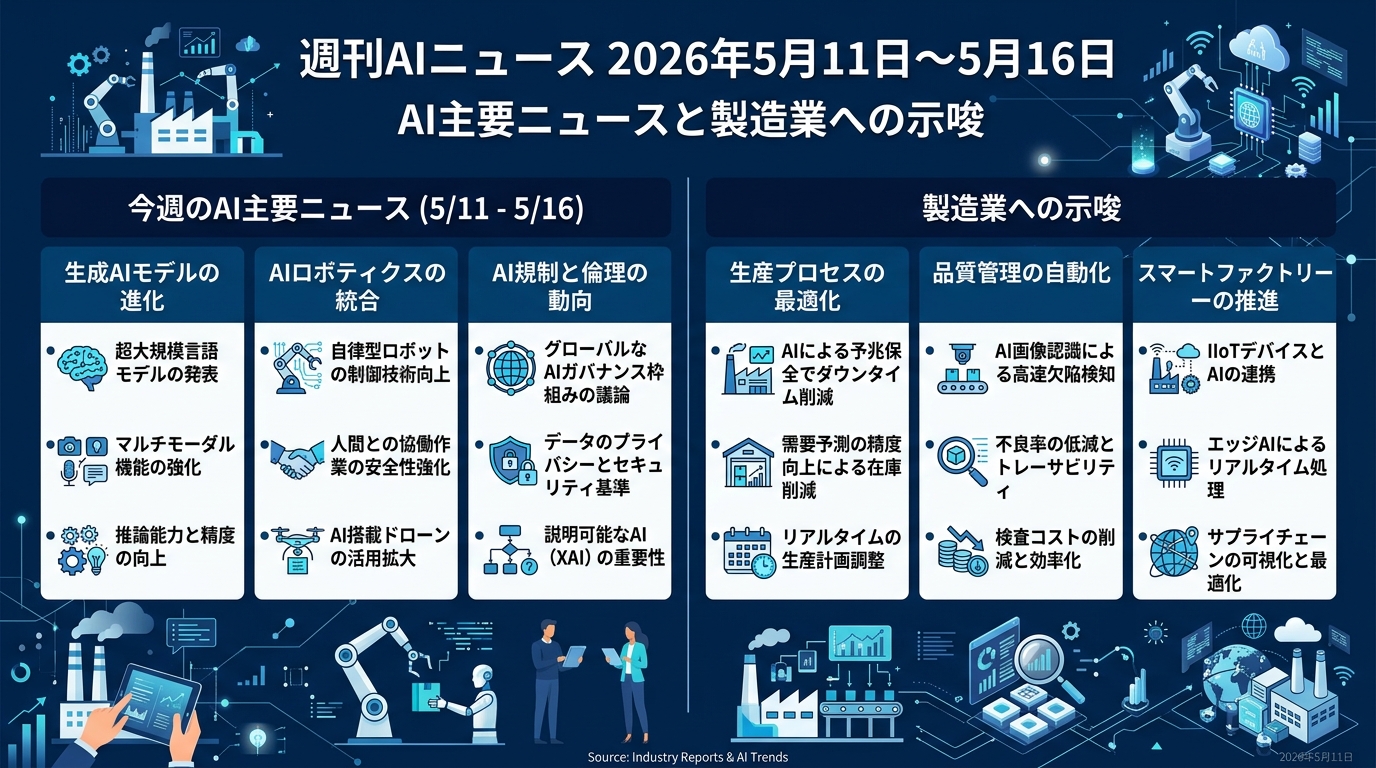
Looking back at this week’s AI news, the focus has clearly shifted from “how smart are the models?” to “who will incorporate that capability, in what field, and with what system of responsibility?” AI is becoming not just an IT topic, but an agenda for redesigning the very structure of industry itself. For the manufacturing industry, this trend cannot be simply “wait-and-see.” It has entered a stage where it is being asked how to reconfigure design, procurement, production, maintenance, and quality assurance based on the premise of AI.
1. OpenAI commercializes “implementation itself
On May 11, OpenAI announced the launch of its new “OpenAI Deployment Company” and the full-scale deployment of a dedicated unit to implement AI in the workplace. Forward Deployed Engineers will provide comprehensive support from business diagnosis to system design, connection to existing data and business tools, and operational implementation. This announcement shows that the competitive edge of AI has shifted from “model performance” to “implementation speed” and “operational redesign capabilities.
Implications for the manufacturing industry: In the manufacturing industry, it is important to embed generative AI into workflows such as design change management, work standards, maintenance history, quality anomaly analysis, and procurement inquiries, instead of using it as a one-time chat tool. The OpenAI movement shows that this “implementation support” has already begun to establish itself as a huge market. The OpenAI movement shows that “implementation support” has already started to become a huge market.
2. Anthropic accelerates “social implementation” and “corporate implementation” at the same time
On May 14, Anthropic announced a four-year, $200 million partnership with the Gates Foundation to deploy AI in global health, education, and economic mobility, combining not only funding but also Claude usage credits and technical assistance. On the same day, Anthropic also announced the expansion of its partnership with PwC, starting with the U.S. team for Claude Code and Claude Cowork, and moving on to the training and certification of 30,000 professionals and the establishment of a joint Center of Excellence. In other words, Anthropic is evolving into a “company that makes AI work” in both the public value domain and the business transformation domain of large corporations.
Implications for Manufacturing: Even in manufacturing, AI implementation is no longer just about the information systems department. The combination of Anthropic and PwC may accelerate the trend of BPO, auditing, business transformation consulting, and AI vendors coming together to enter the manufacturing industry in the future. BPO, audit, business transformation consulting, and AI vendors will be integrated into the manufacturing industry in the future.
3. the U.S. administration’s AI regulation theory, as reported by AP News, began to deal with “rules” and “power” at the same time.
The U.S. White House this past week presented Congress with a federal-level framework that could override state-by-state AI regulations. Issues discussed include child protection, intellectual property, censorship, education, and controlling the rising cost of electricity due to AI infrastructure. The same week, it was also reported that AI data centers will require data center operators to develop their own power supplies and bear the burden of long-term contracts in light of their impact on electricity prices and supply stability. The AI policy has entered a phase in which the legal system, electric power, and industrial infrastructure are being designed in an integrated manner.
Implications for Manufacturing: The use of AI in factories is not complete with software investment alone. Profitability will easily collapse unless we look at the total cost, including the inference infrastructure, edge devices, cloud integration, and data center-derived power costs. Especially in the energy-intensive manufacturing industry, it is important to control the counter-current of “increasing efficiency through AI” and “increasing power costs for AI. In the future, companies that do not handle AI investment decisions and energy strategies separately will be the stronger.
4. Google is pushing AI as a “national infrastructure
In conjunction with the AI Impact Summit 2026, Google announced a major initiative that bundles infrastructure, government, science, education, and talent development. In addition to the $15 billion investment stream for India, the company also outlined its America-India Connect initiative, Google.org’s $30 million each for government and science, Google DeepMind’s government and research partnerships, and even the global expansion of AI Skilling. The picture here is that AI is more than just a product. What we see here is that AI is beginning to be treated as a “social infrastructure” that includes communications, government, research, and education, rather than just a product function.
Implications for the manufacturing industry: AI competitiveness in the manufacturing industry is more likely to be determined by how much high-quality data, human resources, connections, cloud computing, research institutions, and government support can be connected than by the number of PoCs conducted by a single company. Google’s announcement showed once again that AI implementation is not only a corporate strategy, but also a theme for the international division of labor and industrial policy.
5. TSMC outlook reported by Reuters suggests prolonged demand for AI semiconductors
Reuters reported on May 14 that TSMC expects the global semiconductor market to reach $1.5 trillion by 2030, with AI and high-performance computing accounting for 55% of that. The composition of the market, with 20% for smartphones, followed by automotive, indicates that the center of gravity of semiconductor demand is clearly tilting toward AI. This is not simply a tailwind for GPU makers, but a broad industrial linkage that includes front-end, back-end, materials, inspection equipment, power supplies, and cooling.
Implications for Manufacturing: Manufacturing executives need to view AI not only as a “business efficiency tool” but also as a macro variable that influences capital investment and the supply-demand balance for materials. The companies that can be on the receiving end of AI applications as well as the supply side of AI infrastructure demand should see the greatest growth opportunities in the next few years.
General Considerations for Manufacturing
The news over the past week shows that the most important question for manufacturers has shifted from “to implement AI or not” to “from which business layer to make AI native”. The OpenAI and Anthropic movements indicate that AI implementation has moved beyond the PoC phase and become a management issue that includes workflow redesign, human resource certification, auditability, and operational responsibility. On the other hand, U.S. policy discussions and power issues, Google’s national infrastructure path, and TSMC’s demand outlook have also made it clear that AI is not a closed topic only in the factory, but strongly dependent on external infrastructure, international supply networks, and energy constraints.
In practice, it is easy to organize a manufacturing AI strategy with at least four layers. First, a data infrastructure that allows reuse of in-house knowledge such as design drawings, quality records, maintenance logs, SOPs, and procurement specifications. Second, business agents such as design support, anomaly factor analysis, maintenance proposals, and procurement inquiry automation. Third, on-site optimization linked with simulation and digital twin. Fourth, operational governance, including power cost, security, accountability, and regulatory compliance. This week’s developments suggest that companies that integrate these four layers as a single management architecture, rather than building them up separately, will prevail.
summary
This week in the AI industry, rather than a flashy demonstration race, we began to move into “heavy areas” such as implementation support, institutional design, social infrastructure, and supply chains all at the same time. For manufacturers, the use of AI itself is no longer a differentiator. What will make the difference in the future will be how AI is embedded in on-site operations, which departments it is operated across, and which infrastructure constraints are foreseen when making investment decisions. From next week onward, we will not only talk about new model features, but also follow developments in implementation systems, power, semiconductors, and systems, which should enhance the accuracy of AI strategies for the manufacturing industry.
Source List
- OpenAI launches the OpenAI Deployment Company to help businesses build around intelligence
- Anthropic forms $200 million partnership with the Gates Foundation
- PwC is deploying Claude to build technology, execute deals, and reinvent enterprise functions for clients
- Here’s how the White House wants Congress to regulate AI
- Trump and governors target AI power shortages and price spikes
- AI Impact Summit 2026: How we’re partnering to make AI work for everyone
- TSMC says global chip market to hit $1.5 trillion by 2030 as AI drives growth