

In the past week, the AI industry has moved beyond the mere “race for high-performance models” and entered a phase in which the question is how to link funding, computational resources, business implementation, and industrial infrastructure. Leading companies are shifting their focus from flashy demonstrations and single-function applications to “AI that performs,” which is deeply embedded in the workflow of a company. At the same time, open models are expanding, semiconductor supply networks are being restructured, and AI is being deployed in physical spaces, including factories and logistics, at an accelerated pace. For the manufacturing industry, it is now beyond the stage of “to use AI or not to use AI,” and it is now a week that determines competitiveness in terms of which models to use, in which areas, and under which controls.

Topics.
1. OpenAI’s “Selection and Concentration” is Sharply Sharpened with a Large Amount of Funding
On March 31, OpenAI announced the completion of $122 billion in funding, with a post-money valuation of $852 billion. The funds will be allocated to research, products, and expansion of computational resources, and the company has also launched an “AI Super App” concept that bundles ChatGPT, Codex, browsing, and various agent functions. Meanwhile, Reuters reported that OpenAI is reallocating resources and shifting its focus to coding and enterprise tools in response to increased competition from Google and Anthropic. The decision to terminate Sora was made due to a decline in users from approximately 1 million at its peak to less than 500 , 000, consuming approximately $1 million per day in costs. In other words, this week OpenAI went from being a “do-it-all” company to a company that focuses on areas of business that are easier to monetize. OpenAI Reuters TechCrunch

Implications for the manufacturing industry: The manufacturing industry is entering a phase in which it is easier to achieve results by concentrating AI investment in operations where ROI is easily visible, such as design change management, procurement inquiries, quality documentation, and maintenance knowledge retrieval, rather than by creating a barrage of PoCs.
2. with OpenAI’s GPT-5.4, AI goes from “answering” to “operating
On April 3, OpenAI released GPT-5.4. The focus this time is not only on inference and coding performance, but also on native computer-use capabilities and the ability to work across software and desktop environments. OpenAI describes a reduction in factual errors compared to previous models and outperforms humans in OS operations benchmarks, demonstrating that the general-purpose model has become a fully-fledged The results are impressive and show that the general-purpose model is evolving into a full-fledged “practical agent. OpenAI
Implications for the manufacturing industry:Automation of indirect tasks that span multiple applications, such as updating production planning sheets, comparing specifications, organizing equipment data, and drafting documents to be submitted to customers, is becoming a reality. Especially in the factory management and production engineering departments, the impact of time compression of routine tasks is likely to be significant.
Google’s Gemma 4 will take the open model competition to the next level.
On April 2, Google announced Gemma 4, available under the Apache 2.0 license and touting inference, agent applications, code generation, image and voice input, long-text processing, and support for over 140 languages. The 26B Mixture of Experts model, in particular, has narrowed down the parameters enabled during inference, making it efficient enough to be handled by a single 80GB H100 GPU. In addition, the smaller version for the edge is aware of RAM and power constraints, and has the flexibility to be deployed on-device, on-premise, or in the cloud. This indicates that AI deployment is no longer a “pay-as-you-go API” but is expanding into a multi-pronged option that includes in-house ownership, local operation, and sovereignty. Google DeepMind
Implications for manufacturing: The value of closed-loop operations using an open model will increase at sites that handle data that is difficult to transmit externally, such as drawings, equipment logs, inspection images, and maintenance manuals. This trend is more important for companies with quality assurance, defense and medical supply chains.
4. Microsoft advances “long-time, multi-process” business AI
On March 30, Microsoft launched Copilot Cowork in its Frontier program. Users tell the system what results they want, and the AI creates a plan and then moves through the task, showing progress across tools and files. Wave 3’s Microsoft 365 Copilot includes embedded agents in Word, Excel, PowerPoint, and Outlook, The direction toward AI as an “execution entity” rather than an “assistant” is clear. Microsoft 365 Blog Microsoft 365 Blog
Implications for manufacturing:Companies that are more likely to standardize cross-functional workflows, such as procurement, sales, production control, accounting, human resources, etc., will benefit more; when coupled with ERP and M365 environments, meeting preparation, progress consolidation, and report generation will be automated.
NVIDIA and Chinese semiconductor trends show that AI’s main battlegrounds are “physical space” and “supply chain
According to Reuters on April 1, Chinese GPU and AI chip companies have secured a 41% share of the Chinese AI accelerator server market in 2025, with NVIDIA still in the lead but down to 55%; Huawei is the top Chinese player, reportedly shipping about 812,000 units; AI semiconductor The geopolitical fragmentation of AI semiconductors is further increasing. In parallel, NVIDIA highlighted in its GTC 2026 communications that robots, vehicles, and factories are moving from one-off deployments to enterprise-scale “Physical AI. The competitive landscape for AI is shifting from model performance to which computational infrastructure is secured and how it is implemented in the field. Reuters NVIDIA Blog NVIDIA Blog
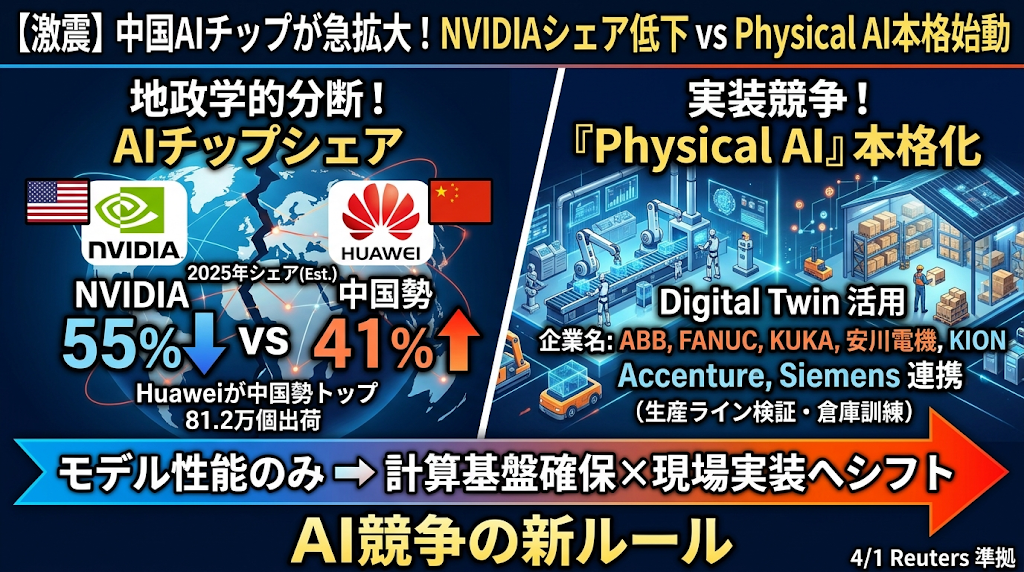
Implications for manufacturers: Companies considering factory automation must not only select a model, but also design it to include GPUs, cloud computing, edge devices, and distributed industrial software supply networks. The difference in the future will be how AI can be “physically implemented” in factory layout, transportation, maintenance, and inspection.
General Considerations for Manufacturing
Looking over the news this week, there are three things that are important to the manufacturing industry.
First, AI is no longer a convenience feature of the chat UI, but has begun to move to the execution layer to complete tasks, as exemplified by OpenAI’s GPT-5.4 and Microsoft’s Copilot Cowork. In the manufacturing industry, AI is increasingly likely to fill in the “manual gaps” that span multiple systems, from order receipt to design changes, material procurement, production planning, quality reporting, and maintenance history management. OpenAI Microsoft 365 Blog
Second, deployment architectures are polarized. In areas where sensitive field data and regulatory compliance are heavy, open models such as Gemma 4 are more valuable for closed and on-premise edge operations. On the other hand, for sales material creation, meeting organization, and cross-company document processing, cloud-based high-performance models and M365 integration will deliver results faster. In the future, a portfolio strategy of combining models by use is more realistic, rather than “one AI for the entire company. Google DeepMind Microsoft 365 Blog
Third, governance is still essential in field application: an argument introduced by Reuters on April 1 shows that the error rate of LLMs can increase with longer and more complex contexts, and in high-precision domains such as accounting and legal, “about right In high-precision areas such as accounting and legal, it is not enough to say, “It’s about right. The same is true in the manufacturing industry for process conditions, conformance to standards, quality judgments, regulatory documents, and EHS-related judgments. Therefore, AI is strong in primary drafting, extracting candidate anomalies, and summarizing information, while humans are responsible for approving, making final judgments, and assigning responsibility. Reuters
In addition, “Physical AI” is the main focus for the mid- to long-term. The ability to embed AI into the factory design, operation, and improvement cycle itself, rather than simply generating documents, will be a differentiating factor in the future. NVIDIA Blog
summary
This week’s AI news was not just about “smarter models”. Rather, the essence of the story was the clear structural change that AI is entering into practice, corporate control, semiconductor supply networks, and factory operations. The four priorities for manufacturers are:
1) Implement from the most cost-effective operations,
2) Use cloud-based and closed systems,
3) Incorporate human approval design based on the assumption of wrong answers,
4) Finally, connect to Physical AI and Digital Twin,
In spring 2026, we will move from the implementation phase of generative AI to the Spring 2026 can be seen as the entry point from the implementation phase of generative AI to the implementation phase of rewriting the business operating system of the manufacturing industry.
Source List
- OpenAI raises $12.2 billion to accelerate the next phase of AI
https://openai.com/index/accelerating-the-next-phase-ai/ - Artificial Intelligencer: OpenAI’s $852 billion problem: finding focus
https://www.reuters.com/technology/artificial- intelligence/artificial-intelligencer-openais-852-billion-problem-finding-focus-2026-04-01/ - Why OpenAI really shut down Sora
https://techcrunch.com/2026/03/29/why-openai-really-shut-down-sora/ - Introducing GPT-5.4
https://openai.com/index/introducing-gpt-5-4/ - Gemma 4: Our most capable open models to date
https://blog.google/innovation-and-ai/technology/developers-tools/gemma-4/ - Copilot Cowork: Now available in Frontier
https://www.microsoft.com/en-us/microsoft-365/blog/2026/03/30/copilot-cowork-now-available-in- frontier/ - Powering Frontier Transformation with Copilot and agents
https://www.microsoft.com/en-us/microsoft-365/blog/2026/03/09/powering-frontier- transformation-with-copilot-and-agents/ - Chinese chipmakers claim nearly half of local market as Nvidia’s lead shrinks
https://www.reuters.com/world/china/chinese- chipmakers-claim-nearly-half-of-local-market-nvidias-lead-shrinks-idc-2026-04-01/ - NVIDIA GTC Showcases Virtual Worlds Powering the Physical AI Era
https://blogs.nvidia.com/blog/gtc-2026-virtual-worlds-physical-ai/ - NVIDIA, Energy Leaders Accelerating Power-Flexible AI Factories to Support the Grid
https://blogs.nvidia.com/blog/energy-efficiency-ai- factories-grid/ - Does the AI business model have a fatal flaw?
https://www.reuters.com/technology/does-ai-business-model-have-fatal-flaw-2026-04-01/