

If we had to describe the AI industry in one word this week, it would be “AI sees, thinks, and operates itself” week. The biggest topic was the March 5 release of GPT-5.4–a historic model update that includes the first “native computer operation” feature that allows AI to autonomously operate a PC like a human. At the same time, it was a dense week with a concentration of news that the manufacturing industry could not afford to be indifferent to, including geopolitical tensions in semiconductors, the full-scale landing of personal AI agents at MWC 2026, and the acceleration of domestic AI agent implementation.
1. GPT-5.4 Launch: “Operating AI” will change manufacturing sites.
The biggest news of the week was the release of GPT-5.4 by OpenAI on March 5. Billed as “the most capable and efficient frontier model for professional services,” it opens the door to “real-world AI,” which is fundamentally different from the previous GPT-5.3 family of models.
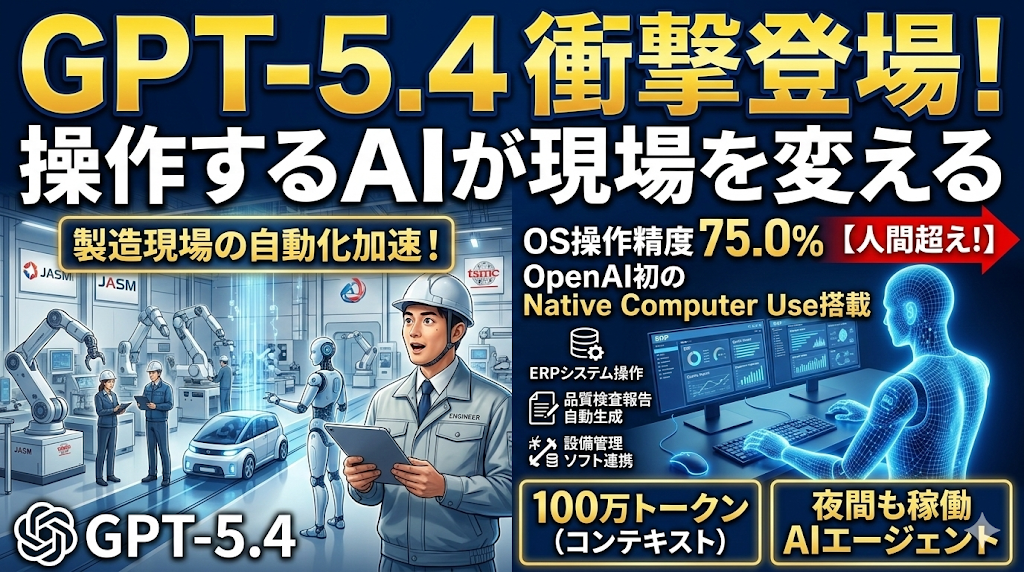
The most significant feature is the inclusion of native Computer Use (Computer Use) functionality, a first in OpenAI’s history. It can read screenshots and autonomously manipulate the mouse and keyboard to execute complex workflows on applications, achieving 75.0% on the OSWorld-Verified benchmark, surpassing the human score of 72.4% for the first time.
Other notable features include A context window of up to 1 million tokens allows users to plan, execute, and verify work while keeping track of large code bases and long-term project documents in their entirety. A ” steerability ” function that allows users to add or modify instructions while the AI is thinking has also been implemented, making human-AI collaboration more intuitive.
In addition, a financial plug-in that integrates directly into Microsoft Excel and Google Sheets is now available simultaneously. The deep dive into professional services is highlighted by the announced integration with financial data providers such as FactSet.
The GPT-5 .4Thinking is available for Plus, Teams, and Pro users of ChatGPT (successor to GPT-5.2 Thinking), while the GPT-5.4 Pro API is the highest-precision model, priced at $30 for input and $180 for output (per million tokens), the highest unit price offered by the company. (per million tokens), the company’s highest unit price.
Implications for the manufacturing industry: GPT-5.4’s Computer Use function opens up the possibility of “AI replacing humans” in the operation of ERP systems, automatic generation of quality inspection reports, and data linkage with equipment management software at manufacturing sites. The era in which routine tasks such as data transcription, report generation, and configuration changes between systems, which used to be performed by skilled engineers, can now be performed by AI agents that work throughout the night is becoming a reality.
2. OpenAI x Pentagon: The AI Governance “Red Line” Debate
While overshadowed by GPT-5.4, the contract issue between OpenAI and the U.S. Department of Defense (Pentagon ) rocked the first half of the week: on February 28 (March 1, Japan time), OpenAI disclosed details of its contract to deploy AI models on the Pentagon’s classified network. Despite the fact that the contract specified three red lines prohibiting “mass surveillance, directing autonomous weapons, and automated decision-making with significant stakes,” the contract was criticized both internally and externally as an “ethical aberration. The situation even led to the “ChatGPT cancellation movement.
CEO Sam Altman publicly explained on March 3 that “I made a mistake,” and amended the contract by adding language assuring the Pentagon that it “will not be used for surveillance purposes. “Comparisons to the redlines Anthropic has established in similar contracts have also drawn controversy.
Implications for the manufacturing industry: When introducing the powerful autonomous agent capabilities that GPT-5.4 brings to the manufacturing floor, it is essential to clearly state “what we can let AI do. Monitoring employee behavior, making autonomous order decisions, fully automating quality decisions, etc., and establishing a rule book on the scope of AI involvement and human supervisory obligations will be central to future corporate risk management.
NVIDIA’s New Chip Initiative and U.S. Export Restrictions: Semiconductor Geopolitics Shake Up Manufacturing Costs
Significant developments coincided in the semiconductor sector.
First, there are a number of reports that NVIDIA is preparing to announce its next-generation AI inference-specific chip for GTC 2026 (San Jose), which opens on March 16; the ” Feynman ” architecture, which uses TSMC’s 1.6nm process, is considered a strong candidate, and NVIDIA is expected to announce its next-generation chip by the end of 2025 with approximately Integrated with Groq’s LPU (Language Processing Unit) technology, acquired by NVIDIA for approximately $20 billion, the design is expected to be optimized for agent-based AI tasks such as GPT-5.4 and significantly improve the power efficiency of inference processing.
Meanwhile, on March 5, several media reported (Bloomberg and Reuters) that the U.S. government is considering a regulatory proposal to impose a permit system on the worldwide export of AI chips made by NVIDIA and AMD. A proposal to make investment in U.S. AI data centers by foreign companies a condition for export licenses was also floated, and the stock prices of both companies fell by more than 2-3%.
In its earnings announcement on March 4-5, Broadcom also forecasted that AI chip sales in 2027 will “significantly exceed $100 billion “** (CNBC) and revealed plans to supply 1 gigawatt of TPUs for Anthropic by 2026. The market for AI semiconductors has been dominated by NVIDIA, but custom chip makers are now making a full-fledged entry into the market.
Implications for manufacturing: High-performance chips are a prerequisite for running GPT-5.4-class AI processing at the factory edge. However, tightening U.S. export restrictions will affect procurement costs and supply stability. Smart factory investment plans must incorporate supply chain semiconductor procurement risk, and must be designed to include diversified investments in edge AI and domestically produced chips. Mynavi News / Reuters (Broadcom) / Bloomberg (export controls)
4. MWC 2026: Personal AI Agents in Manufacturing Applications as Seen in Docomo’s “SyncMe
At MWC 2026, the world’s largest mobile trade show, which opened in Barcelona, “AI Agents x Communication Infrastructure” was the theme that ran throughout.
On March 2, NTT DOCOMO announced its personal AI agent service** “SyncMe “**. The service, which learns users’ behavioral habits and suggests necessary information ahead of time, is expected to be officially available around summer 2026. Qualcomm CEO declared that “6G exists for AI” and expressed his view that AI agents will be the next leading interface for smartphones.
Softbank announced its “Telco AI Cloud,” a communications infrastructure for the AI age, and NTT exhibited its next-generation infrastructure that combines AI performance enhancement technology (IAI) and optoelectronic convergence technology (IOWN), clearly demonstrating how communications infrastructure will support the full-scale spread of agent-based AI enabled by GPT-5.4. GPT-5.4 has made it clear that communication infrastructure will support the full-scale diffusion of agent-based AI.
Implications for the manufacturing industry: Personal AI agents such as SyncMe can be applied to “AI co-pilots,” in which workers on the production floor can ask AI questions via voice to perform equipment inspections, respond to abnormalities, and refer to manuals. Ubergizmo / Nihon Keizai Shimbun
5. accelerated implementation of AI agents in Japan: the end of the “consideration” phase
In Japan, the official report of AI Agent Day 2026 (held February 12-13), organized by the AICX Association, was released on March 5 to great acclaim. The number of applicants for the event reached 3,710, with 38% of major companies and 36% of decision makers participating. The report clearly stated that “AI agents have moved beyond the “consideration stage” to the “organizational implementation stage.
A BCG survey (released March 3) reveals that companies plan to double their AI investments in 2026 (approximately 1.7% of sales), and intend to focus at least 30% of those investments on AI agents. 80% of CEOs realize the ROI of AI, and 94% intend to continue investing regardless of short-term results. continue to invest in AI regardless of short-term results.
The GPT-5.4’s combination of “Agent x Computer Use” is precisely at the forefront of these corporate needs, and with the announcement on March 6 of the integration of the latest model into the corporate AI agent ChatSense, the use of GPT-5.4 among Japanese companies is expected to grow rapidly.
Implications for Manufacturing: The time is at hand when AI agents will begin to function as “digital colleagues” on the manufacturing floor. The development of multi-agent systems that can autonomously process multiple tasks across the board, including design support, quality control, supply chain optimization, and maintenance planning, will be the source of future competitiveness PR TIMES(AICX Association) / PR TIMES (BCG)
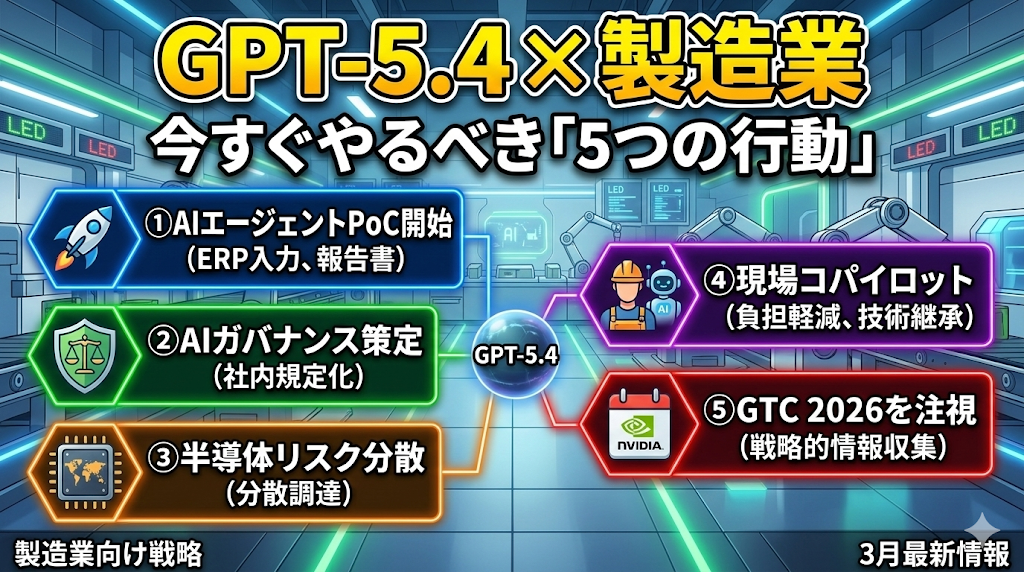
General Considerations for Manufacturing: 5 Actions Required in the GPT-5.4 Era
To summarize this week’s news from a manufacturing perspective, the appearance of GPT-5.4 marks a turning point, and the following five points emerge as pressing issues.
(i) Start PoC (Proof of Concept) for AI agents by the end of this quarter The Computer Use function of GPT-5.4 has a wealth of tasks that can be tested immediately, such as data entry into ERP, automatic generation of quality reports, and inventory inquiries. It is important to start the PoC design before competitors step up to implement it.
(ii) Clearly state the development of AI governance policy in internal regulations As OpenAI’s Pentagon issue has shown, the development of internal governance documents that define the scope of AI use, prohibitions, and human supervision obligations is an urgent need for both risk management and maintaining employee trust.
(iii) Factor semiconductor procurement risk into DX plans In light of the trend toward tighter U.S. export controls, consider a diversified procurement strategy that moves away from NVIDIA as the sole choice for AI infrastructure selection and includes edge AI, domestically produced and European chips.
(iv) Develop a plan to introduce AI co-pilots for on-site workers It is effective to take the perspective of converting the personal AI agent technology demonstrated in MWC 2026 to the factory floor and position it as a solution to reduce the burden on on-site workers and to solve the problem of technology succession.
(5) Strategically watch for announcements at NVIDIA GTC 2026 (March 16-19) The “Feynman” chip and other announcements have the potential to rewrite the optimal solution for manufacturing floor AI infrastructure. We recommend that procurement, IT, and manufacturing departments work together to gather information.
summary
The first week of March 2026 was the week in which “AI operating its own PC”, a feature that a few years ago was the realm of science fiction, became a reality, all centered around the emergence of GPT-5.4, “real-world AI”, geopolitical risk governance controversy, accelerated agent implementation, and personal AI manufacturing field applications. The topics are all connected. Next week, NVIDIA GTC 2026 finally kicks off. In the next issue, we will provide details on new chip announcements that could fundamentally change the AI infrastructure in manufacturing.
Source List
| # of | Title | Media | Date |
|---|---|---|---|
| 1 | Introducing GPT-5.4 | OpenAI Official | 2026-03-05 |
| 2 | OpenAI Releases GPT-5.4, Native Support for PC Operation | ITmedia AI Plus | 2026-03-06 |
| 3 | OpenAI’s New GPT-5.4 Model Rivals Human Professionals in Over 80% of Tasks | ZDNet Japan | 2026-03-05 |
| 4 | OpenAI launches GPT-5.4 with native computer use mode, financial plugins | VentureBeat | 2026-03-05 |
| 5 | OpenAI launches GPT-5.4 with Pro and Thinking versions | TechCrunch | 2026-03-05 |
| 6 | Introducing ChatGPT for Excel and new financial data integrations | OpenAI Official | 2026-03-05 |
| 7 | OpenAI amending deal with Pentagon, CEO Altman says | Reuters | 2026-03-03 |
| 8 | Open AI Changes Contract with U.S. Government Amid Criticism of Military Use | BBC Japanese | 2026-03-03 |
| 9 | OpenAI CEO Altman Explains, “I Made a Mistake” | Business Insider Japan | 2026-03-03 |
| 10 | NVIDIA to Unveil New AI Inference-Specific Chip at GTC? | mynavi news | 2026-03-02 |
| 11 | US mulls new rules for AI chip exports | Reuters | 2026-03-05 |
| 12 | US Considers Requiring Permits for Nvidia, AMD Global AI Chip Sales | Bloomberg | 2026-03-05 |
| 13 | Broadcom sees AI chip sales ‘significantly’ over $10 billion in 2027 | CNBC | 2026-03-04 |
| 14 | Broadcom rallies it touts more than $10 billion AI chip sales in 2027 | Reuters | 2026-03-05 |
| 15 | NTT Docomo Shows SyncMe Personal AI Agent at MWC | Ubergizmo | 2026-03-02 |
| 16 | MWC, the Mobile Trade Show, is All About AI Docomo’s Personal AI Agent | Nihon Keizai Shimbun | 2026-03-02 |
| 17 | AI Agent Day 2026 – 3,710 people signed up – AI Agent Day 2026 Event Report | PR TIMES (AICX Association) | 2026-03-05 |
| 18 | Of these, more than 30% plan to be devoted to AI agents – BCG survey | PR TIMES (BCG) | 2026-03-03 |
| 19 | NVIDIA GTC 2026 Official Site | NVIDIA | 2026-03 |
Next issue: NVIDIA GTC 2026, March 16-19, will feature major announcements related to Physical AI and AI Factory, including the next-generation Feynman chip. We will provide more information on technologies that will accelerate manufacturing DX in next week’s issue.