

Money, robotics, and materials science moved all at once in the world of AI this week: the largest infusion of funding in history for OpenAI, the operation of humanoid robots at BMW’s Leipzig plant, Google’s new model streak, and a material discovery that may make rare earth magnets unnecessary! –. The common theme running through all of these is “from test to production. We summarize this week’s trends, with a focus on news directly related to manufacturing sites.
1. OpenAI Raises $110 Billion — Impact of $730 Billion in Valuation
The biggest story of the week was OpenAI’s unprecedented $110 billion (about $17 trillion ) fundraising, which was finalized on Friday, February 27; according to Reuters, the three main investors are Amazon ($50 billion), Nvidia ($30 billion) and SoftBank ($30 billion). With a valuation of $730 billion, the value of the privately held company is now equivalent to the GDP of most countries.
OpenAI itself released a statement saying that it will “scale AI to all. The funds will reportedly be used for infrastructure development, model development, and deployment in verticals such as manufacturing, healthcare, and education. Notably, manufacturing equipment and semiconductor giant Nvidia has committed $30 billion to the project; the GPU supplier’s deep involvement in the largest AI modeling company will accelerate the integration of hardware and software.
And the same week, Bridgewater Associates released an analysis showing that Alphabet, Amazon, Meta, and Microsoft are expected to invest a combined total of approximately $650 billion in AI-related infrastructure in 2026 (up about 60% from $410 billion in 2025). This means demand for data center construction, power infrastructure, cooling systems, and networking equipment, a story that is directly linked to investment in plant and equipment.

2. Google launches Gemini 3.1 Pro and Nano Banana 2 successively
Google also released a flurry of models this week: Gemini 3.1 Pro, officially released in late February, is a high-performance inference model primarily targeted at solving complex problems in science, research, and engineering. Enterprise, and is expected to be applied to design verification and simulation support in the manufacturing industry.
This was followed by the release of Nano Banana 2 (Gemini 3.1 Flash Image) on February 26. According to a report by TechCrunch, industrial applications such as real-time visual inspection support and automatic generation of design documents are already being discussed.
3. Anthropic deploys Claude Sonnet 4.6 in earnest — and friction with the Pentagon
Anthropic continued to steadily roll out its Claude series this week, with CNBC reporting that Claude Sonnet 4.6 is the new default model for free and paid users. In addition, on February 24, Reuters reported the release of new job-specific plug-ins for manufacturing, human resources, and finance. The proliferation of “occupational AI assistants” that incorporate industry-specific knowledge is a technology that can be directly applied to support operators on the factory floor.
Meanwhile, there has been a stir over the company, with Solutions Review summarizing that the Pentagon, in response to Anthropic’s restrictions on the use of Claude for military applications, has signed a contract to use xAI’s Grok AI, led by Elon Musk, for classified systems. It has even been suggested that Anthropic may be positioned as a “supply chain risk,” and the tug-of-war between the AI code of ethics and business/security continues.
4. BMW’s Leipzig Plant to Operate Humanoid Robots–A New Chapter in European Automobile Manufacturing
Great news directly related to the manufacturing industry broke on February 27, when BMW Group announced the start of a humanoid robot pilot project at its Leipzig plant. The first of its kind in a European car manufacturing plant, the project will utilize Hexagon Robotics’ AEON robot, with testing beginning in December 2025 and plans to move to full-scale testing deployment in April 2026, followed by a full-scale pilot in the summer.
According to Autoweek, BMW emphasizes that “humanoid robots will assist, not replace, workers. The intended applications are repetitive tasks that are burdensome for humans, such as narrow line work and clean room processes in battery manufacturing. Following the success of the Spartanburg plant in the U.S., Tesla, Mercedes, and Hyundai are also working on similar initiatives in Europe, and industrial AI and humanoid robots are expected to be one of the main themes at the Hannover Messe 2026 (to be held in April). Industrial AI and humanoid robots are expected to be one of the main themes at Hannover Messe 2026 (April).
5.Apple’s U.S. Manufacturing Expansion: AI Server Factory to Houston
On February 24, Apple announced the expansion of its Houston, TX facility. the new 240,000+ square foot facility will begin U.S. production of Mac mini and expand manufacturing of advanced AI servers. CEO Tim Cook said, “AI server shipments from Houston are ahead of schedule Tim Cook, CEO, said, “Shipments of AI servers from Houston are ahead of schedule.
This is part of Apple’s previously announced “$60 billion investment in U.S. manufacturing” commitment to domestically manufacture servers equipped with Apple Silicon specialized for AI inference, potentially creating a new option for on-premise AI services for the manufacturing industry while reducing supply chain risk. The company has
6. AI discovers new material that “does not require rare earth magnets” – ripple effects on EV and manufacturing supply chain
Another notable announcement in materials science: according to Science Daily (February 18), a team of researchers at the University of New Hampshire (UNH) has used AI to discover 25 new unknown magnetic materials. These are materials that maintain their magnetic properties at high temperatures and have the potential to replace rare earth magnets such as neodymium, which are currently essential in EV and industrial motors.
The database built by the research team contains 67,573 magnetic materials, which gives a sense of the scale of materials exploration by machine learning. With China producing the majority of rare earths, the procurement risk has long been a concern for manufacturers, and a scenario in which AI-based materials discovery could fundamentally change this problem is becoming a reality.
7. accelerated development of agentic AI infrastructure
This week also brought a series of news about AI agent platforms that can be used in manufacturing.
Red Hat announced Red Hat AI Enterprise, a “Metal to Agent” platform co-designed with NVIDIA to centrally manage AI models and agents from the data center to the hybrid cloud. Its strength is that it can operate under consistent governance from in-factory inference (edge AI) in manufacturing to cloud analytics in the headquarters.
The Agentic AI Foundation (AAIF) also gathered 97 members in the first quarter and announced that OpenAI and Anthropic are working together to develop an open standard. ensuring interoperability among AI agents will greatly facilitate adoption in the manufacturing field, where systems from multiple vendors are mixed. The standard will greatly facilitate its widespread use in the
The “pilot to production” transition is happening right now, as Deloitte predicts a fourfold increase in the adoption of agentic AI in manufacturing from 6% to 24% during 2026.
Application considerations for manufacturing: 3 changes indicated by this week’s news
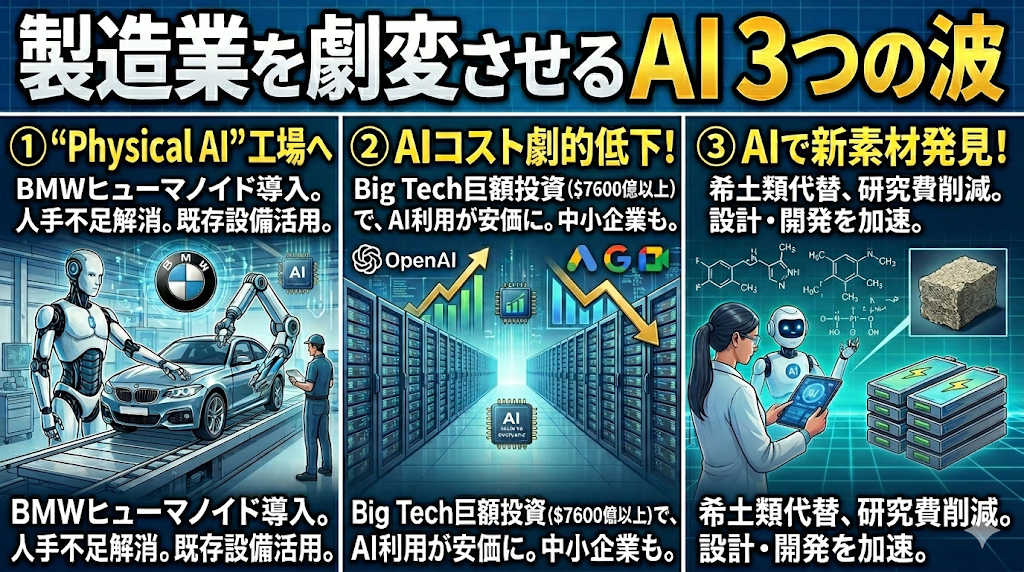
Physical AI” will spread from automobile factories to the industrial world.
BMW’s introduction of humanoid robots is a symbolic event. Until now, robots have mainly been fixed industrial arms, but humanoid robots have the disruptive advantage that they can be introduced with virtually no change to existing factory equipment and layout. For the Japanese manufacturing industry, expectations for “robots that can use the same tools in the same space as humans” will rapidly increase as the labor shortage becomes more serious due to the declining birthrate, and the exhibition at Hannover Messe 2026 shows that this trend is expanding beyond the European giants.
(ii) Increased scale of investment drives down AI service costs.
The $110 billion OpenAI procurement and $650 billion Big Tech infrastructure investment will mean even lower AI inference costs in the medium to long term. For manufacturing SMEs, AI predictive maintenance and quality inspection solutions, which have been hard to reach as expensive cloud services, could become dramatically cheaper within a few years.
Integration of AI into the material exploration and design stages is in full swing.
AI-driven rare earth substitute material discovery is directly related to supply chain risk management in the manufacturing industry Reducing rare earth dependency has long been a challenge for EV, precision equipment, and electronic component manufacturers AI-driven material discovery platform enables discovery of alternative materials while dramatically reducing research costs and time, AI integration of upstream processes from material procurement to product design will be accelerated at once.
summary
The week of February 22-28, 2026 was a week in which AI moved simultaneously at all layers of funding, models, hardware, and materials. In regard to manufacturing in particular, multiple news reports indicate that the transition to “AI that actually works on the factory floor” is steadily underway. The most important thing to watch in the next six months will be how many humanoid robot companies (Boston Dynamics, AEON, Unitree, and others) can get into the mass production lines – and whether Japanese manufacturers can ride that wave.
Source List
- Reuters, “OpenAI’s $11 billion funding round draws investment from Amazon, Nvidia, SoftBank” (February 27, 2026)
https://www.reuters.com/ business/retail-consumer/openais-110-billion-funding-round-draws-investment-amazon-nvidia-softbank-2026-02-27/ - OpenAI’s official blog, “Scaling AI for everyone” (February 27, 2026)
https://openai.com/index/scaling-ai-for-everyone/ - The New York Times, “OpenAI Raises $11 Billion to Fuel Growth, Extending A.I. Boom” (February 27, 2026)
https://www.nytimes.com/2026/02/27/business/ openai-funding.html - Reuters, “Big Tech to invest about $65 billion in AI in 2026, Bridgewater says” (February 23, 2026)
https://www.reuters.com/business/big-tech-invest- about-650-billion-ai-2026-bridgewater-says-2026-02-23/ - Google Blog, “Gemini 3.1 Pro: A smarter model for your most complex tasks” (February 2026)
https://blog.google/innovation-and-ai/models-and-research/ gemini-models/gemini-3-1-pro/ - Google Blog, “Nano Banana 2: Combining Pro capabilities with lightning-fast speed” (February 26, 2026)
https://blog.google/innovation-and-ai/ technology/ai/nano-banana-2/ - TechCrunch, “Google launches Nano Banana 2 model with faster image generation” (February 26, 2026)
https://techcrunch.com/2026/02/26/google-launches- nano-banana-2-model-with-faster-image-generation/ - CNBC, “Anthropic releases Claude Sonnet 4.6, the new default for free and pro” (February 17, 2026)
https://www.cnbc.com/2026/02/17/anthropic-ai-claude- sonnet-4-6-default-free-pro.html - Reuters, “Anthropic touts new AI tools weeks after legal plug-in spurred market rout” (February 24, 2026)
https://www.reuters.com/business/finance/ anthropic-touts-new-ai-tools-weeks-after-legal-plug-in-spurred-market-route-2026-02-24/ - BMW Group official press release, “BMW Group to deploy humanoid robots in production in Germany for the first time” (February 27, 2026)
https://www.press.bmwgroup.com/ global/article/detail/T0455864EN/bmw-group-to-deploy-humanoid-robots-in-production-in-germany-for-the-first-time - Autoweek, “BMW Says Humanoid Robots Will Support, Not Replace Workers” (February 27, 2026)
https://www.autoweek.com/news/a70537237/bmw-using-humanoid -robots/ - Apple Newsroom, “Apple accelerates U.S. manufacturing with Mac mini production” (February 24, 2026)
https://www.apple.com/newsroom/2026/02/apple- accelerates-us-manufacturing-with-mac-mini-production/ - Science Daily, “AI breakthrough could replace rare earth magnets in electric vehicles” (February 18, 2026)
https://www.sciencedaily.com/releases/2026/ 02/260218031611.htm - Solutions Review, “Artificial Intelligence News for the Week of February 27, 2026” (February 27, 2026)
https://solutionsreview.com/artificial- intelligence-news-for-the-week-of-february-27-updates-from-red-hat-splunk-vast-data-more/ - Red Hat Official “Red Hat Launches Red Hat AI Enterprise” (February 27, 2026)
https://www.redhat.com/en/about/press-releases/red-hat-launches-red-hat-ai- enterprise-deliver-unified-ai-platform-spans-metal-agents - Hannover Messe official “AI at HANNOVER MESSE: Out of theory. Into application.” (February 25, 2026)
https://www.hannovermesse.de/en/press/press-releases/ hannover-messe/ai-at-hannover-messe-out-of-theory-into-application- - GlobeNewswire, “AI-Driven Defense Manufacturing Infrastructure Report” (February 27, 2026)
https://www.globenewswire.com/news-release/2026/02/27/ 3246330/28124/en/AI-Driven-Defense-Manufacturing-Infrastructure-Report-2025-2030 - Dataiku, “Manufacturing’s 2026 Mandate: From AI Pilot to Agentic Profit” (2026)
https://www.dataiku.com/stories/blog/ manufacturing-ai-trends-2026