“We’ve progressed to AI PoC (proof of concept), but it won’t deploy to the actual production line”
“We’re struggling with yield loss due to chamber aging and defect generation”
“We don’t know how to transfer veteran engineers’ ‘adjustment know-how’ and tacit knowledge to AI”
“We want to know how our actions and materials will be evaluated in the AI transformation of cutting-edge fabs”
Four values you’ll gain from this document
01
Grasp the essence of the latest paper in 15 minutes
Explains the mechanism of “event-driven reinforcement learning (RL)” that surpasses conventional time-fixed control, validated in the production fab of European semiconductor giant STMicroelectronics.
02
Includes infographic illustrations
Intuitively understand the critical difference between conventional periodic control and event-driven RL, and the steps of autonomous feedback, with a single diagram sheet.
03
Practical translation from both TEL × Samsung perspectives
Masayuki Tomoyasu, who experienced both frontlines of Tokyo Electron (equipment development and management) and Samsung Electronics (device adoption), reveals “where the equipment side (makers) and the fab side (users) are misaligned.”
04
Implementation checklist for equipment, materials, and component manufacturers
Practical guide covering “data preparation pitfalls,” “linkage of process capability (Cpk) and reliability,” “on-site UI that veterans won’t ignore,” and “explanation scripts for customer QA.”
“Exposure correction (OPC) rules for advanced nodes (3nm/2nm) are becoming complex, and we’re troubled by yield loss due to interference”
“Experienced process engineers’ intuition and past troubleshooting logs are scattered among individuals”
“Trial-and-error OPC recipe corrections take several weeks, delaying production qualification”
Four values you’ll gain from this document
01
Grasp the latest trends in autonomous repair AI (VPEvolve) in 15 minutes
Explains the self-evolving correction mechanism through Virtual Process Engineer (VPE) Harness and Skill Bank.
02
Includes infographic illustrations
Illustrates the comparison between manual OPC correction and self-evolving AI, and VPEvolve’s autonomous feedback steps in a single diagram.
03
Practical translation from both TEL × Samsung perspectives
Masayuki Tomoyasu, who was involved in process development and management on both the equipment manufacturer side (makers) and the fab side (users), provides an original analysis of “why this AI Agent represents a business opportunity for exposure, inspection, and component manufacturers.”
04
Implementation checklist for equipment, materials, and component manufacturers
Four-perspective guide: “data preparation pitfalls,” “criteria for decision metrics,” “on-site UI design,” and “customer explanation scripts.”
Innovating VLA (Vision-Language-Action) Model Adaptation in Manufacturing and Robotics: How Noise Space Learning (NSL) Delivers a Practical Solution for Autonomous Control
Published October 9, 2026 Latest Paper Analysis
“Without rewriting the model’s weights, only the ‘first move’ is adapted to the field.”
The full story of an autonomous adaptation AI that raised task success rates from 0% to over 85% in just 10 to 20 real-machine trials—without ever breaking a single safety guardrail.
500 yen(tax included) / PDF document (14 pages total)
“We want to deploy robot AI (VLA models) on our production line, but we’re afraid fine-tuning could break the safety controls.”
“Trial and error on real equipment carries the risk of millions of yen in equipment damage or line stoppage per attempt, making it hard to experiment with AI casually.”
“The ‘know-how’ behind veteran engineers’ fine adjustments is highly personal and tacit, and it’s unclear how to carry that knowledge over when introducing AI.”
Four values you’ll gain from this document
01
Grasp the Latest Trends in Field-Adaptive Robot AI in 15 Minutes
A clear, accessible explanation of the mechanism behind “Noise Space Learning (NSL),” which adapts VLA models to the field while keeping the model weights completely frozen—no specialist knowledge required.
02
Includes infographic illustrations
A single diagram comparing conventional fine-tuning methods with NSL, illustrating how NSL achieves safe, low-cost field adaptation.
03
Practical translation from both TEL × Samsung perspectives
Masayuki Tomoyasu, who has been involved in process development and management on both the equipment manufacturer (supply) side and the device manufacturer (user) side, offers his own analysis of why “AI that doesn’t break the model” is becoming an essential requirement for manufacturing sites.
04
An Implementation Checklist for Executives, Production Engineers, and AI Adoption Leaders
A 5-step implementation guide—covering “inventory of target processes,” “base model selection,” “preparing reference data,” “small-scale PoC,” and “roadmap for horizontal deployment”—plus a Frequently Asked Questions (FAQ) section.
Price and Format
Price
500 yen (tax included)
Format
High-Quality PDF Document (A4, Print-Ready, 14 Pages Total)
“During mass production ramp-up, failure analysis (FA) cases are bottlenecked, concentrating the burden on a limited number of veteran engineers.”
“The veteran’s judgment know-how—the ‘I’ve seen this defect before’ intuition—is personalized and siloed, risking total loss upon their retirement.”
“We need to fix the inefficient analysis process of checking equipment telemetry, inspection images, and past cases in isolation.”
Four values you’ll gain from this document
01
Grasp the latest trends in semiconductor failure analysis AI agents in 15 minutes
A clear, accessible explanation of the “SemiFA” mechanism that integrates image recognition AI, equipment telemetry, and past case databases, even for those without specialized knowledge.
02
Includes infographic illustrations
A single-page comparative infographic showing conventional manual failure analysis versus the SemiFA 4-agent diagnostic relay.
03
Practical translation from both TEL × Samsung perspectives
Masayuki Tomoyasu, who has been involved in mass production ramp-up and troubleshooting for both equipment manufacturers (the makers) and device manufacturers (the users), provides a unique analysis of “why externalizing the veteran’s diagnostic process is an urgent priority.”
04
Implementation checklist for Factory Managers, Production Engineering, and Quality Assurance departments
A 5-step implementation guide covering “Digitizing Past FA Records,” “SECS/GEM Telemetry Infrastructure Audit,” “Small-scale PoC,” and “Designing Human-AI Role Distribution,” plus Frequently Asked Questions (FAQ).
Price and Format
Price
500 yen (tax included)
Format
High-Quality PDF Document (A4, Print-Ready, 14 Pages Total)
Failure Analysis in the Advanced Packaging Era: Tracing Invisible Defects Through Connected Data
Published June 20, 2026 Latest Paper Analysis
“Even when the location of a defect is visible, the cause often lies in a different layer, process, or dataset.”
Insights from a survey of roughly 100 practitioners reveal the frontier of failure analysis and standardization in the era of hybrid bonding and 3D integration.
“Defects in advanced packages are increasing, but cross-sections and images alone make it difficult to pinpoint the cause.”
“Electrical testing, X-ray imaging, equipment logs, and material data all exist separately, slowing down the back-and-forth of analysis.”
“We want to use AI to streamline failure analysis, but our data formats and preprocessing conditions aren’t yet aligned.”
Four values you’ll gain from this document
01
Grasp the Priority Issues in Advanced Package FA in 15 Minutes
A practical breakdown of industry survey findings, including 54% adoption of hybrid bonding, a non-destructive imaging score of 8.18, and 83% support for standardization.
02
Includes infographic illustrations
A single chart organizing the challenges of “hard-to-see structures” and “disconnected data,” tracing the flow from non-destructive observation to standardization.
03
Practical translation from both TEL × Samsung perspectives
Drawing on perspectives from both equipment and device sides, Masayuki Tomoyasu offers an original analysis of why data integration matters more than standalone equipment, and what suppliers and customers should share.
04
Implementation Roadmap and Handover Sheet
Concrete guidance covering the criteria for transitioning from non-destructive to destructive analysis, common data fields, action items by organization, and a 90-day small-scale implementation plan.
CausalPulse: From AI that detects anomalies to AI that explains causes
Published March 31, 2026 Latest Paper Analysis
“Issuing an alert is not the end of the on-site root cause investigation.”
The full picture of an Industrial Diagnostic Copilot that presents the background and candidate causes of anomalies using process knowledge and multiple AI agents.
“We have sensor-based anomaly detection, but the subsequent root cause investigation relies heavily on veteran intuition.”
“Sensor data, process history, and technical knowledge are siloed, making it difficult to distinguish between correlation and causation.”
“We want the AI to explain the causes, but we cannot use black-box answers directly for process control.”
Four values you’ll gain from this document
01
Grasp the design of explainable manufacturing AI in 15 minutes
A clear explanation of CausalPulse—which integrates anomaly detection, causal discovery, and causal path ranking—using a detective team analogy.
02
Includes infographic illustrations
A single-sheet summary of the differences between conventional anomaly-only detection and CausalPulse, where knowledge, AI, and humans collaborate.
03
Practical translation from both TEL × Samsung perspectives
Drawing from both equipment-side and device-side experience, Masayuki Tomoyasu analyzes the difference between “being able to explain the cause” and “being able to implement countermeasures safely.”
04
Evaluation Metrics, Implementation Roadmap, and Report Templates
Includes the difference between 98% execution success rates and causal accuracy, how to proceed with PoC, how to cultivate knowledge, a 90-day implementation example, and diagnostic report templates.
Direct Measurement of Instantaneous Kerr Response in Semiconductors: Capturing Time-Resolved Nonlinear Refractive Index of Germanium
Published October 30, 2026 Latest Paper Analysis
“Refractive index changes with light. Does that change truly happen instantaneously?”
An explanation of a new measurement technique that resolves the electric field itself to distinguish between the instantaneous Kerr response and delayed free-carrier effects.
“Indirect measurements such as z-scans cannot capture the temporal evolution of nonlinear optical responses.”
“I want to evaluate materials by separating the instantaneous Kerr effect from delayed free-carrier effects.”
“I want to accurately grasp the nonlinear characteristics of semiconductor materials like germanium and mid-infrared photonics.”
Four values you’ll gain from this document
01
Understand Field-Resolved Pump-Probe Measurement in 15 Minutes
A clear summary, accessible even to non-specialists, of the mechanism for directly reading phase changes in the transmitted electric field while varying the time delay between a strong pump and a weak probe pulse.
02
Illustrated Measurement Principles and Response Separation
A single-page diagram illustrating the difference between standard intensity-based measurements and field-resolved measurements, and how to distinguish the instantaneous Kerr response from delayed components.
03
Correctly Interpreting Measured Values for Germanium
An explanation of the nonlinear refractive index n2=(0.87±0.16)×10-17 m²/W at a wavelength of 5 μm, and results showing phase changes increasing in proportion to pump intensity.
04
TEL × Samsung Perspectives: Implications for Materials, Metrology, and Equipment Development
An analysis of semiconductor material characterization, differentiation of metrology equipment, and applications in mid-infrared photonics from both the equipment and device manufacturer perspectives.
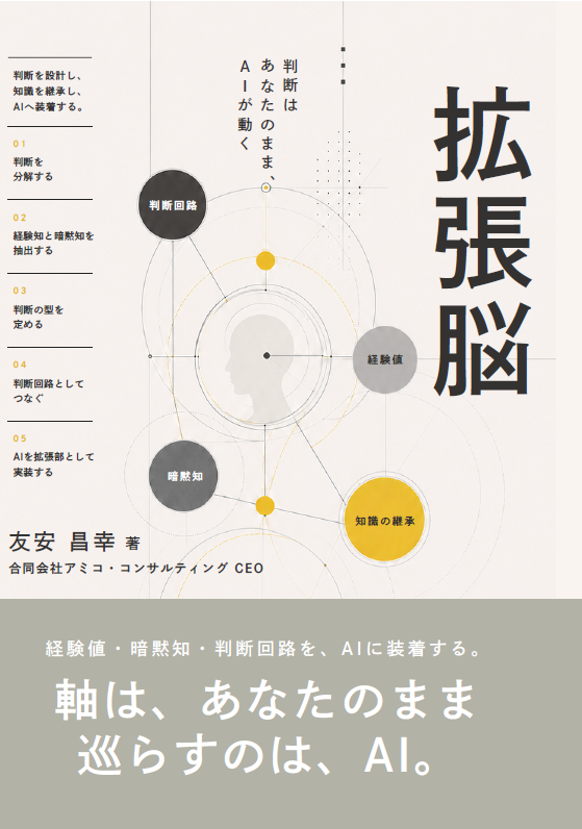
The more polished drafts you get, the more the burden of judgment increases. This book calls that phenomenon ‘spinning in place.’
This book was produced through Tenro-in Bookstore’s author production service “AI Hyper Press.”
“Install” your experience, tacit knowledge, and decision-making circuits into AI. Your axis remains yours. AI does the circulation. A book to reclaim not speed, but the quality of judgment.
This book designs “judgment” in the AI era for professionals in corporations, government, and academia who face challenges in “knowledge utilization.” It traces five stages: ①decompose judgment ②extract experiential and tacit knowledge ③define patterns ④connect as decision circuits ⑤implement AI as an extension—through four real-world examples.
The author is a practitioner with 37 years in the semiconductor industry, having served as an executive on both the “selling side” and the “using side” of equipment. The practical knowledge of “judgment” gained from both perspectives is the starting point of this book.
─────────────────────────
■ Recommended for
・Those who feel that while AI has increased drafts, the burden of judgment has actually grown ・Those who end up rethinking everything themselves each time they instruct “create this” ・Those who want to transfer their experience and tacit knowledge to AI ・Those in corporations, government, and academia facing challenges in knowledge utilization and succession
─────────────────────────
■ Table of Contents
Prologue: One Morning in 2026 Chapter 1: Three Types of Spinning in Place—What’s Happening in Your Work Chapter 2: Handing Purpose to AI Chapter 3: The Concept of Extended Mind Chapter 4: Handing Over in Five Stages Chapter 5: Four Real Examples—Proposals / Monthly Reviews / Management Decisions / Tacit Knowledge Succession Chapter 6: Three Functions That Circulate the Extended Mind—Metrics, Weaving, Resonance Chapter 7: Filling the Scaffolding of Tacit Knowledge—The Scaffold Method Afterword: One Morning, Brewing Coffee Again What to Read Next / Appendix (Templates for Decision Patterns, Self-Profile, Purpose Hierarchy)
─────────────────────────
■ Author Profile
Masayuki Tomoyasu CEO, Amiko Consulting LLC. Graduate of the Faculty of Engineering, University of Tokyo. 37 years in the semiconductor industry, having served as an executive on both the “selling side” and the “using side” of equipment. Based on the practical knowledge of “judgment” gained from both perspectives, he systematized a methodology for installing knowledge and judgment into AI.
─────────────────────────
Author: Masayuki Tomoyasu Format: A5 Pages: 218 Price: 1,980 yen (1,800 yen + tax) ISBN978-4-9914979-0-2 *Shipping fee of 500 yen applies separately.
This book provides an insight into the industrial structure in 2030, when generative AI, geopolitics, and ESG will intersect, based on our unique “Triple Structure Industry Framework”. This book was written for those involved in strategic planning and business development in the semiconductor industry.