
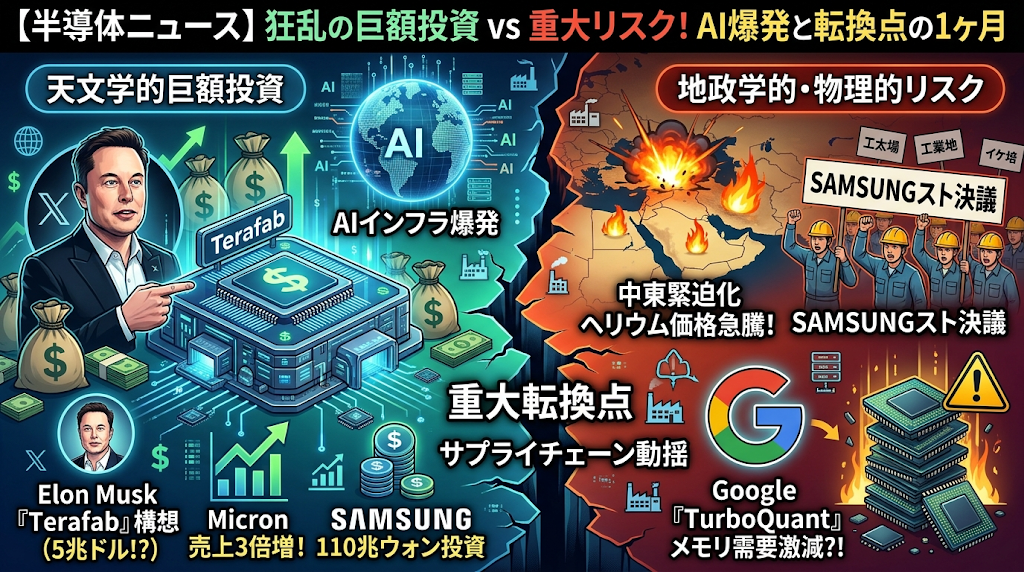
This month’s semiconductor news has been marked by an intense mix of astronomical investments in building AI infrastructure and geopolitical and physical risks that could shake the supply chain to its very foundations. There has been a series of capital investments that could be described as frenzy, such as Elon Musk’s “Terafab” concept with a total investment estimated to be in the order of $5 trillion, Micron’s tripling of sales, and Samsung’s 110 trillion won investment. On the other hand, there have been a series of critical turning points that have brought uncertainty to the industry’s growth trajectory, including a sharp rise in the price of helium due to tensions in the Middle East, a resolution by the Samsung Electronics labor union for a large-scale strike, and the possibility of a sharp decline in memory demand due to Google’s “TurboQuant” data compression technology, It has been a month of rapid change.
Samsung Electronics plans to invest over 110 trillion won in the AI semiconductor field, wins HBM4 supply contract for OpenAI
Samsung Electronics has officially announced plans to invest a whopping 110 trillion won in AI semiconductor-related facility expansion and R&D in 2026. It is also reported in various media that Samsung Electronics has won a contract to supply HBM4, the next-generation high-bandwidth memory for OpenAI, the leader in generative AI. In order to meet this extremely large demand, Samsung plans to make a bold and aggressive shift in its production line, shifting more than 50 percent of its Pyeongtaek Foundry’s production capacity to HBM4 base die manufacturing. At this year’s general shareholders’ meeting, Samsung strongly emphasized its complete business shift to AI memory through the HBM showcase, demonstrating its seriousness in regaining market supremacy from its rivals SK Hynix and Micron. While this 110 trillion won investment and forced conversion of production lines will bring historic special demand to semiconductor equipment manufacturers and material suppliers, it will also mean a dramatic reduction in the production quotas for smartphone processors and general-purpose logic semiconductors that have been manufactured at the plant. There are fears that this will add to the tight supply of analog ICs and legacy semiconductors throughout the supply chain and, as a result, will be a major factor contributing to higher prices for electronics products as a whole.
Micron Triples Quarterly Sales on Explosive AI Demand; Capital Expenditures Surge to $25 Billion in FY2026
Micron Technology’s Q2 FY2026 financial results set a historic record with revenue nearly tripling year over year, driven by strong tailwind from surging demand for data center infrastructure for generative AI. The company was among the first to begin high-volume production of HBM4, which is essential for AI infrastructure, and PCIe Gen6 SSDs for servers, and the strong demand led to the industry’s first five-year long-term customer agreement. As a result, Micron has quickly and significantly raised its capital investment plan for FY2026 to the $25 billion level. Furthermore, Micron has completed the acquisition of P5, a 300mm plant owned by Taiwan’s PSMC, and is rapidly constructing a second plant on the same site, pushing ahead at full speed with an extraordinary business expansion backed by special demand for AI. This ultra-massive capital investment is a strong move to break through the memory supply stagnation caused by the lack of physical clean room space by brute force. While this will bring an unprecedented rush of orders to all suppliers of semiconductor production equipment, specialty gases, ultrapure water systems, and other key infrastructure, the concentration of funds in the advanced memory area is also creating structural distortions that will cause price volatility as capital investment in general-purpose memory is put on the back burner. This has also created structural distortions that have led to price volatility.
NVIDIA Declares $1 Trillion AI Inference Market at GTC 2026, Unveils New Vera Rubin Architecture and Multi-Foundry Strategy
At NVIDIA’s GTC 2026, the world’s largest AI developer conference, CEO Jensen Huang shocked the entire industry when he predicted that the future AI inference market will grow to an astronomical $1 trillion. In response, NVIDIA announced its plan to outsource the manufacturing of LPU chips specialized for inference processing to Samsung Electronics’ foundry. This marks a historic turning point in the company’s manufacturing strategy, which has been centrally dependent on TSMC’s leading-edge processes, to a full-fledged shift to a multi-foundry structure. In addition, at the same event, TSMC unveiled the new CPUVera, which is dedicated to agent AI, and unveiled its next-generation architecture, Vera Rubin, in its entirety. At the same time, the company also announced solutions to streamline system design in collaboration with Cadence, a leading electronic design automation company, and others, further strengthening the encompassing of a broad AI ecosystem that includes not only hardware offerings, but also design infrastructure and software. The focus of the AI industry is shifting from a race for hardware performance to the “economics of inference”-how to lower the cost of inference.
Elon Musk’s “Terafab” initiative is in full swing, aiming to manufacture 200 billion AI chips per year with a total investment of $5 trillion.
Elon Musk, the leader of Tesla and other companies, has announced that his own AI chip manufacturing project, Terafab, will soon be fully operational. Wall Street securities analysts estimate that the total investment in this project could reach a staggering $5 trillion, which is equivalent to a large portion of the annual U.S. national budget. It is an ambitious vision to completely in-house manufacture its own AI chips, which will be the brains behind fully automated driving and humanoid robots, on an unprecedented scale of 200 billion chips per year, without being bound by the production capacity constraints of existing semiconductor manufacturers and giant foundries. Currently, Tesla is rapidly expanding its recruiting efforts in Taiwan, reportedly targeting people from TSMC, the world’s largest foundry, as its main target. The existing business model of the foundry industry is under great threat if giant technology companies come to have their own super giant fabs with their enormous capital power. This will have the impact of fundamentally disrupting the paradigm of the semiconductor industry, where the horizontal division of labor between fabless and foundries has been the norm.
Tensions in the Middle East have caused the spot price of helium to soar over 50 percent, severely damaging the supply chain.
Intensifying geopolitical tensions in the Middle East over Iran and Israel have caused the spot price of helium, a specialty gas essential for semiconductor manufacturing and cooling processes, to soar by more than 50 percent. Production and distribution routes in Qatar, a major producer, have been severely disrupted, leaving the global semiconductor supply chain under severe inventory constraints with a two-week time limit. South Korean chipmakers, including memory giants Samsung Electronics and SK Hynix, as well as Taiwan’s TSMC, are on high alert for this physical material supply disruption risk. A shortage of helium is a critical bottleneck that can immediately force even the most advanced plants with the most advanced technology to shut down operations. Furthermore, the prolonged Gulf crisis has caused logistics detour and soaring oil prices, which have also dramatically pushed up the cost of procurement of petrochemical products and resin materials. This has resulted in intense inflationary pressures that have spilled over into the electronics industry as a whole, further driving up the already high cost of manufacturing chips.
Google’s new “TurboQuant” technology reduces LLM memory demand by 6x, a strong headwind for the overheated memory market.
Google’s newly announced breakthrough algorithm technology TurboQuant has successfully reduced the KV cache memory capacity requirements when inferring large language models by a factor of six or more. This technology has the potential to fundamentally reset the cost curve of AI inference by compressing data to the limit without sacrificing AI accuracy. Until now, the biggest bottleneck in building AI data centers has been securing high-bandwidth memory and high-capacity DRAM, which has been so frenzied that some analysts have predicted DRAM prices to rise up to 80 percent in the first quarter of 2026. However, the announcement suggested that future demand for memory as hardware could be structurally drastically reduced, immediately pouring cold water on the previously overheated share prices of memory-related stocks such as Samsung and SK Hynix. On the other hand, a major paradigm shift is expected, as the cost of manufacturing inference servers will drop dramatically, accelerating the spread of edge AI and creating new semiconductor demand for communication infrastructure and small devices.
SK Hynix Considers ADR Listing on U.S. Market to Secure 100 Trillion Won in Net Cash for AI Investment
Memory giant SK Hynix has set a goal of securing an order of magnitude net cash of 100 trillion won to meet the exploding demand for AI infrastructure and the race to develop next-generation memory over the long term. As a means of achieving this massive fundraising, SK Hynix has announced that it is considering a depositary receipt listing on the U.S. market by the second half of 2026. The company has also agreed to invest an additional $8 billion in ASML’s EUV lithography equipment by 2027 in order to significantly increase its next-generation memory production capacity. SK Hynix is also planning to adopt TSMC’s cutting-edge 3-nanometer technology to gain a technological edge over Samsung Electronics, its biggest competitor in logic die manufacturing for the next-generation broadband memory HBM4E. It is a strategic move by SK Hynix to leverage the global capital market to support its astronomical capital investment and establish absolute market superiority.
Japanese Power Semiconductor Realignment Intensifies; Denso’s Proposed Acquisition of ROHM and Business Integration Talks with Toshiba and Mitsubishi Electric Emerge
A major restructuring battle for survival in the Japanese power semiconductor industry has begun in earnest. Denso, a core component manufacturer in the Toyota Motor Group, has made headlines by proposing a massive acquisition of ROHM, a major Japanese semiconductor manufacturer, for up to $8 billion to strengthen its automotive semiconductor and power control business, which is essential for electric vehicles and automated driving technology. Around the same time, it was also reported that Toshiba, ROHM, and Mitsubishi Electric had begun full-scale talks to merge their power device and semiconductor businesses. In the power chip market, where demand is surging amid the trend toward decarbonization, the major Japanese companies are not competing separately, but rather are coming together to secure economies of scale and enormous investment capacity in order to compete with Chinese and Western giants that are rapidly expanding their share of the global market. This mega deal, which transcends the boundaries of affiliations, will fundamentally change the structure of Japan’s semiconductor supply chain and will be an important turning point in creating a strong competitive edge.
Arm announces “AGI CPU” for data centers, its first full-scale entry into the silicon manufacturing business in-house.
Arm, a world leader in semiconductor design architecture, has entered the chip manufacturing and sales business for the first time with the announcement of its AGI CPU, a silicon product designed specifically for general-purpose artificial intelligence processing in data centers. The company, whose core business has been the provision of IP design licenses, has made a major shift to a business model in which it manufactures its own chips using TSMC’s state-of-the-art 3-nanometer process and supplies them directly to giant IT companies such as Meta and OpenAI, promising up to twice the performance of existing processors. This strategic shift is a direct result of APC’s efforts to develop and manufacture its own chips using the most advanced nanoprocesses. This strategic shift has caused serious competition and conflicts of interest with chipmakers that have relied on Arm’s existing ecosystem, as well as TSMC-backed ASIC design firms such as GUC, A new wave of vertical integration is sweeping through the AI hardware market, with architectural design firms getting into manufacturing themselves and connecting directly with cloud vendors, a historic event that is fundamentally shaking the balance of power in the industry.
Rapidus Raises $1.7 Billion, Closing in on TSMC by “Six Months” in Next-Generation 1-Nanometer Semiconductor Development
Rapidus, Japan’s leading semiconductor manufacturer, announced today that it has successfully raised $1.7 billion in new financing from dozens of private companies to secure its plan to mass produce the 2-nanometer generation by 2027. This brings the total amount of public and private investment to date to an enormous sum, further solidifying the financial foundation of this national project to revive Japan’s semiconductor industry. The company’s CTO Ishimaru expressed strong confidence that the company has narrowed the technological gap with TSMC, the world’s largest foundry, in the development of next-generation 1-nanometer semiconductor technology to just six months. In addition, the company has made steady progress in building its own ecosystem, including the introduction of AI tools to significantly shorten design time, a partnership with Canon on 2-nanometer image processing chips, and the development of cutting-edge packaging technology. The challenge to regain the lost market share of Japan’s semiconductor industry is closing in on the top runner as a realistic threat on the frontlines of the global ultra-fine process competition.