

Looking at this week’s AI news, the focus is no longer just on whether a new model has emerged. From cyber defense, to securing computational resources, to power needs, to redesigning the way we work, AI is now being treated as an “industrial system” in earnest. It is important for manufacturers to move beyond viewing generative AI as a mere documentation tool and rethink it as a management platform that links design, maintenance, procurement, field operations, and energy management.
*This report is organized as trends for the week of April 5-11, based on key information available as of April 10 UTC.
Topics.
1. Anthropic Launches “Project Glasswing”; AI Cyber Defense Enters New Phase
On April 7, Anthropic announced “Project Glasswing,” a collaboration with AWS, Apple, Broadcom, Cisco, CrowdStrike, Google, JPMorganChase, the Linux Foundation, Microsoft, NVIDIA, Palo Alto Networks, and others. Project Glasswing” has been announced. The idea behind the project is the recognition that the unpublished “Claude Mythos Preview” has reached the point where it can find a large number of high-severity vulnerabilities in major operating systems, browsers, and the Linux kernel. This week’s major turning point was the realization that AI is not only a “tool to automate attacks” but also a “tool to anticipate defenses. Anthropic

Implication for drafting industry: “Software-enabled assets” at manufacturing sites, including design drawings, BOM, PLC settings, maintenance procedure manuals, inspection equipment software, and even MES linkage codes, are more vulnerable than imagined. In the future, not only quality assurance, but also a system that constantly rotates OT/IT integrated vulnerability inspections using AI will become a competitive advantage.
2. Anthropic secures large-scale computing resources for next-generation TPUs with Google and Broadcom
Anthropic announced on April 6 that it has signed multi-gigawatt next-generation TPU computing resource contracts with Google and Broadcom. The company expects to begin operations in 2027 or later, but what is noteworthy is the scale of the project. The AI competition is shifting from model performance to “supply chain competition” to determine how much computing resources can be stably held in reserve. The competition is shifting from model performance to “supply chain competition” to determine how much stable computational resources can be held. Anthropic
Implications for the drafting industry: AI for manufacturing’s future use also cannot be an extension of in-house PoC. If design optimization, image inspection, demand forecasting, maintenance, and document generation are to be deployed company-wide, they need to have an “AI procurement strategy” that includes the risk of external cloud dependencies, inference costs, response latency, and data sovereignty.
Meta releases “Muse Spark,” a step forward in multimodal inference.
On April 8, Meta released Muse Spark, the first set of models from Meta Superintelligence Labs. Meta sees this as the first step toward “personal superintelligence. Meta sees this as the first step toward “personal superintelligence” and has clearly set its sights on integrating image understanding, dialogue, environmental awareness, and practical task support. Meta AI
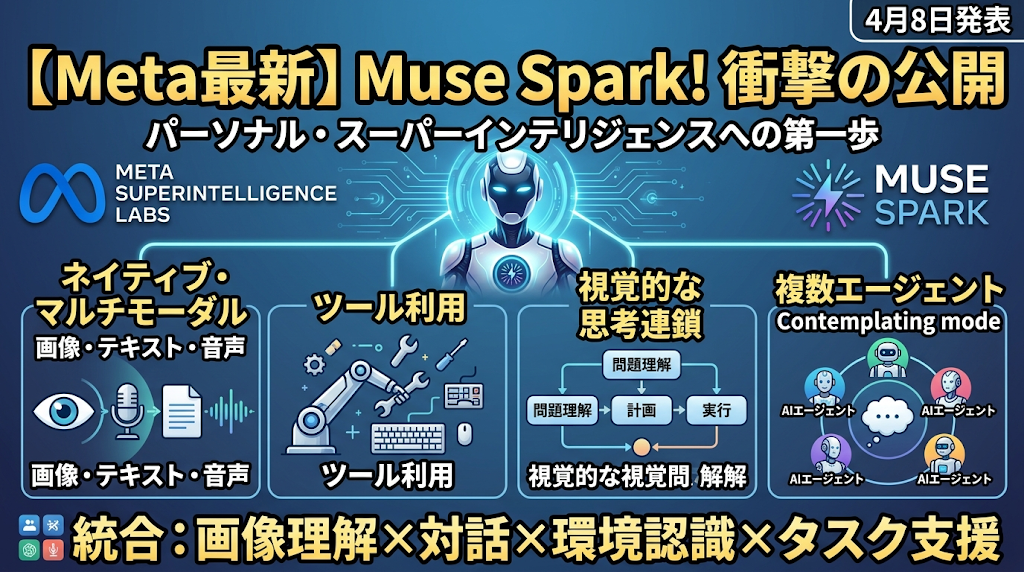
Implications for the drafting industry: In the field of drafting, design, and manufacturing preparation, drawings, 3D models, photographs, equipment manuals, and verbal know-how are fragmented. When AI that can understand these different types of data across the board becomes widely available, the ability to check the impact of design changes, automatically generate work instructions, and suggest potential causes from faulty photographs will all become a reality.
4. OpenAI presents “Industrial Policy for the AI Age,” focusing on institutions rather than technology
On April 6, OpenAI released “Industrial Policy for the Intelligence Age,” bringing to the forefront a policy argument for how to distribute the fruits of AI to society. Proposals include a public wealth fund, consideration of taxation related to AI-driven profits and automated labor, a 32-hour, 4-day work week demonstration, portable benefits, wage insurance, and retraining support. Rather than “which model is stronger” this week, “how to design employment, taxation, and retraining after AI implementation” emerged as a key issue. OpenAI OpenAI PDF
Implications for Draftsmen: In the manufacturing industry, whether to replace the shop floor with AI or to enhance human resources with AI will greatly affect the outcome. It is important to design a transition that incorporates shorter working hours and retraining, based on the premise that “people are responsible for the last tasks,” such as drawing, process design, maintenance records, and procurement documents.
5. “The industrialization of AI as an equipment industry” as indicated by the Reuters report – data centers and power are at the core.
On April 9, Reuters summarized the situation with CoreWeave and Meta’s $21 billion cloud capacity deal, as well as OpenAI, Meta, NVIDIA, Google, and others accumulating AI infrastructure contracts in the billions to hundreds of billions of dollars. In addition, on April 7, the U.S. EIA forecast reported that U.S. electricity consumption will hit record highs in 2026 and 2027 due to increased demand for data centers for AI and crypto assets AI is clearly not a “software industry” but involves “semiconductor, power, cooling, land, and construction”. It is turning into a heavy equipment industry. Reuters Reuters

Implications for Drafting Industry: The use of AI in factories does not end with algorithm implementation alone. Companies that treat AI as facility design, including power contracts, server placement, edge inference, communication latency, cooling, and even BCP, will have an advantage in implementation speed.
General Considerations for Manufacturing
In a nutshell, the trend this week is that AI has moved from “useful intelligent applications” to “industrial infrastructure”. In the manufacturing industry, generative AI has often been deployed from minutes, summaries, and inquiry response, but that is not the main battleground for the future. The focus will shift to areas directly related to profitability and stable operation, such as design information integration, predictive detection of quality anomalies, automatic proposals for equipment maintenance, procurement and inventory simulation, and OT security monitoring. Anthropic Meta AI
Of particular importance is the evolution of multimodal AI. The ability to handle drawings, photos, videos, sensor data, inspection records, and conversation logs together will greatly improve information fragmentation in the manufacturing industry. For example, support for pulling similar past cases from images of defective products and presenting candidate causes across related drawing differences and maintenance history is now well within the realm of possibility. This is not just a simple improvement in operational efficiency, but the formalization of human knowledge. Meta AI
On the other hand, it is not only technical capabilities that make the difference between success and failure in implementation; as OpenAI has presented, AI implementation without retraining, wage design, benefits, and labor-management dialogue will lead to a backlash on the shop floor and blurring of quality responsibilities. The companies that will succeed in manufacturing will be those that can design AI that amplifies the judgment of skilled workers and reduces dangerous, simple, and repetitive tasks, rather than AI that reduces the number of people. OpenAI OpenAI PDF
In addition, the proliferation of AI will bounce back to the factory’s infrastructure strategy. If large-scale inference and image analysis are to be fully operational, cloud costs, lines, power, security, and edge placement must be optimized. In the future, the new competitive advantage for manufacturing will be the architectural design that determines not only “which AI model to use,” but also “which processing will be done in the factory and which will be done in the cloud. Anthropic Reuters
summary
AI news in the second week of April 2026 showed the reality beyond the model performance race. AI has become the mainstay of defense in cyber defense, securing gigawatts of computing resources is a point of contention, institutional reform is being discussed in the way we work, and power and data centers are bottlenecks in terms of infrastructure. The lesson for manufacturers is clear: AI utilization has entered a stage where it should be treated not as a one-off PoC, but as a company-wide strategy that spans design, shop floor, management, and infrastructure. The future winners will not be those companies that implement AI, but those that can restructure their operations, facilities, and human resource design based on AI assumptions.
Source List
- OpenAI, “Industrial policy for the Intelligence Age,”
https://openai.com/index/industrial-policy-for-the- intelligence-age/ - OpenAI, “Industrial Policy for the Intelligence Age: Ideas to keep people first”
https://cdn.openai.com/pdf/561e7512- 253e-424b-9734-ef4098440601/Industrial%20Policy%20for%20the%20Intelligence%20Age.pdf - Anthropic, “Project Glasswing: Securing critical software for the AI era”
https://www.anthropic.com/glasswing - Anthropic, “Anthropic expands partnership with Google and Broadcom for multiple gigawatts of next-generation compute”
https://www.anthropic.com/news/google-broadcom-partnership-compute - Meta AI, “Introducing Muse Spark: Scaling Towards Personal Superintelligence”
https://ai.meta.com/blog/introducing- muse-spark-msl/ - Reuters, “From OpenAI to Nvidia, firms channel billions into AI infrastructure as demand booms”
https://www.reuters.com/ business/autos-transportation/companies-pouring-billions-advance-ai-infrastructure-2026-04-09/ - Reuters, “US power use to beat record highs in 2026 and 2027 as AI use surges, EIA says,”
https://www.reuters.com/business/ energy/us-power-use-beat-record-highs-2026-2027-ai-use-surges-eia-says-2026-04-07/