
The “semiconductor shortage is over”–this has been on my mind ever since people started saying that.
Indeed, the panic supply shortage of 2022-2023 has calmed down. However, the rules of the semiconductor industry itself are not over. Rather, the real structural change begins here.
This new book was written with this conviction.
📘 Book Information
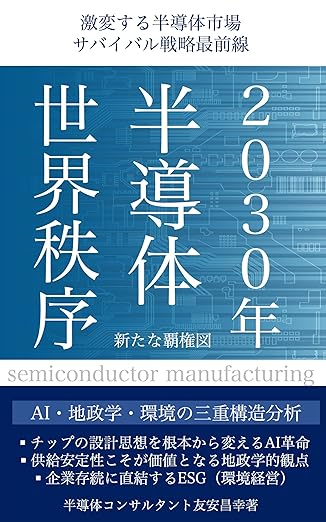
The 2030 Semiconductor World Order: The Triple Structure Redefines the World,
by Masayuki Tomoyasu (Amico Consulting) Kindle eBook / Amazon.co.jp
🎁 Publication anniversary and limited time free Kindle campaign! → Read for free on Amazon Kindle now!
Why can’t we read and understand the “linear value chain”?
As a consultant, I deal with companies involved in semiconductors on a daily basis.
What I repeatedly feel there is a disconnect: “The conventional industrial map cannot explain what is happening now.
In the past, the semiconductor industry could be described in terms of a single line: design, manufacturing, assembly, and sales. Now, however, that line has split into three layers, and each layer is beginning to operate under a different logic.
- Generative AI turns “computing power” itself into new capital.
- Geopolitics is redesigning the supply chain as a “weapon”
- ESG is becoming a requirement for the manufacturing license itself.
Because we try to understand the world in which these three things are moving simultaneously with a single line, we see only “fragments” of the news.
The “Triple Structure Industry” framework presented in this book
In this book, the structure of the semiconductor industry toward 2030 is recaptured in the following three layers.
🔷 Upper layer: computational capitalism With the explosive spread of generative AI, computational power is going beyond mere product specifications and becoming “capital” with which nations and companies compete. –The semiconductor market today cannot be described without reading about the dynamics at the upper levels.
🔷 Middle Tier: Resilient Green Infrastructure As the U.S.-China conflict deepens, supply chain “resilience” and “decarbonization compatibility” have become prerequisites for deals Both the TSMC Kumamoto plant and the national investment in Rapidus are happening at the intersection of geopolitics and ESG in this middle tier The strength of Japan’s materials and manufacturing equipment is a prerequisite for a deal. It is precisely here that Japan’s strengths in materials and manufacturing equipment are being reassessed by the rest of the world.
🔷 Lower Tier: Distributed Intelligence Society Edge AI and autonomous control systems will be embedded in factories, automobiles, medicine, and infrastructure. Semiconductors will no longer be “sell and be done” components, but will become embedded as the nervous system of society. In this phase, Japan, with its “on-site capabilities for social implementation,” has a unique winning edge.
Japan’s “Winning Chance”–As an Alliance Integrator
In writing this book, I spent the most time thinking about the question, “Where will Japan win?
Competing head-to-head with TSMC, Samsung, Intel, or Rapidus in the manufacture of cutting-edge nodes – that is not the only strategy.
Japan’s strength lies in its “middle layer. Semiconductor manufacturing equipment that boasts the world’s top market share, special materials that support nano-level quality, and manufacturing wisdom that has been accumulated onsite for decades.
By placing this at the nexus of the upper layer (computational capitalism) and the lower layer (distributed intelligence society), Japan can stand out in the world as an “Alliance Integrator” that designs a three-layer cycle, rather than a mere parts supplier.
In this book, I carefully discuss my own answer to the question, “Is there a future for semiconductors in Japan?
This book should be read by
- Those involved in the semiconductor industry, equipment, materials, and trading companies
- For management planning, business development, and R&D departments in the manufacturing industry
- Those who want to systematically understand the industrial trends at the intersection of AI, geopolitics, and the energy transition.
- Those who want to read the daily semiconductor news as a “strategy story” rather than a “fragment”.
- Those who continue to think about where Japanese companies can find competitive advantage.
It was written with the intention of being used as a framework by those involved in practical business, rather than as an esoteric technical book. For those of you who read semiconductor news on this blog every day, I hope you will find it useful as a map to help you sort out “why” the news is important.
🎁 Publication Commemoration and Free Kindle Campaign
To celebrate the publication of this book, the Kindle version is available for free for a limited time.
📅 F ree period: 5 days only 📗 Target: Amazon Kindle edition
The Kindle app is available for free on smartphones, PCs and tablets, and can be read by those without a Kindle device.
→ Download now for free on Amazon Kindle
If you read the book, we would greatly appreciate your review on Amazon and your feedback and sharing on X, LinkedIn, etc. Thank you in advance.
Amico Consulting Masayuki Tomoyasu Your partner in transforming semiconductor manufacturing with data and technology https://amiko.consulting